
Original briefings. Zero spin.
Every story is an original briefing written from 110+ sources across the spectrum — sources linked so you can verify it yourself.
 defense
Major Story (7/10)
September 4, 2026 at 01:32 AM
defense
Major Story (7/10)
September 4, 2026 at 01:32 AM
Pacific Islands Forum 'Registers Concern' Over China's Missile Test, Stops Short of Condemning Beijing
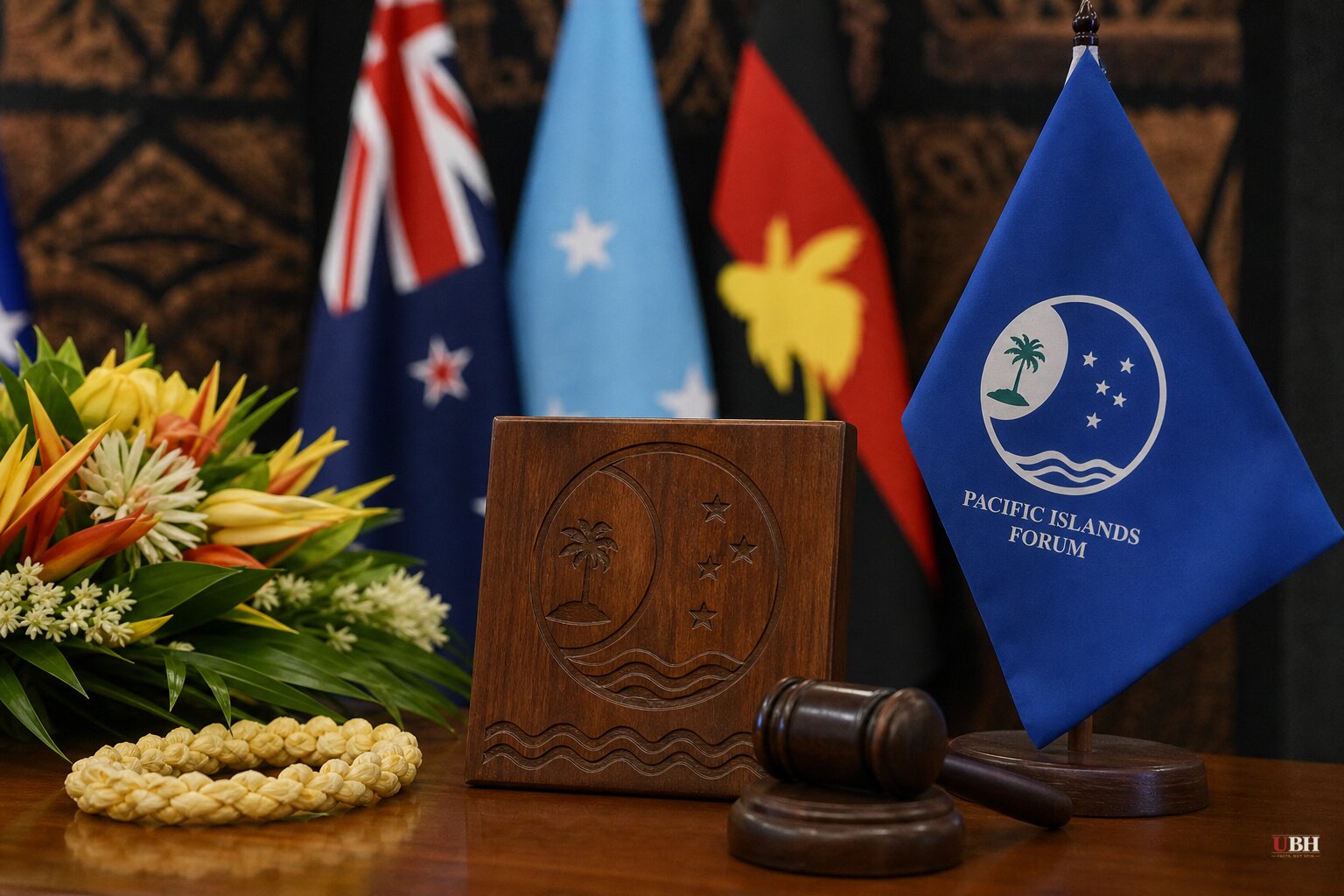
The Pacific Islands Forum wrapped its annual leaders' summit in Koror, Palau, on Thursday with a joint communique addressing China's July intercontinental ballistic missile test, a launch that flew over the airspace of several member nations and reignited a running argument inside the bloc over how hard to push back on Beijing.
According to Palauan President Surangel Whipps Jr., who read the relevant clause aloud at a news conference alongside the forum's outgoing and incoming chairs (Solomon Islands and New Zealand), the communique states that leaders "registered concern" about the test, which "overflew a number of members without adequate notice." It calls on any state conducting ICBM tests to give at least 24 hours' advance notification, in line with what it calls international practice, and to "respect the sovereignty of the Forum members."
The statement does not name China. Whipps told reporters there was no need to. "It's clear what the statement says," he said. "It says anybody firing missiles should do it in a transparent manner, give proper notice. Nobody should be firing without proper notice, and what happened was not acceptable."
What China did, and what China says happened
The July launch was Beijing's first known ballistic missile test in the Pacific since September 2024, and only the second since 1980, according to Reuters. Intelligence cited by SBS shows the nuclear-capable missile flew over the Philippines, Palau and Micronesia before landing in the ocean, with Reuters reporting the impact point fell somewhere between the Solomon Islands, Nauru and Tuvalu. The test came hours after Fiji and Australia signed a defense treaty, Fiji's first-ever formal alliance, according to Reuters.
China has said the launch was "a routine arrangement of China's annual military training" and that "relevant countries were informed in advance," according to the Taipei Times. Whipps disputed that directly. "There's no sensationalism, it's just stating the facts," he said, per SBS. "The Pacific Islands weren't informed. The ones that were informed were informed late." He added that Beijing sent missiles near French Polynesia and Tuvalu in a prior test and "never bothered to tell us that's what's happening."
The test drew condemnation at the time from Australia, Japan and the United States. State Department spokesman Tommy Pigott said in July, "At a time when the United States is working harder than ever to prevent nuclear proliferation, China is doing the opposite."
A fractured bloc gets closer to consensus, not all the way there
A meeting of Pacific foreign ministers in August failed to produce a joint statement condemning the test at all, with Kiribati and Nauru reportedly blocking stronger language, according to SBS. That failure had been read across the region as a sign China's growing economic and diplomatic weight in the Pacific was splintering the forum's traditional consensus model.
The outcome Thursday moved further than that August meeting did, singling out the ICBM test specifically and attaching a 24-hour notice demand that wasn't in the earlier draft, according to SBS. But it fell short of the sterner rebuke some members, including host Palau, had wanted going in.
Nauru was the only one of the forum's 18 members to formally dissent from the clause, a rare break from PIF's usual all-or-nothing consensus process, according to the Associated Press and SBS. Nauru severed diplomatic ties with Taiwan in 2024 to align with Beijing. Kiribati's president skipped the closed-door leaders' retreat where the communique was hashed out, sending the country's former ambassador to China instead. New Zealand Prime Minister Christopher Luxon said Kiribati had no representative in the room at all, though he downplayed the significance of the absence.
Taiwan's shadow over the summit
The missile dispute unfolded alongside a separate fight over Taiwan's presence at the summit. China's foreign ministry objected to Taiwan attending, and Chinese Special Envoy for Pacific Island Countries Affairs Qian Bo warned there would be "consequences" after Taiwan's foreign minister, Lin Chia-lung, attended the PIF opening ceremony, according to the Taipei Times. Palau, one of a small number of countries that still recognizes Taiwan diplomatically, hosted a separate dialogue where Taiwan, Palau, the Marshall Islands and Tuvalu signed a joint statement backing the region's 2050 Strategy for the Blue Pacific Continent.
New Zealand Foreign Minister Winston Peters said this week he was "highly suspicious" that foreign interference might explain why several Pacific leaders, including the prime ministers of Fiji, Vanuatu, Samoa and Solomon Islands, sent lower-ranking ministers instead of attending in person, according to Reuters. Peters did not directly accuse Beijing, and China's foreign ministry called his comments unfounded. No investigation into the absences has been announced, and Reuters' sourcing does not establish any specific cause for them.
Coverage of the outcome split along predictable lines. The Associated Press and the Independent framed the story around the forum's failure to reach unanimous condemnation, while the Epoch Times described the result as "a largely united response." Both are technically accurate. The same document produced 17 of 18 members' agreement on registering concern and demanding notice, while stopping short of naming China or using the word condemn, which is the framing SBS and the Australian outlet nit.com.au emphasized as "falling short" of pre-summit hopes.
The forum's secretariat had not released the full communique text at the time leaders spoke to reporters Thursday. Whether China complies with the 24-hour notice request the next time it tests a missile in the Pacific, and whether Kiribati's position hardens or softens by next year's summit, remain open questions the forum did not resolve this week.
Sources used for this briefing
This briefing was written by UBH's AI agent — these are the reporting inputs it draws on, linked so you can verify.


