
Unbiased headlines. Facts, not spin.
Unbiased Headlines is an independently owned news organization. We bring you the facts, not opinions, written fresh from 110+ named sources. Sources linked so you can verify it yourself.
 finance
Notable (6/10)
Oracle Closes at $128.23, Down 61% From Its Peak, as Ellison's Fortune Drops $6.1 Billion in One Day
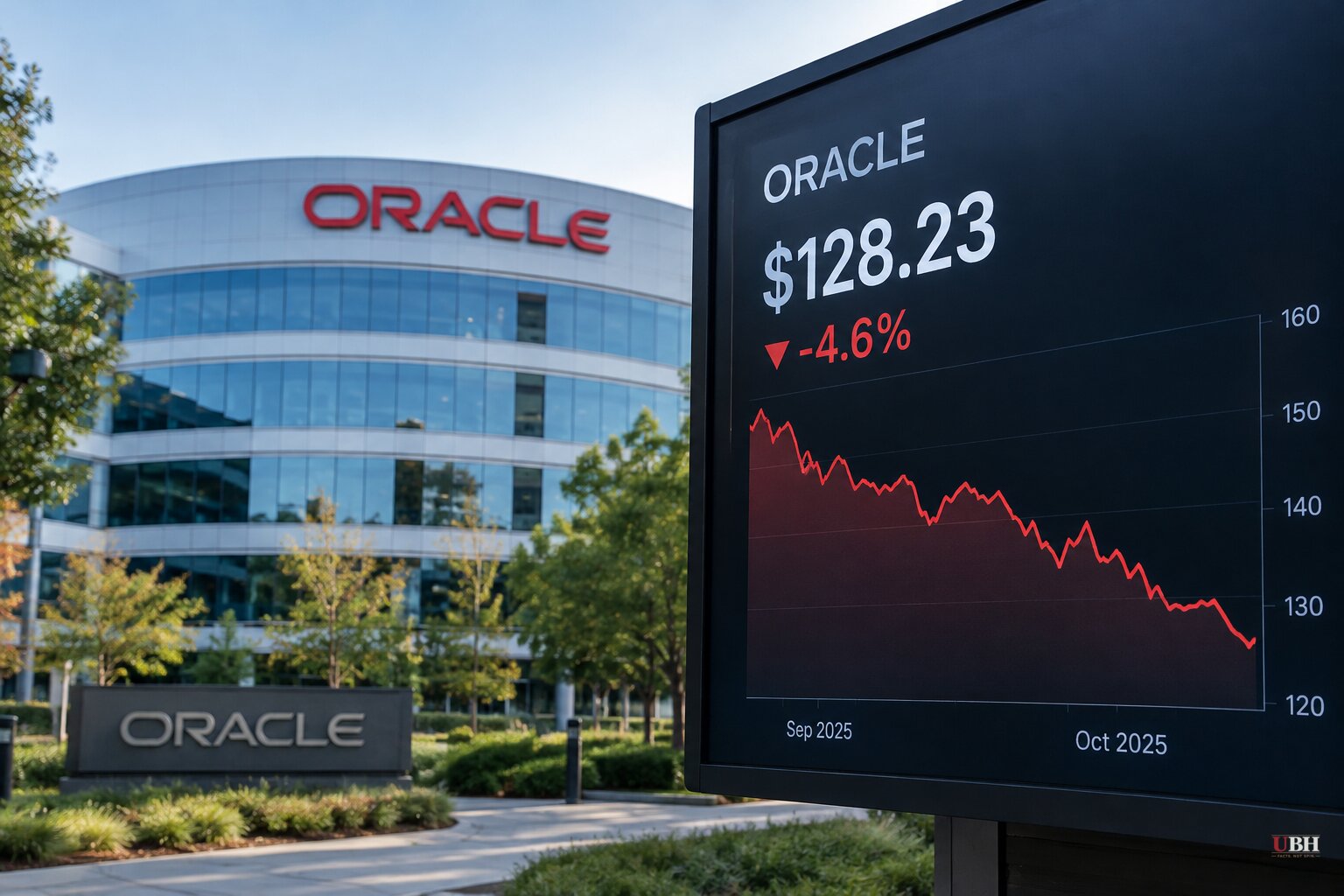
Oracle closed Friday, Oct. 16, at $128.23, down 4.6% on the day and down from $141.40 a week earlier. The market value of the company stood at roughly $388 billion.
The stock has now lost about 61% since its record close of $328.33 on Sept. 10, 2025. That was the day shares jumped 36% after Oracle reported a surge in cloud contracts.
What it did to Ellison
The Bloomberg Billionaires Index put the one-day drop in Larry Ellison's net worth at $6.11 billion, or 3.3%, leaving him at about $178 billion. That makes the 82-year-old co-founder, executive chairman and chief technology officer the world's eighth-richest person.
Over 12 months the index shows his fortune falling by roughly $194 billion, from about $372 billion, a 52.1% decline. In September 2025 he briefly passed Elon Musk as the richest person alive.
A straight calculation from his roughly 1.16 billion Oracle shares, the figure in the company's 2026 proxy statement, gives a larger Friday hit of about $7.2 billion on the stake alone. Over the five-day week, that stake fell by roughly $15.3 billion, from about $163.7 billion to $148.5 billion. Bloomberg's index figure and a shares-times-price figure measure different things, so the numbers differ.
Ellison has also borrowed against his stock. Bloomberg's data shows about one-third of his Oracle holdings are pledged as collateral against personal debt.
Debt, rates and the AI build-out
The latest slide began Wednesday, Oct. 14, when Oracle fell 8.8% to $130.55. The same day, CoreWeave, which rents Nvidia chips to AI developers, dropped 15.5% as yields on its 2032 bonds touched 15%. The worry spread to other heavy data-center spenders, including Nebius and Dell.
Inflation added pressure. Consumer prices rose 3.7% in September from a year earlier, up from 3.4% in August, which raised bets on another Federal Reserve rate hike. The 10-year Treasury yield ended Friday near 5.09%. The Nasdaq Composite fell 2.1% Friday and about 4.5% on the week.
CNN quoted Steve Sosnick, chief strategist at Interactive Brokers, on the broader AI trade: "Trees don't grow to the sky." He said you can't assume things will go up forever without something going wrong.
Oracle is among the most indebted companies in the build-out. Its debt has climbed to roughly $160 billion to $169 billion, depending on the measure, from about $88 billion early last year. S&P Global Ratings cut its credit rating to BBB-, the lowest investment-grade tier, in July.
The cost of that borrowing is showing in the bond market. Oracle's bonds maturing in 2036 yield 7.8%, against a 2026 low of 5.3%. Its 2066 bonds yield 8.73%.
The company has guided for $90 billion to $95 billion in capital spending and plans to raise about $40 billion this fiscal year through debt and equity. It reported negative free cash flow of $5.4 billion last quarter.
OpenAI and Project Jupiter
Investors are also focused on Oracle's reliance on OpenAI. OpenAI agreed to buy $300 billion of computing capacity from Oracle under the Stargate data center initiative. Oracle reports $664 billion in remaining performance obligations, contracted revenue it has not yet booked.
Project Jupiter, a major data center in New Mexico, has hit trouble. Oracle has declared force majeure on the project, citing power and gas supply constraints. In July the New Mexico State Land Office rejected a permit for the Green Chile pipeline, citing water use, carbon emissions and limited economic benefit to the state. Air-quality permit issues are also reported.
The case for the business
The operating numbers do not look like a company in retreat. In its latest quarter, revenue rose 30% to $19.3 billion. Cloud infrastructure revenue jumped 121% to $7.4 billion, and cloud applications brought in $4.2 billion. For the fiscal year ended May 31, 2026, revenue was $67.4 billion.
Analysts expect about $90 billion in revenue for the current year and $117 billion next year, with earnings of $8.14 per share against $7.63 last year. Those are estimates, not reported results.
The contracted backlog is enormous, but the stock is being priced on whether Oracle can pay for the buildout needed to deliver it, with borrowing costs rising and a large share of future revenue tied to a single customer.
What comes next
The path to resolving the power and permitting problems at Project Jupiter remains unclear. Whether Oracle can raise roughly $40 billion at yields near 8% while holding an investment-grade rating is the open question the market is now pricing.
Sources used for this briefing
7 links from 7 independent newsrooms (syndicated copies of the same report count once)
These are the sources it draws on, linked so you can verify.


