
Unbiased headlines. Facts, not spin.
Unbiased Headlines is an independently owned news organization. We bring you the facts, not opinions, written fresh from 110+ named sources. Sources linked so you can verify it yourself.
 finance
Major Story (8/10)
Kospi Drops as Much as 3.2% in Monday Asian Trading as DeepSeek Model and AI Funding Worries Hit Chip Stocks
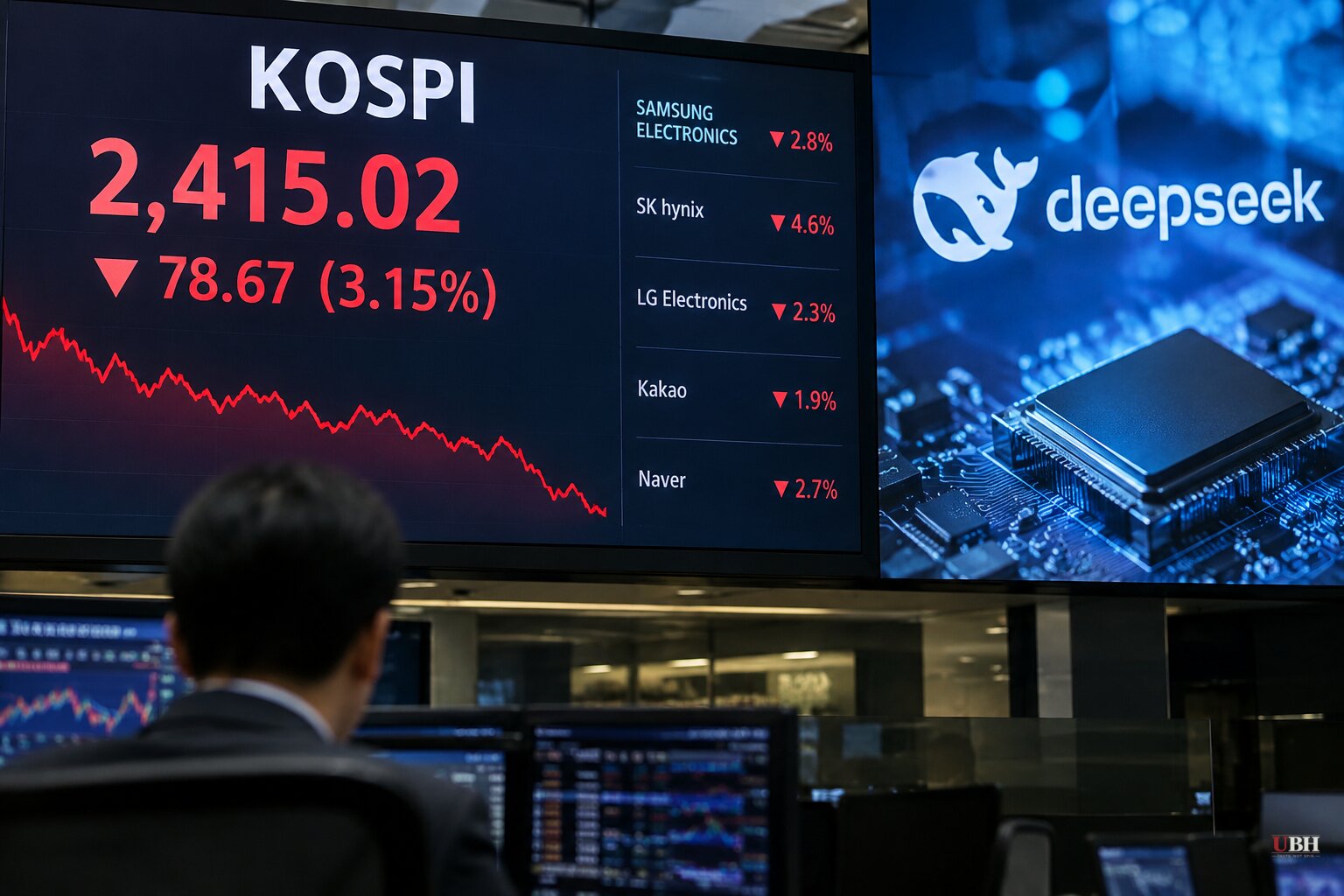
Since U.S. chipmakers logged their eighth straight daily decline on Friday, Oct. 16, the AI selloff has moved into Asia, where a new Chinese model added a second source of pressure to the funding worries already weighing on chip stocks.
In Asian trading Monday, Oct. 19 local time, South Korea's Kospi fell as much as 3.2%. Samsung Electronics and SK Hynix each dropped more than 4% at one point before paring losses. Japan's Nikkei 225 slid about 2%, with chip-equipment maker Advantest among the biggest decliners. These are intraday moves, not closing levels.
Bloomberg's gauge of Asian chipmakers slid more than 2% to its lowest since July. Taiwan Semiconductor Manufacturing, SK Hynix and Advantest were the biggest drags.
The Kospi is coming off its worst week since October 2008. It is still up more than 30% this year, after AI spending pushed memory prices to record highs.
What DeepSeek released
DeepSeek said on its official X account and website that it released V4.1-Flash-1017 on Oct. 17. It is an upgrade of V4.1-Flash, which came out Sept. 10, and DeepSeek says it has better coding and AI-agent capabilities, runs faster and gives shorter answers.
The company's own tests put the model at 77.0 on DeepSWE v1.1, a software-development benchmark. That is ahead of Anthropic's Claude Opus 5 at 74.0 and OpenAI's GPT-5.6 Sol at 73.0. On AutomationBench it scored 60.5 against 50.3 for Opus 5.
The model beat Opus 5 in only four of 11 comparison categories. DeepSeek published all of the figures itself, and none has been externally verified.
Price is the sharper point. During off-peak hours, DeepSeek charges $0.60 per million output tokens. GPT-5.6 Sol costs $20 and Opus 5 costs $25. Citing a DeepSeek cost chart, the German publication The Decoder reported an average cost under $0.20 per task for the new model, versus $2 to more than $10 for U.S. rivals.
Hugging Face co-founder Thomas Wolf questioned the scores on X. "It's funny to call it a 'small update' after raising the TerminalBench score from 31.2 to 42.3," he wrote, adding that he wondered "whether these scores will hold up outside its own evaluation environment."
Why memory makers are exposed
Samsung and SK Hynix dominate supply of high-bandwidth memory, the premium chips stacked beside AI accelerators. DeepSeek has claimed that V4.1-Flash needs only a quarter of the HBM its predecessors required during inference, the stage where a trained model answers user requests. It also claims one-eighth of the SSD storage.
If efficiency gains like that spread, memory pricing and volumes could change. Samsung fell about 3.5% and SK Hynix about 2.2% around Sept. 11, right after the earlier V4.1-Flash release.
Kang DaeKwun, CEO of Life Asset Management, tied the weakness to U.S. spending rather than to any one model. "There are too many uncertainties to call a bottom," he said. "Korean companies cannot make money unless the US firms continue to spend."
The funding question
The DeepSeek release landed on top of existing stress over how the AI buildout is paid for. CoreWeave shares fell 23.5% in the week beginning Oct. 12, and concerns about the neocloud company's financial health have spread across the sector.
The January 2025 precedent is on traders' minds. When DeepSeek's R1 reasoning model arrived then, Nvidia's stock fell about 17% in a single day, wiping out roughly $589 billion in market value. The Korean outlet mk.co.kr reported that analysts expect the new model to reignite the debate over whether U.S. tech giants' AI spending will pay off.
Not everyone reads the selloff as the start of a downturn. KB Securities called the recent declines in Samsung and SK Hynix an "asymmetric investment opportunity," with analysts noting the stocks trade at roughly 2.6 to 3.1 times earnings. Competition from Chinese memory maker CXMT is a separate risk to market share.
Pivotal Research took a similar line on the spending itself last week. On Oct. 13, analyst Jeffrey Wlodarczak raised his Meta price target to $930 from $790 and kept a Buy rating. He said returns on Meta's AI investments are "coming into focus," citing 2.8 million installs of its Muse assistant in the first 12 days and benchmark parity for its new Muse Wonder models.
What comes next
U.S. markets are closed for the weekend, so the Asian moves are the first read on how investors are treating the DeepSeek release. New York trading resumes Monday, Oct. 19, with chip stocks coming off eight straight losing sessions and earnings week ahead.
The open question is whether DeepSeek's benchmark and cost figures hold up under independent testing, and whether the memory savings it claims show up in real deployments.
Sources used for this briefing
8 links from 7 independent newsrooms (syndicated copies of the same report count once)
These are the sources it draws on, linked so you can verify.


