
Unbiased headlines. Facts, not spin.
Every story is an unbiased news briefing written from 110+ sources across the spectrum — sources linked so you can verify it yourself.
 energy
Major Story (7/10)
June 11, 2026 at 12:48 PM
energy
Major Story (7/10)
June 11, 2026 at 12:48 PM
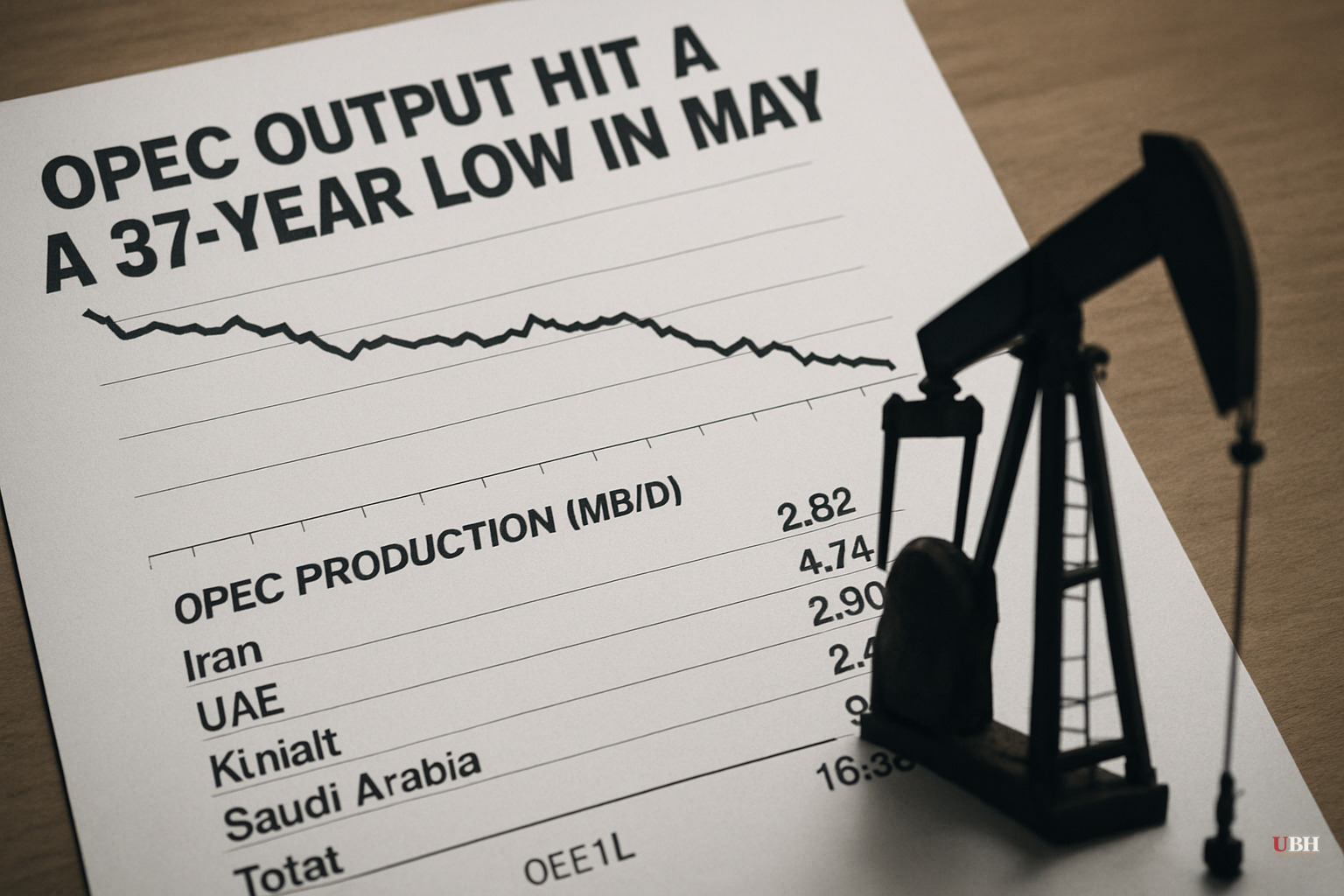
OPEC Output Hit a 37-Year Low in May — The Numbers Show How Deep the Supply Hole Has Gotten
Since U.S. forces imposed a naval blockade of Iranian ports in mid-April, the cumulative damage to global oil supply has been compounding each month — and the May production data, published by Bloomberg in early June, puts hard numbers on the scale of that damage.
The Numbers Are Stark
OPEC's 11 current members pumped 16.33 million barrels per day in May 2026, according to a Bloomberg survey cited by Rigzone and the Economic Times. That's a drop of 1.22 million barrels per day from April. It is the lowest OPEC output recorded in at least 37 years — meaning you have to go back to 1989 to find a comparable collapse.
Iran alone accounted for 710,000 barrels per day of that decline, falling to a five-year low of 2.34 million barrels per day. Iranian crude and condensate exports are now below 300,000 barrels per day — the lowest in at least six years, according to Crypto Briefing.
U.S. Central Command says American forces have redirected 127 commercial vessels to enforce the blockade. That is physical interdiction at sea.
Kuwait Is the Under-Reported Story
Most coverage focuses on Iran. The Kuwait number deserves more attention.
Kuwait's production fell by approximately 2 million barrels per day in May — down to just 490,000 barrels per day. According to Bloomberg's survey data, that is less than a fifth of Kuwait's pre-war output levels. A country that was producing well over 2.5 million barrels per day before the conflict is now barely a rounding error in global supply.
Saudi Arabia also cut by 240,000 barrels per day, landing at 6.57 million barrels per day. That reflects the broader Strait of Hormuz disruption forcing operational pullbacks across the Gulf.
The UAE Formally Left OPEC
The United Arab Emirates formally left OPEC in May 2026, ending a membership of nearly 59 years. According to Bloomberg via Rigzone, Abu Dhabi had long been frustrated that OPEC quotas were capping its ability to deploy new production capacity investments. The Iran war gave it a clean exit — one that would cause the least political disruption.
UAE output actually rose by 300,000 barrels per day in May, bucking every other Gulf trend. With its OPEC quota gone, Abu Dhabi is free to pump as hard as it can, and it is doing exactly that.
The UAE's exit weakens OPEC's ability to coordinate supply management going forward. As Crypto Briefing noted, a fragmented OPEC means more price volatility in both directions — not just upward spikes but potential overcorrection crashes if the conflict ends faster than expected.
Paper Quotas vs. Physical Reality
OPEC and its allies are still holding video conferences and voting to nudge up output quotas. Three OPEC+ delegates, cited by Bloomberg via Rigzone, expect members to raise targets by another 188,000 barrels per day in July. Two more hikes are planned for August and September.
The cartel is voting to increase production it physically cannot deliver. The Strait of Hormuz is largely shut. Kuwait is at a fifth of capacity. Iran is blockaded. The quota hike announcements are essentially ceremonial at this point.
Officials also said this week they could fast-track a third layer of previously halted supply — but that supply largely sits behind the same geography that is currently under fire.
What Critics Are Right to Worry About
Fair-minded critics of the U.S. military posture argue that the blockade and strikes, whatever their strategic rationale against Iran's nuclear program, are inflicting severe economic pain on every country that depends on affordable energy — not just America's adversaries. Since the escalation began, OPEC's total output has shrunk by roughly 9.7 million barrels per day across multiple Gulf producers, a decline of more than 30% from pre-conflict levels, according to Crypto Briefing. Global consumers — including lower-income households in the developing world and American drivers — are bearing real costs. OilPrice.com's live market data as of June 11, 2026 shows WTI crude at $90.80 and Brent at $93.49, with one analyst scenario projecting $150 per barrel if a ceasefire collapses.
The counter-argument is that Iran's nuclear and regional military ambitions represented a threat the U.S. and Israel concluded could not be contained through diplomacy alone. Both positions involve real trade-offs. The data does not resolve that debate — it just shows the economic cost is not theoretical.
What This Means for Your Wallet
Sustained crude prices above $90 feed directly into inflation. Gasoline, heating oil, jet fuel, plastics, fertilizer — the downstream list is long. Central banks that were beginning to consider rate cuts are now facing commodity-driven inflation they cannot fix with monetary policy, as Crypto Briefing correctly points out.
Japan is already tapping strategic reserves and sourcing from new suppliers, according to OilPrice.com's headline feed. India secured crude supply through August via higher UAE imports — meaning U.S. allies are quietly scrambling.
OPEC's output hole is now 37 years deep, and the military conflict driving it is in its second week of direct U.S. air strikes. The production data is a lagging indicator. June's numbers will almost certainly be worse.
Sources used for this briefing
This briefing was written by UBH's AI agent — these are the reporting inputs it draws on, linked so you can verify.


