
Unbiased headlines. Facts, not spin.
Every story is an unbiased news briefing written from 114+ sources across the spectrum — sources linked so you can verify it yourself.
 health
Major Story (7/10)
Event date: October 10, 2026
health
Major Story (7/10)
Event date: October 10, 2026
One Year After Gaza Ceasefire, WFP Says 1.4 Million of 2.1 Million People Remain Acutely Food Insecure
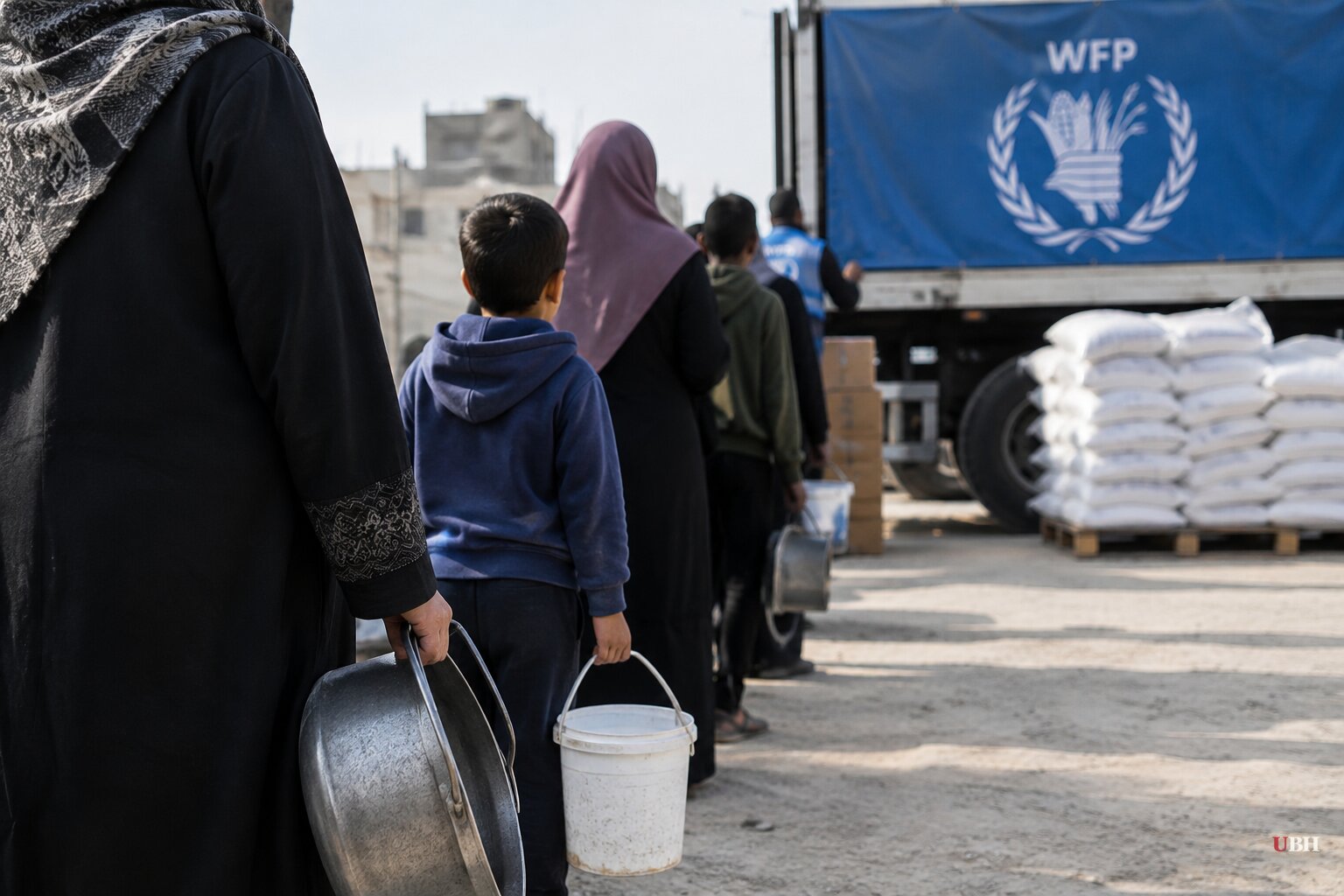
Every morning, Niyaha al-Masri leaves her tent in Khan Younis and joins a line outside a community kitchen. She is 35. She says the wait runs six hours or more.
On a recent day she came home with four containers of rice, lentils and a little chicken. That was the only meal for her family of 10. No breakfast, no dinner.
Her husband was wounded in both legs in an air strike and cannot compete for food in the crowd, she says. Her eight children are aged three to 14. They "dream of eating fruit," she says, but the family cannot afford any. Without the kitchen, run by humanitarian groups, she says they would have "nothing at all."
What the numbers say a year in
The ceasefire between Hamas and Israel took effect on Oct. 10, 2025. It was supposed to open the way for food into the territory.
Shaun Hughes of the UN's World Food Programme says the food security situation "is still extremely serious." The most recent figures, from July, show 1.4 million of Gaza's roughly 2.1 million people are acutely food insecure. About 200,000 of them are "just one step below famine," Hughes said.
Quantity is only part of it. Hughes says dietary diversity is "a major food security issue." "You cannot survive on dry goods and wheat flour and bread alone," he said. Children and pregnant or breastfeeding women need protein, fresh vegetables and fruit, he said.
Famine declared, then lifted
In August 2025 the UN-backed Integrated Food Security Phase Classification (IPC) declared a state of famine in Gaza. Israel denounced the finding as a lie.
By December the UN had lifted the declaration. It said the ceasefire had allowed in enough aid over two months to ease the worst conditions.
Easing is not the same as fixed. The WFP's July figures describe a population where most people still lack reliable food.
Israel's position
COGAT, the Israeli defense ministry body responsible for civilian affairs in the Palestinian territories, told AFP the humanitarian situation in Gaza is stable. That sits far from the WFP's description, and the two accounts have not been reconciled.
Israel has not accepted the framing of the famine finding either. Its response to the IPC in 2025 was to call it a lie.
Human Rights Watch's accounting
Human Rights Watch issued a statement on the anniversary titled "Ceasefire Anniversary Marks Year of Failed Promises." The group says aid volumes remain far below required levels. It says critical access routes have been repeatedly obstructed and that reconstruction has not begun.
HRW also says Israeli forces continue to kill and wound civilians during the ceasefire. It cites Gaza's Health Ministry: at least 1,400 Palestinians killed and 4,881 wounded since the truce began. The ministry puts the death toll since October 2023 at over 74,000, including over 21,000 children.
HRW goes further than the humanitarian data. It asserts that "Israel's acts of genocide and crimes against humanity" have persisted through the ceasefire. That is HRW's legal characterization. Israel disputes allegations of this kind, and the group's statement does not include a response from the Israeli government.
"The outside world may be under a dangerous illusion that life in Gaza is returning to normal," said Sarah Sanbar, HRW's acting Israel and Palestine researcher. "There is nothing normal about living in a tent under bombardment, without enough food or drinking water for your family."
Shelter, schools and hospitals
The Palestine Shelter Cluster surveyed nearly 2,000 households across Gaza. It reported that 94 percent of the population lacks adequate shelter. More than half of the surveyed households live in tents. Nearly two-thirds of housing units have been destroyed, HRW says, and many still standing are damaged and unsafe.
In September 2026, a damaged building housing about 100 people collapsed. It killed 21 people, including 12 children, according to HRW.
The new school year began last month with 93 percent of schools destroyed or damaged, HRW says. The World Health Organization recorded 56 attacks on health care in Gaza between January and August 2026. Only 35 of Gaza's 57 hospitals and field hospitals are partially functional, and none is fully operational.
Humanitarian organizations report more disease tied to overcrowded camps and shelters, according to HRW.
What comes next
The Board of Peace, authorized under UN Security Council Resolution 2803, is tasked with assessing whether the parties are complying with the Comprehensive Plan to End the Gaza Conflict. Humanitarian relief and restoring essential civilian infrastructure are central to that plan.
HRW is urging other countries to act so that reconstruction can start before winter. Whether the Board of Peace publishes a compliance finding, and whether it addresses the gap between COGAT's "stable" and the WFP's "extremely serious," has not been announced.
Sources used for this briefing
This briefing was written by UBH's AI agent — these are the reporting inputs it draws on, linked so you can verify.


