
Unbiased headlines. Facts, not spin.
Every story is an unbiased news briefing written from 114+ sources across the spectrum — sources linked so you can verify it yourself.
 health
Low Interest (4/10)
Event date: October 7, 2026
health
Low Interest (4/10)
Event date: October 7, 2026
Experimental Injection CBL-514 Cut Visceral Fat 12% in 23 Treated Patients, Developer-Linked Study Finds
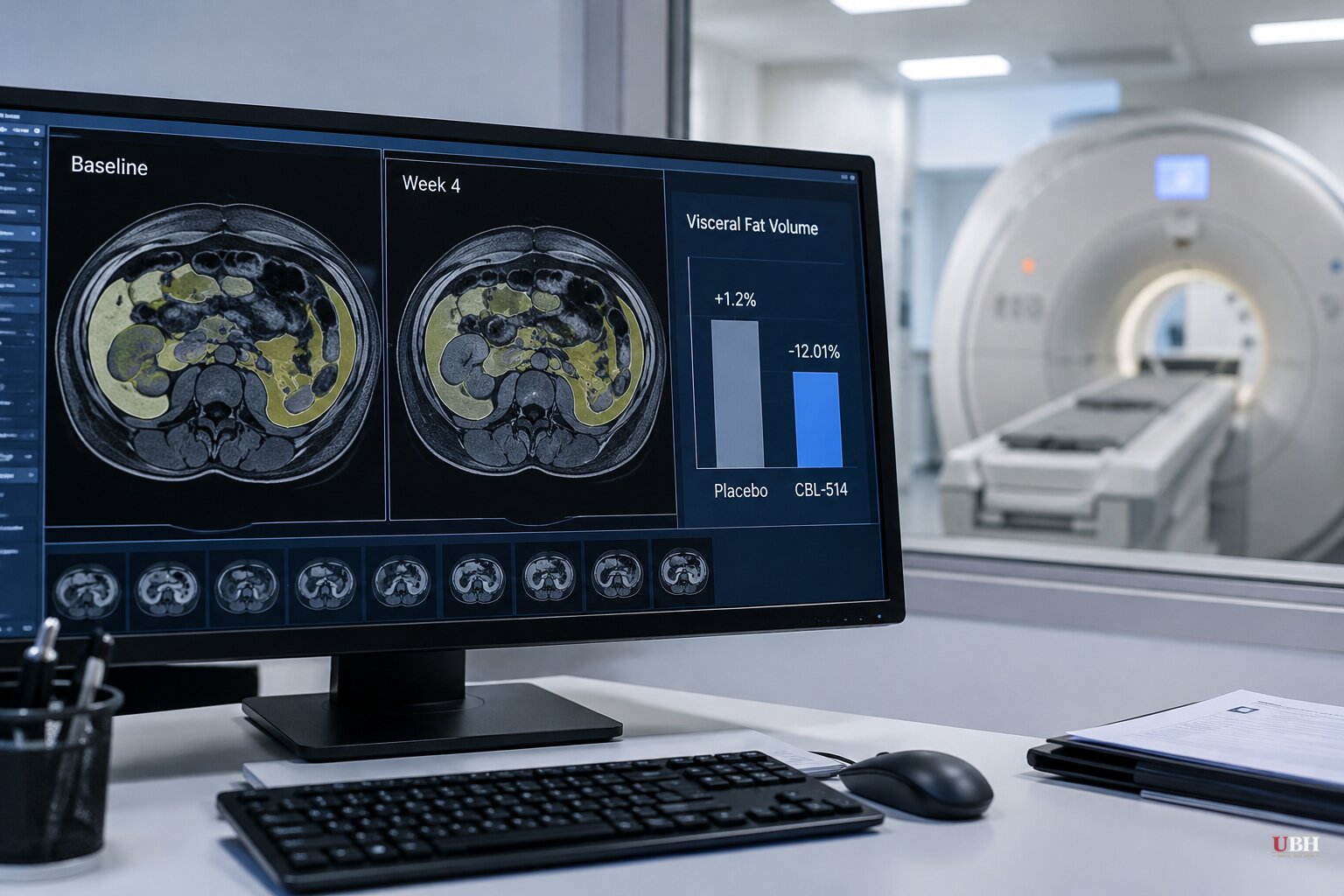
An experimental fat-dissolving injection called CBL-514 reduced visceral fat in a small analysis of two phase 2 trials. The data were slated for presentation at the European Association for the Study of Diabetes (EASD) annual meeting in Milan, which ran Sept. 28 to Oct. 2.
The drug is not approved. It is not a proven obesity treatment.
What the analysis found
Visceral fat sits deep in the abdomen, wrapped around internal organs. It is linked to insulin resistance, type 2 diabetes and cardiovascular disease. Liposuction cannot remove it.
Dr. W. Timothy Garvey of the University of Alabama at Birmingham and Yu-Fang Ling of Caliway Biopharmaceuticals in New Taipei City, Taiwan, examined MRI scans from trials CBL-0204 and CBL-0205. Only participants with usable MRI data were included: 40 people with a body mass index of 22 to 30. Of those, 23 got CBL-514 and 17 got placebo.
Participants were injected in the lower abdomen every three weeks for up to 12 weeks, at doses up to 600 milligrams. The number of injections depended on abdominal fat thickness and dropped as the fat layer thinned.
Baseline visceral fat was similar in both groups. Four weeks after the last treatment, average visceral fat volume was 12.01% lower in the CBL-514 group and 5.68% higher in the placebo group.
At the later follow-up, eight weeks out in one trial and 12 weeks in the other, the treated group was 10.45% below its starting level. The placebo group was 11.76% above. The gap between the two groups was 22.21 percentage points.
How the drug works
CBL-514 is designed to trigger apoptosis, programmed cell death, in fat cells while leaving neighboring cells alone. Earlier phase 2 data showed it reduced subcutaneous fat, the layer under the skin. At an eight-week follow-up, 69.6% of treated participants had lost at least 150 milliliters of that fat, about five U.S. fluid ounces. No placebo participants did.
The peer-reviewed publication describes the apoptosis mechanism, but parts of the proposed molecular detail rest on confidential, unpublished Caliway material. That detail has not been independently confirmed.
Safety and the limits of the data
The researchers reported pain, swelling and redness at injection sites. These reactions were mostly mild to moderate and temporary. No serious adverse events were reported. Participants were followed for no more than 12 weeks after their last treatment, so long-term safety is unknown.
The sample is small. Three authors declared they are employees or shareholders of Caliway, the developer of CBL-514. Two others reported consulting, advisory or research ties to several companies, Caliway among them. The study abstract did not explicitly report limitations.
The visceral fat figure also does not describe overall weight loss. The 12.01% refers specifically to visceral fat measured by MRI. It is not a reduction in total abdominal fat, and it is a separate measure from subcutaneous fat.
The GLP-1 question
Garvey has said the data suggest CBL-514 may help blunt weight regain after people stop GLP-1 drugs such as tirzepatide. That evidence comes from animal work. Rats given CBL-514 with tirzepatide regained less weight after tirzepatide was stopped than rats given tirzepatide alone.
The working hypothesis is that fewer fat cells limit how much fat can be re-accumulated. Garvey acknowledged that research is needed to prove it. No human data show this effect yet.
CBL-514 also works differently from GLP-1 drugs. It is a local injection aimed at abdominal fat, not a systemic therapy for appetite and body weight.
What comes next
The phase 3 trial, SUPREME-01, is recruiting about 320 adults. It is randomized, double-blind and placebo-controlled. It is evaluating the drug's effect on abdominal subcutaneous fat, with up to four treatment sessions at four-week intervals.
The visceral fat result from the 40-person subgroup is a lead, not a finding that regulators will weigh. A confirmed result would need a trial that measures visceral fat directly in a larger group, and the one now enrolling does not.
Garvey said patients may like cosmetic effects such as a flatter stomach. He said what matters for health is the reduction in body weight, loss of visceral fat, and improvements in blood pressure and cholesterol that should accompany it. Those health outcomes have not yet been demonstrated in a trial built to test them.
Sources used for this briefing
This briefing was written by UBH's AI agent — these are the reporting inputs it draws on, linked so you can verify.


