
Unbiased headlines. Facts, not spin.
Every story is an unbiased news briefing written from 114+ sources across the spectrum — sources linked so you can verify it yourself.
 health
Notable (5/10)
October 11, 2026 at 09:45 PM
health
Notable (5/10)
October 11, 2026 at 09:45 PM
NYU Langone AI Model Estimates Five-Year Breast Cancer Risk From Years of 3D Mammograms
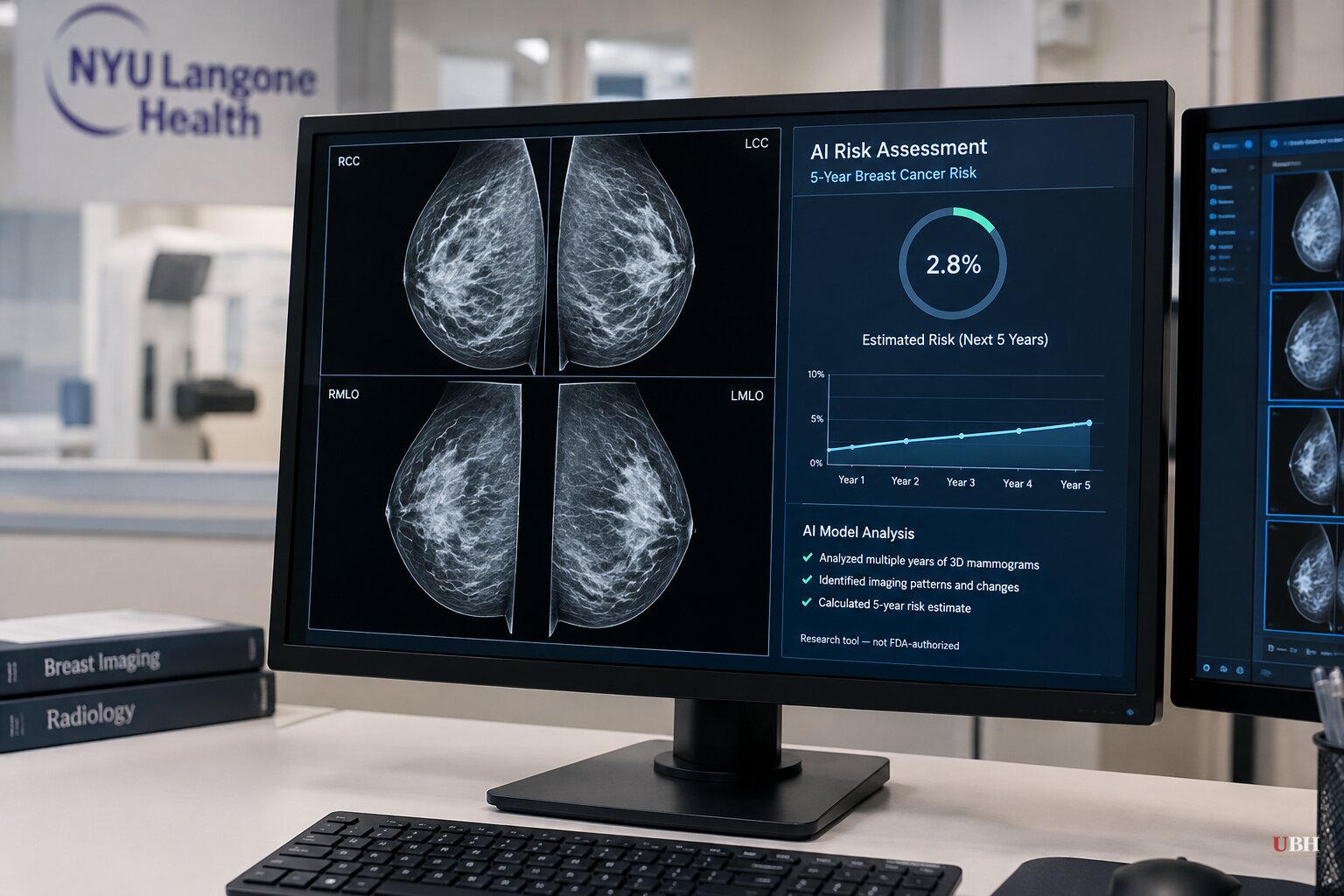
An AI model built at NYU Langone Health and its Perlmutter Cancer Center is designed to estimate a woman's chance of developing breast cancer within five years. It does that using mammograms she has already had.
The work was published in the American Journal of Roentgenology.
How the model works
Most screening asks one question: is there cancer visible on today's image? This tool asks a different one. It looks at several years of a woman's 3D mammograms and tracks how her breast tissue changes over time, rather than judging only the latest scan, according to the researchers.
The model was developed using more than 313,000 mammograms from more than 161,000 women, according to the study.
That is a large training set. It is also a single-system data set, which matters for what comes next.
What an outside specialist says it could do
Connie Lehman, a breast imaging specialist and professor of radiology at Harvard Medical School, was not involved in the study. She told Fox News Digital that AI could flag women whose elevated risk would otherwise go unnoticed.
"For decades, as a doctor and breast imaging specialist, I have cared for women who were shocked by a breast cancer diagnosis," Lehman said. "Again and again, I heard: 'How can this be? No one in my family has had breast cancer.'"
Traditional risk assessments weigh factors such as family history and genetic mutations. Lehman said AI can look for additional clues inside the breast tissue itself. "A mammogram can tell us more than whether cancer is visible today," she said. "It can also provide information about a woman's risk of developing cancer in the years ahead."
In practice, she said, that could eventually let doctors tailor screening to the individual. Women flagged as higher risk could discuss additional screening, such as MRI, with their health care providers. Women at average risk could continue routine mammograms.
The technology could also be run on mammograms a woman has already had. Lehman noted that this means the added risk information would not require another imaging exam or more radiation.
The limits Lehman and the researchers spell out
Lehman was direct that a risk score is not a diagnosis. It cannot say with certainty whether a woman will develop breast cancer.
"A higher score can prompt a conversation with your health care provider about additional screening and risk-reduction options," she said. "A lower score does not eliminate risk or replace regular mammography."
The model is a research tool. According to Lehman, it is not FDA-authorized for clinical use, so no patient can currently get a score from it as part of routine care.
The researchers also said more testing is needed. The study drew on mammograms from NYU Langone hospitals and imaging equipment from one manufacturer. A model that performs well on one health system's scans and one vendor's machines may not perform the same way elsewhere. The team plans to test it on data from other medical centers and on different 3D mammography systems.
The wider push for AI in screening
The study fits into a broader conversation about AI in breast imaging. Dr. Elisa Port, director of breast surgery at Mount Sinai and author of "The Breast Advice," has said AI can help uncover hidden tumors and cut false-positive results, especially for women with dense breasts. She has also said the technology aims to raise screening adherence among the 30 to 40 percent of women who currently do not get regular mammograms.
Port's comments concern AI in screening generally, not the NYU model specifically.
What happens next
The immediate question is whether the NYU model holds up outside NYU. Testing on other medical centers' data and other manufacturers' 3D systems is the step the researchers have said they plan to take. Clinical use would require FDA authorization, and no application has been described.
Until then, the guidance from Lehman is plain: an AI risk score would be a prompt for a conversation with a doctor, and it would not replace regular mammography.
Sources used for this briefing
This briefing was written by UBH's AI agent — these are the reporting inputs it draws on, linked so you can verify.


