
Unbiased headlines. Facts, not spin.
Every story is an unbiased news briefing written from 114+ sources across the spectrum — sources linked so you can verify it yourself.
 health
Notable (5/10)
Event date: October 6, 2026
health
Notable (5/10)
Event date: October 6, 2026
PRIMA Retinal Implant Held Its Vision Gains at 36 Months in a 38-Patient European Trial
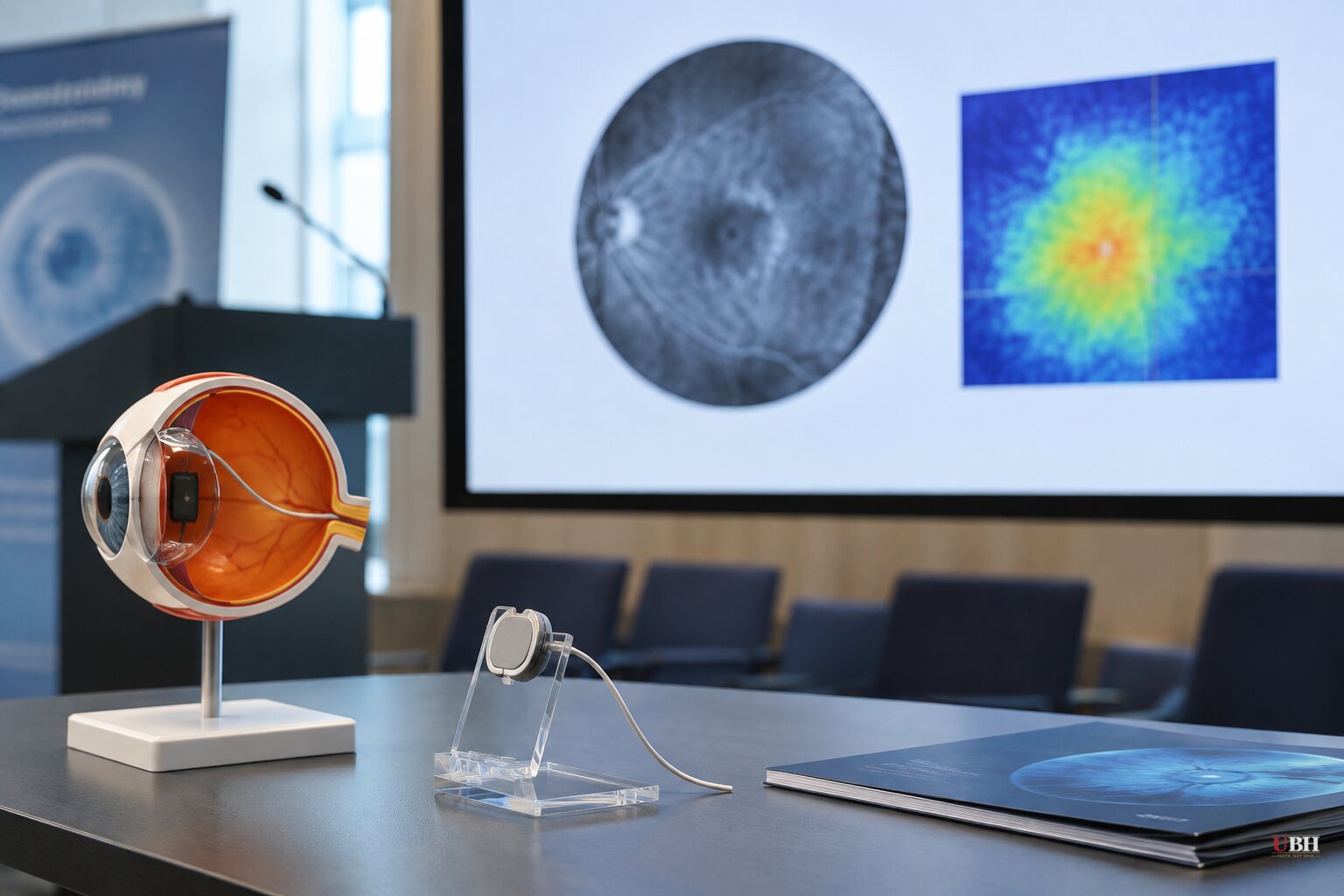
A wireless chip implanted under the retina is still helping people with end-stage geographic atrophy read three years after surgery, according to new data from Science Corporation's PRIMAvera trial.
The 36-month results were presented at the EURETINA congress in Vienna, which ran Oct. 1 to 4, and at the American Academy of Ophthalmology's annual meeting in New Orleans on Sunday, Oct. 11. Science issued its own announcement of the data on Oct. 5.
What the 36-month numbers show
The trial enrolled 38 patients with geographic atrophy, an advanced form of age-related macular degeneration, at 17 sites in five European countries. At 36 months, 27 patients were evaluable for safety and 18 for efficacy.
Among those 18, vision with the device improved by an average of about 29 letters, nearly six lines on an eye chart. At 12 months the average gain was 24.5 letters. Fourteen of the 18 gained at least 15 letters.
Baseline vision averaged roughly 20/460. At three years, vision with the device averaged about 20/120, according to the American Academy of Ophthalmology.
In the implanted eye, natural vision outside the device's use stayed stable. Ehsan Rahimy, MD, of Stanford Medicine told the AAO meeting that the untreated eye lost about 1.4 lines of vision over the same period.
Function went beyond reading letters. Rahimy said more than 80% of patients could read letters, numbers and words at 12 months. Between 24 and 36 months, half reported they could handle tasks like using a smartphone, reading a menu or playing cards.
How the device works
The implant is a photovoltaic chip measuring 2 mm by 2 mm and 30 micrometers thick. Surgeons place it beneath the retina, in the area where light-sensing cells have died.
The patient wears glasses with a built-in camera. They project the scene onto the chip as near-infrared light. The chip converts it into electrical signals that surviving retinal cells carry to the brain. A zoom feature lets patients magnify text.
The technology came out of Daniel Palanker's lab at Stanford. Science Corporation now makes it.
It is not plug-and-play. "It's not like you turn on the switch and they have vision," Rahimy said. Patients go through a long rehabilitation course to learn to use the device.
Safety and the questions raised
Serious adverse events included high eye pressure, retinal tear, macular hole and subretinal hemorrhage. Rahimy said they were uncommon after the first six months and did not affect natural vision. "Adverse events are front loaded, as would be expected after surgery," he said.
Mahi Muqit, MD, PhD, of Moorfields Eye Hospital, who presented the data in Vienna, said the complications were expected risks of subretinal surgery. They happened in the first weeks, he said, and "nothing new emerged across three years of follow-up." Three adverse events occurred after the 12-month mark, and none was attributed to PRIMA alone.
Joan Miller, MD, of Mass General Brigham, who was not part of the study, said the trial changed her mind about implants for GA. "I was probably a naysayer about any kind of implant for GA," she said. "You've proved me wrong."
She also flagged a number. Seven patients died during the study, none judged related to the implant or surgery. "It just seemed like there were a lot of deaths, and they were not that old," Miller said. The mean age was 78.9. She said a comparator group would help show what to expect in this population, adding, "Not something to worry about, but it seems a little high."
Rahimy answered that all the patients had bilateral, end-stage GA and were older than the typical patient considered for GA treatment. Four more patients dropped out because they relocated or could not continue follow-up. Those 11 patients account for the gap between 38 enrolled and 27 safety-evaluable at three years.
The trial also had no randomized control arm, and the 36-month efficacy figures rest on 18 patients. Science sponsored the study.
Where PRIMA stands commercially
SCIENCE says the device is commercially available in Europe and the UK. Rahimy said it was approved in Europe in July. Asked about it during the AAO discussion, he said he had no data on units sold or on any post-market safety issues.
In the U.S., Science describes PRIMA as pending FDA approval, and Rahimy said the company is on track to seek it. The company's website says the FDA granted PRIMA Humanitarian Use Device designations on July 22. No FDA decision date has been announced.
A retina specialist writing for Retina Care Oregon put it more bluntly: a U.S. decision is unlikely before 2027. He called himself cautiously hopeful, and noted the surgery carries real risk and the vision it gives is limited.
Max Hodak, Science's co-founder and CEO, called the results "the first multi-year durability data for a BCI that restores form vision." He added: "In clinical trials, PRIMA is working better at month 36 than it did at month six."
The drugs now available for GA, Izervay and Syfovre, approved in 2023, slow the disease. They do not bring back lost sight. Joseph Martel, MD, the study's lead author, said he hopes the data support U.S. approval "so I can offer PRIMA to my patients."
What remains unanswered is how PRIMA performs outside a trial. Martel said he looks forward to seeing the results replicated in real-world use in Europe, where the device has been on sale since July. No such data has been released.
Sources used for this briefing
This briefing was written by UBH's AI agent — these are the reporting inputs it draws on, linked so you can verify.


