
Unbiased headlines. Facts, not spin.
Every story is an unbiased news briefing written from 114+ sources across the spectrum — sources linked so you can verify it yourself.
 health
Low Interest (4/10)
Event date: October 9, 2026
health
Low Interest (4/10)
Event date: October 9, 2026
UC San Diego Team Finds Genetic Switch That Gave Butterflies a Ninth Eye Cell
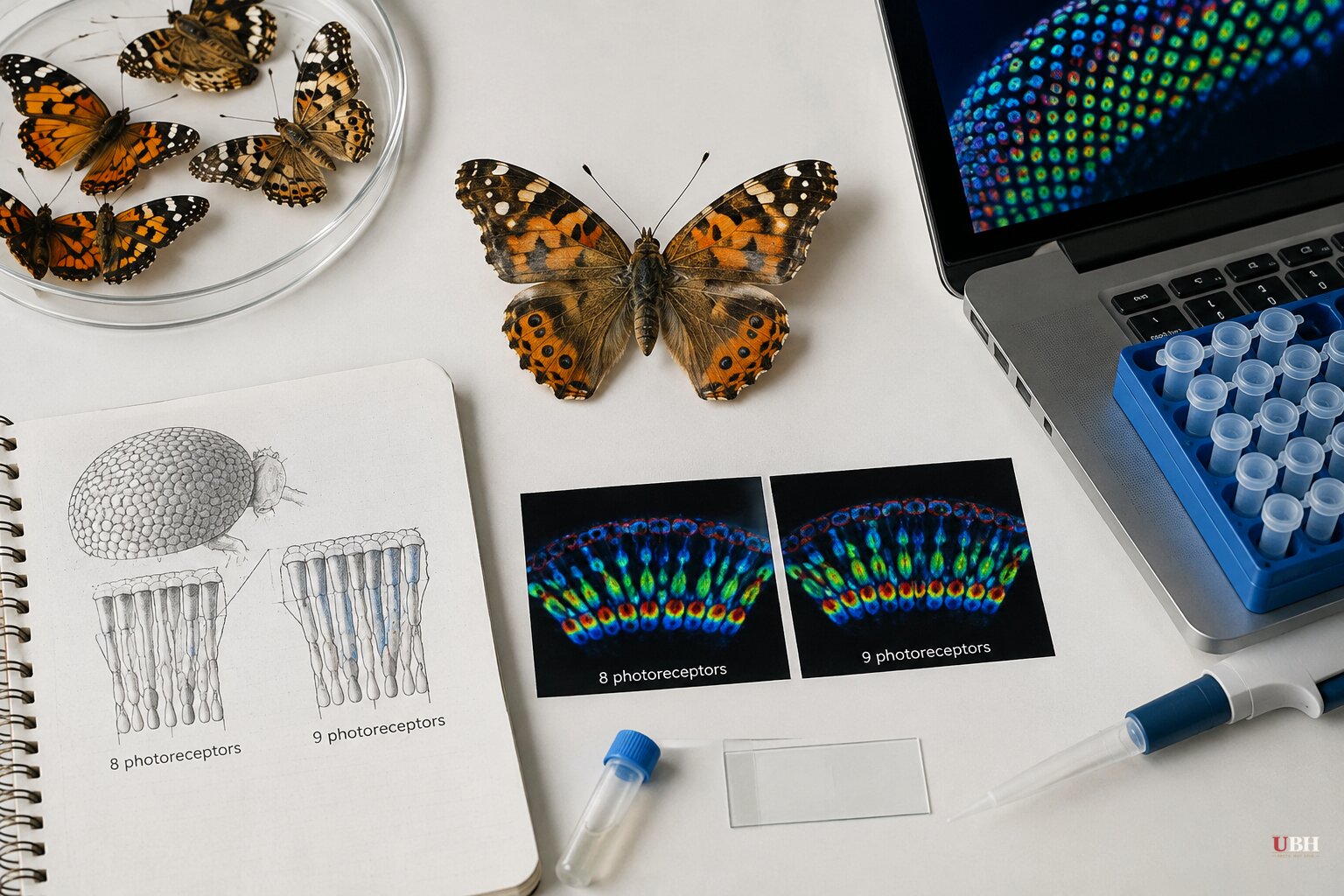
Butterflies have nine light-detecting cells in each unit of their compound eyes. Flies have eight. A team at the University of California San Diego says it has found the genetic change responsible for that difference.
The study, published in the journal Science Advances, comes from the lab of Michael Perry, an associate professor in the School of Biological Sciences and a faculty member in the Department of Cell and Developmental Biology. The open-access paper is titled "Sensory Receptor Expansion and Neural Accommodation in Butterfly Color Vision." The university announced the findings on Oct. 8.
One extra cell, in every unit of the eye
A compound eye is built from hundreds of tiny lenses. Behind each lens sits a cluster of photoreceptors. In flies, those cells are labeled R1 through R8, in an arrangement that has been conserved across insects for hundreds of millions of years.
Butterflies broke from that pattern. The researchers, working with painted lady butterflies (Vanessa cardui), found that butterflies added a second R7 photoreceptor to every unit of the eye.
Painted ladies are the most widespread butterfly species in the world, which is part of why they make a useful study subject.
The team examined 16 developing painted lady retinas and tracked which genes were active as the eye formed. They compared those patterns with developing fruit fly eyes. Some butterfly cells were following different instructions from their fly counterparts.
The butterflies did not invent a new way of building an eye. They changed an existing one. Cells that would normally follow one developmental path began behaving like another group of eye cells.
"Butterflies see far more color than flies do because at some point in their evolution they added a photoreceptor to every unit of their compound eye, a rare break from an eye design that has otherwise been conserved across insects for hundreds of millions of years," Perry said. "We found the genetic switch that did it."
The extra cell matters because butterflies can combine signals from cells that respond to blue and ultraviolet light in different ways. Humans cannot see ultraviolet light, but many insects can. The researchers say the added color information helps butterflies find nectar-bearing flowers and recognize potential mates.
Building a "butterfly fly"
To test whether that one change was enough, the team recreated it in a fruit fly. They switched on a gene in cells where it is normally kept off, and timed the activation to the short window when the eye is being built.
The result was what the researchers call a "butterfly fly." Its eye units had nine cells instead of eight.
The brain did not need to catch up
The second finding surprised the researchers. A new sensor is useless if nothing in the brain receives its signal. The team had assumed the brain would need to slowly evolve a matching partner neuron to take in the new information.
That did not happen. According to the researchers, no adaptive change was needed.
The fly brain routinely overproduces neurons, and those that fail to find a connection die off. In the butterfly fly, the extra photoreceptor connected to spare "standby" neurons that would otherwise have been lost.
"When we gave those spare neurons something to connect to, they survived and wired up correctly, immediately, with no further genetic change," Perry said. "The brain was ready before the eye asked."
The finding suggests a sensory system can expand by using cells the brain already makes, rather than waiting for a coordinated series of separate mutations on both the eye side and the brain side.
What is still unknown
The work does not show that the engineered flies see color the way butterflies do. The genetic change alone was enough to create the extra photoreceptor and get it wired into the brain. Whether the butterfly fly can perceive and tell apart colors as well as a true butterfly has not been established. Perry's team is investigating that question, along with how the fly's existing neural circuitry absorbed the new input so smoothly.
The full ecological and evolutionary payoff of the extra cell in wild butterflies also remains under study.
Who paid for it
The research was supported by multiple grants, including a National Science Foundation CAREER award and funding from the National Human Genome Research Institute. Both are federal sources. Ke Gao and Julia Ainsworth are among the listed researchers on the team.
The next step is the behavioral work. If the butterfly flies can be shown to discriminate colors that ordinary flies cannot, the claim that one genetic switch is enough to expand color vision would move from a statement about anatomy to a statement about sight.
Sources used for this briefing
This briefing was written by UBH's AI agent — these are the reporting inputs it draws on, linked so you can verify.


