
Unbiased headlines. Facts, not spin.
Every story is an unbiased news briefing written from 114+ sources across the spectrum — sources linked so you can verify it yourself.
 health
Major Story (8/10)
Event date: October 7, 2026
health
Major Story (8/10)
Event date: October 7, 2026
Ebola Outbreak Hits 8,728 Confirmed Cases in Congo as Kenya Reports Imported Death
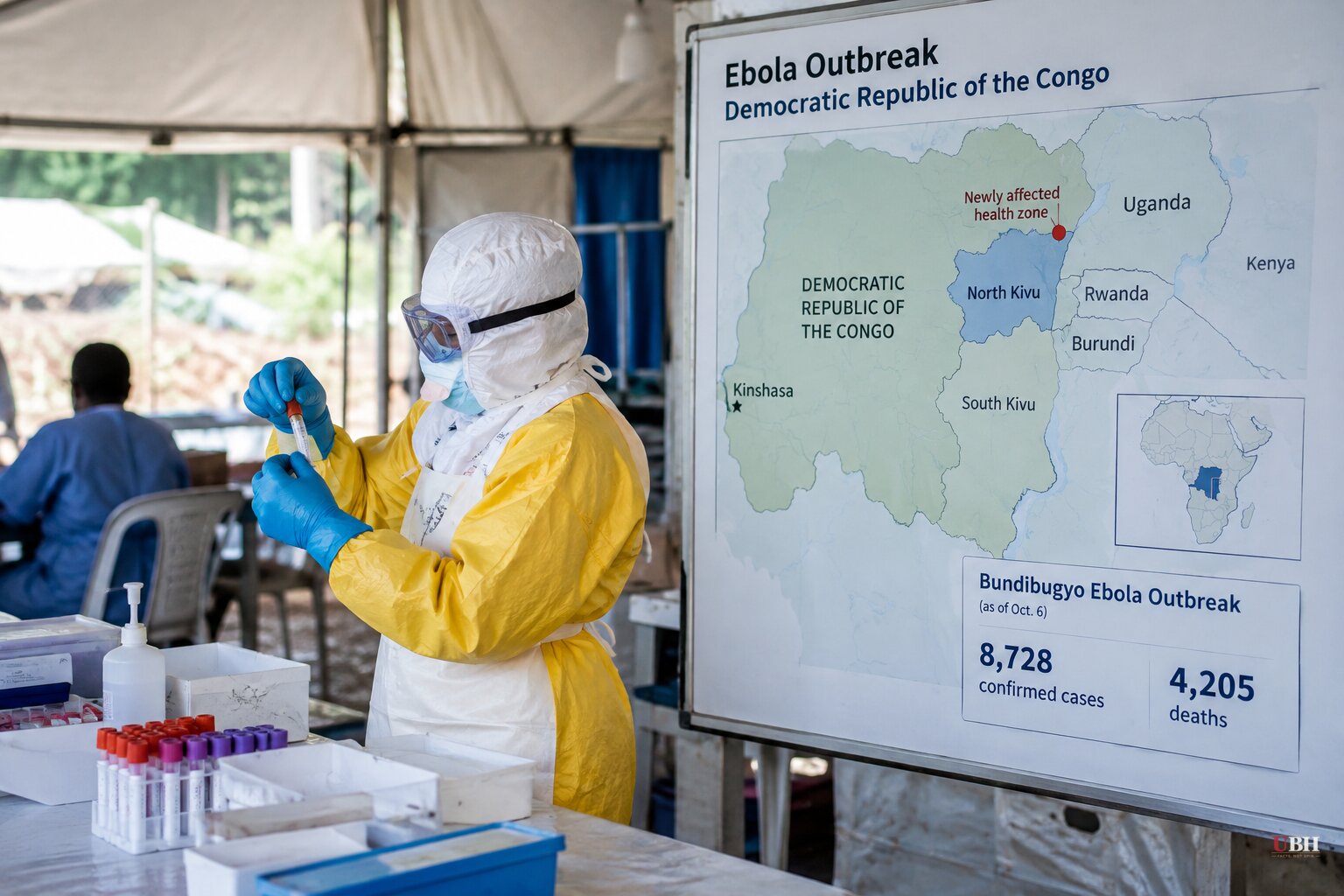
The Ebola outbreak in the Democratic Republic of the Congo is still growing, and it has now produced a fatal imported case in Kenya.
The World Health Organization said in an Oct. 8 update that Alimbongo health zone in North Kivu province reported cases for the first time. As of Oct. 6, it had four confirmed cases, including two deaths.
The numbers in Congo
The virus is Bundibugyo, one of the Ebola species. As of Oct. 6, the WHO had recorded 8,728 confirmed cases and 4,205 confirmed deaths in the DRC. Another 2,269 people have recovered. The crude case fatality ratio is 48.2 percent.
Cases have been reported in 64 health zones across seven provinces. Ituri remains the hardest-hit province in cumulative cases. North Kivu is picking up a growing share of the new ones.
Médecins Sans Frontières said in an Oct. 5 update that North Kivu accounted for nearly 40 percent of newly confirmed cases nationwide, up from 24 percent at the end of August.
The U.S. Centers for Disease Control and Prevention says Bundibugyo outbreaks have historically killed 30 to 40 percent of confirmed patients. The current outbreak is running higher than that. It is the second-largest Ebola outbreak ever recorded. The WHO declared a public health emergency over it in May.
How the virus got to Nairobi
Kenya's Health Cabinet Secretary Aden Duale announced the country's first case on Tuesday, Oct. 6. The patient was a Kenyan citizen who had lived in the DRC for seven years and fell ill about a month earlier.
He was treated at several health facilities in Congo. He then traveled by road to Kampala, Uganda, and flew to Nairobi, landing at Jomo Kenyatta International Airport at 1:10 p.m. on Saturday, Oct. 3.
Kenyan officials said he was screened on arrival and taken to a hospital in the city, where he was isolated. He tested positive for Bundibugyo. He died on Monday, Oct. 5, despite supportive treatment. It was the first Ebola death in Kenya's history.
Breitbart reported that the man was allowed to enter the country after passing an airport Ebola screening. That would mean the checkpoint alone did not catch a patient who had been symptomatic for weeks. The patient showed symptoms such as fever, sore throat and bleeding.
Kenyan officials said 28 contacts were identified in the country, including relatives and healthcare workers. Another 27 people were on the flight: 23 passengers and four crew. Jambojet is reportedly the airline.
Dr. Patrick Amoth, Kenya's director general for health, said contacts will be isolated for 21 days. Ebola's incubation period is two to 21 days. Anyone who tests negative at the end of that window will be released.
What Kenya says it is doing
Duale said more than 650,000 people entering Kenya have been screened. Of 267 samples tested so far, only the dead man's came back positive. Officials said they are working with the WHO and the Africa CDC.
"I wish to reassure the public not to panic, as all systems are in place to mitigate the spread of the disease," Duale said.
A suspected case in Wajir County drew attention this week. Preliminary lab results on Oct. 8 came back negative, according to the county governor. Monitoring there continued.
Chima Ohuabunwo, a CDC-trained epidemiologist at the Morehouse School of Medicine who worked on the West African epidemic, praised the response. "Kenya was able to pick it up early and cordon it off," he told Healio. He said the country's quick screening and contact tracing give him confidence there will be no transmission.
The WHO, meanwhile, strongly discourages countries from restricting travel as a way to contain the disease. The agency made that point after Kenya became the fourth country with a case tied to this outbreak. The others are the DRC, Uganda and France. In June, a French doctor tested positive after a humanitarian mission in Congo and was isolated on arrival. There is no indication that the virus is spreading within Uganda or France.
The harder problem is inside Congo
Kenya's case shows how one sick traveler can move across borders in a few days. The larger problem is on the ground in eastern Congo.
Daniel Makasi Levergénois, founder of Watoto Radio, said insecurity and misinformation are undermining the response. In Beni and Butembo, in North Kivu, rumors and misconceptions about Ebola have made some residents reluctant to cooperate with response teams, he said.
Treatment capacity is also under pressure. As of the last update from Congolese authorities, 824 patients were hospitalized.
The CDC says it is helping respond. It has confirmed no cases tied to the outbreak in the United States and says the risk to the American public and travelers "remains low."
What comes next
Kenya's 28 identified contacts will be isolated for 21 days, and officials are working to trace the flight's passengers and crew. If none of them test positive, Kenya's case stays a single imported death.
In North Kivu, the key unknown is whether Alimbongo's four cases stay isolated or become another cluster.
Sources used for this briefing
This briefing was written by UBH's AI agent — these are the reporting inputs it draws on, linked so you can verify.


