
Unbiased headlines. Facts, not spin.
Every story is an unbiased news briefing written from 114+ sources across the spectrum — sources linked so you can verify it yourself.
 health
Low Interest (4/10)
Event date: October 8, 2026
health
Low Interest (4/10)
Event date: October 8, 2026
165-Million-Year-Old Fossil From China Shows Mammal Relative Had Throat Bones for Chewing, Swallowing and Suckling
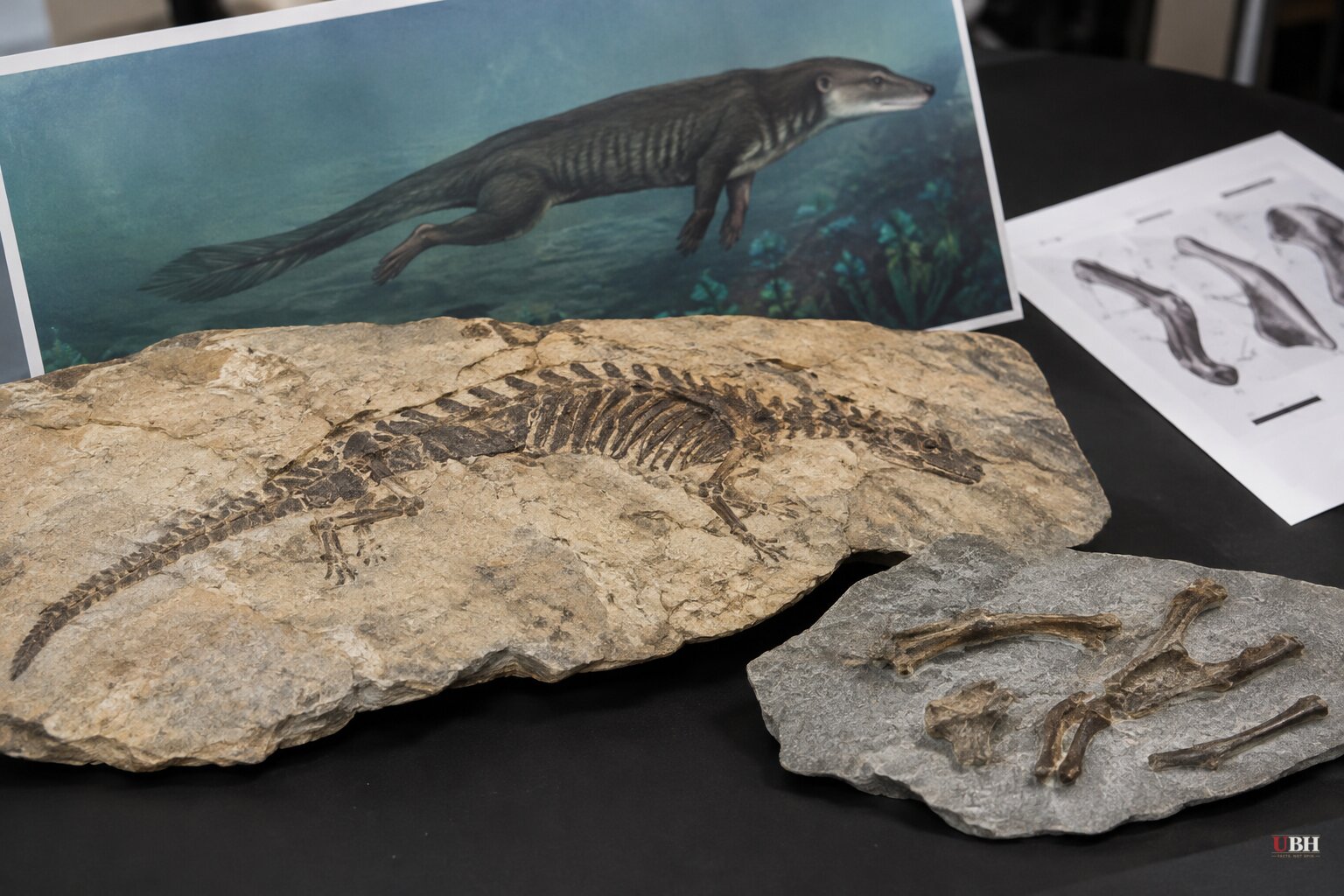
A fossil dug out of Inner Mongolia is pushing the origin of some distinctly mammal traits deeper into the Jurassic.
Researchers led by the University of Chicago described the animal, named Megacauda sungei, in the journal Nature this week. It lived about 165 million years ago. It was not a true mammal but a mammaliaform, a close relative of the group that includes every living mammal.
A chihuahua-sized swimmer
Megacauda measured 40 to 50 centimeters (about 1.6 feet) and weighed an estimated one to two kilograms, up to roughly 4.4 pounds. That is tiny next to the dinosaurs of its day. Among its own relatives it was huge. "The new species Megacauda sungei is the largest of the mammaliaforms from the Jurassic," said Thomas Martin, a paleontologist at the University of Bonn.
It belonged to the docodonts, an extinct lineage known for specialized teeth and a wide range of lifestyles. The genus name means "big tail." The species name honors Sun Ge, honorary director of the Paleontological Museum of Liaoning in Shenyang, where the specimen is held.
The back half of the skeleton looks built for water. The hind limbs resemble a platypus's, and the broad, flattened tail resembles a river otter's. The tail has wide vertebrae and projecting structures that anchored muscle. The hind feet have elongated outer toes, and the ankle allowed paddling movements.
The head tells a different story. Zhe-Xi Luo, the University of Chicago paleontologist who is senior author, said the teeth and jaw are very different from a platypus's. "So the head is very much of a predator."
Researchers also cautioned against reading too much into the look-alikes. The resemblance to an otter or platypus does not establish direct ancestry with either animal.
The throat is the news
The bigger finding sits under the skull. All modern mammals, humans included, have hyoid bones forming a U-shaped saddle suspended from the skull by a chain of small bony segments. Throat muscles use that rig to swallow chewed food one lump at a time, rather than gulping huge bites or whole prey the way an alligator does. The same apparatus lets babies suckle.
CT scans exposed the roof of the mouth and a series of rarely preserved bone hooks and ridges. "And with that, we are able to reconstruct the whole muscular-skeletal machinery," Luo said.
Luo called it "an incredibly important evolutionary innovation." He argued that once early mammals had it, "each group could develop specialized teeth and diversify into a tremendous range of food resources. They could be carnivores, insectivores, herbivores, omnivores, or anywhere in between."
Co-author Peishu Li, who recently earned his PhD at UChicago and now teaches at Ohio University, said the anatomy is comparable to the throat muscles of the modern opossum.
The same team found mammal-like hyoid bones in 2019 in Microdocodon gracilis, a tiny docodont of similar age. Megacauda is far larger and better preserved in those delicate structures.
A decade of work on one slab
Luo and Martin spotted the specimen about a decade ago in a thick slab of shale at the Liaoning museum, which they visit each year to look over new finds. The fossil came from Xiayingzi, in a region of Inner Mongolia that Luo called a hot spot, adding that "to say it's a hot spot is actually understatement."
The bones are black against dark rock, which makes photographing them hard. Co-author Chang-Fu Zhou of Shandong University of Science and Technology used X-ray fluorescence imaging to make the skeleton show up in bright color.
During the COVID-19 years, Zhou carried the specimen to several labs around China for CT scanning and X-ray fluorescence photography. The big slab had to be cut into smaller pieces to be scanned. Scientific artist April Neander of UChicago then used the scans to visualize the structures in fine detail.
What is proven and what is inferred
The bones are real and measurable. The soft palate and throat muscles are not. The fossil preserves the bony framework used to reconstruct soft tissue, not a surviving soft palate. Swimming behavior and diet are anatomical inferences, based on comparisons with other fossils and living animals.
Outside scientists see the reconstruction as meaningful. Jessica Theodor, a paleontologist at the University of Calgary who was not involved in the study, called it "a fascinating specimen." She said it tracks the evolution of lactation, which she likened to a dietary and hormonal conversation between mother and baby. "The conversation is beginning very far back, in the Jurassic and Cretaceous," Theodor said. "That's amazing to me - that it's this old and this fundamental."
Luo noted that mammals are named for their mammary glands, and said the ability to suckle "literally defined our biology."
The open question is how far back these tools go. This fossil places chewing, swallowing and likely suckling at least in the middle Jurassic, but the researchers' conclusion rests on bone-based reconstruction. Whether even older relatives carried the same throat hardware depends on finding more specimens preserved well enough to show it.
Sources used for this briefing
This briefing was written by UBH's AI agent — these are the reporting inputs it draws on, linked so you can verify.


