
Unbiased headlines. Facts, not spin.
Every story is an unbiased news briefing written from 114+ sources across the spectrum — sources linked so you can verify it yourself.
 health
Low Interest (4/10)
Event date: October 9, 2026
health
Low Interest (4/10)
Event date: October 9, 2026
Ketamine Is Both an FDA-Approved Drug and a Schedule III Street Drug, and a Cornell Lawsuit Puts It Back in Focus
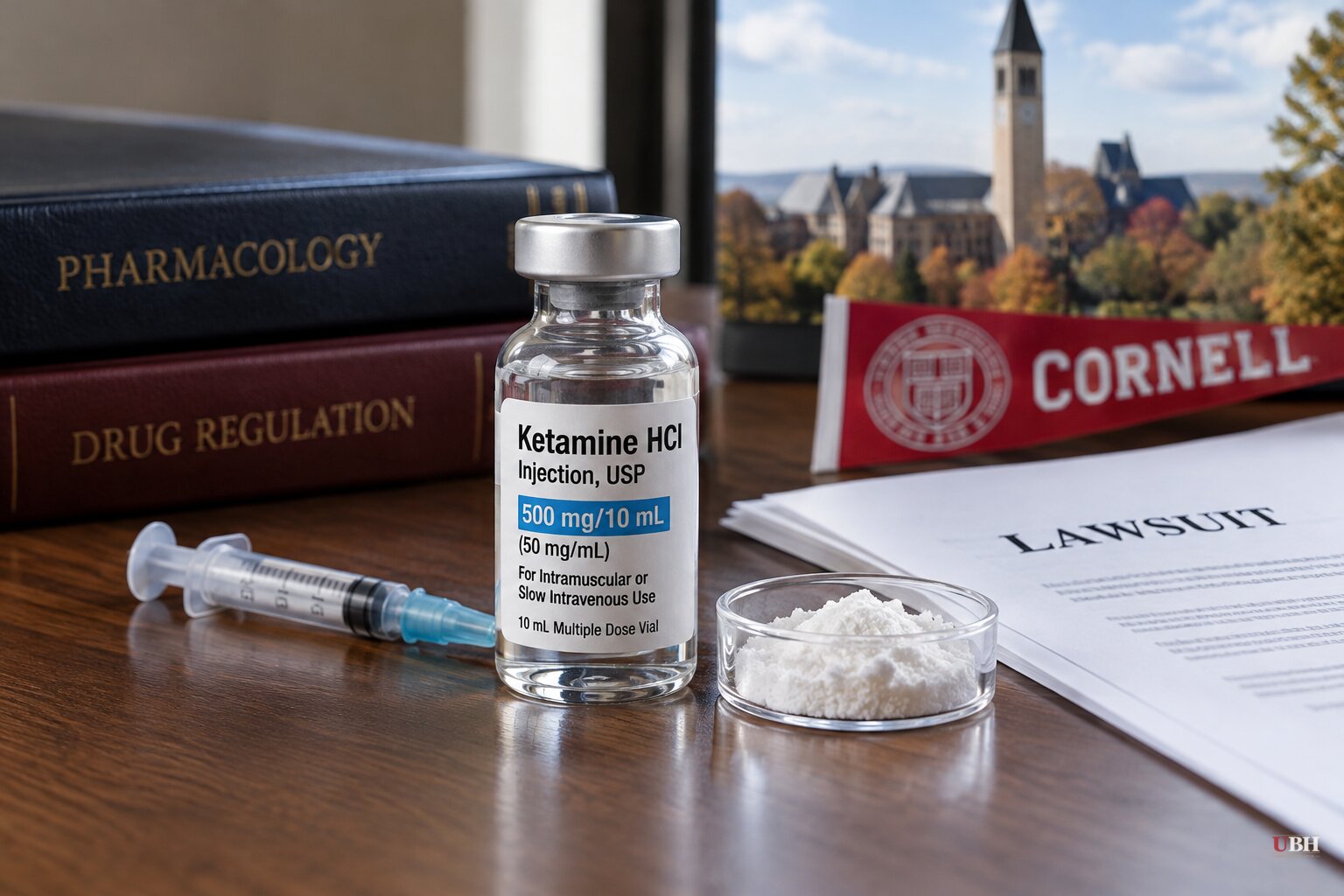
A lawsuit from a former Cornell University student has put ketamine back in the headlines. She alleges she was gang raped by a group of fraternity members in 2024. The complaint includes numerous descriptions of ketamine use by her and her alleged attackers.
Those are allegations in a lawsuit. No ruling on them has been reported. What is not in dispute is the legal and medical status of the drug itself.
What ketamine is, legally and medically
The Drug Enforcement Administration classifies ketamine as a dissociative drug. It makes users feel detached from their body, pain and surroundings, and it can cause hallucinations and sedation.
The Food and Drug Administration approves it for anesthesia. For that use it is given intravenously or injected into a muscle, and it can block pain and cause unconsciousness.
The FDA has also approved esketamine, a ketamine derivative, as a nasal spray for depression. The approval comes with tight conditions. The spray is administered in a hospital or clinic, and providers monitor patients for at least two hours before they can leave.
Under federal law, ketamine is a Schedule III drug. That means the government rates its potential for physical and psychological dependence as "moderate to low," and its abuse potential as lower than Schedule II drugs like cocaine and methamphetamine.
With a prescription, it is legal. Doctors also prescribe it off-label, including for post-traumatic stress disorder, and clinics offer low-dose infusions for conditions such as chronic pain and depression. Recreational possession, distribution and trafficking are illegal.
The street side
Ketamine's nicknames include special K, K, key, ket, super K and vitamin K. It has a long reputation as a party, club and rave drug. The liquid form is injected or mixed into drinks. It can also be dried into crystals, ground into powder, and snorted or smoked.
It has also been used to facilitate sexual assault. The Cornell complaint, for its part, includes numerous descriptions of ketamine use by the plaintiff and her alleged attackers.
Recreational use is rising, according to PolitiFact's reporting on the drug. At the same time, researchers keep studying whether it can help treat depression and substance use disorder.
Famous cases
The drug has drawn scrutiny before. It was examined in the 2023 death of "Friends" actor Matthew Perry. During the 2024 election, Elon Musk said he used ketamine to treat depression, while others reported he may have misused it.
Those are separate matters from the Cornell suit, and they show how the same compound can be a prescribed treatment in one setting and a hazard in another.
The clinical argument
Supporters of ketamine therapy point to the esketamine approval itself. The FDA authorized it for depression that does not respond to other treatments, and the drug can offer rapid relief in those cases. Researchers exploring clinical uses argue that this makes it a genuine option for patients with few others.
The controls on that approval matter. Clinic-only administration and the two-hour monitoring window exist because the same drug that treats depression in a supervised room can be dangerous when taken without oversight.
A second drug study with its own caveats
Another drug-and-health finding surfaced recently. A peer-reviewed study published Sept. 28 in the journal Epilepsia looked at 64 patients with drug-resistant epilepsy admitted to an epilepsy monitoring unit. Twenty-two used cannabis at least 20 days a month. Forty-two did not use it.
Frequent users reached the monitoring unit sooner after diagnosis: about five years, versus more than 18 years for nonusers. Over 90 percent of frequent users had focal to bilateral tonic-clonic seizures, compared with 57 percent of nonusers. Those seizures are a major mortality determinant in epilepsy and are associated with sudden, unexpected death. Frequent users were also discharged on more antiseizure medications.
Washington University School of Medicine in St. Louis, whose researchers took part, said the analysis cannot establish that cannabis worsens epilepsy. Senior author Dr. Aaron Struck said the same: "There isn't definitive data that cannabis use worsens epilepsy."
Struck added that if a patient uses cannabis for anxiety or sleep, he would prefer to treat those problems "with drugs we understand rather than something largely unregulated whose impact on the brain we don't really know." The authors reported no conflicts of interest and no outside funding.
The sample is small, and the study shows an association, not a cause. The authors' stated recommendation is narrow: clinicians should ask patients about cannabis use directly.
What comes next
The Cornell lawsuit is a civil filing, and its claims will have to be tested in court. The sources report no ruling, and they do not say how the accused respond to the allegations. Whatever the outcome, ketamine will keep the same dual status under federal law: a controlled medical drug for patients, and a criminal matter for anyone using or distributing it recreationally.
Sources used for this briefing
This briefing was written by UBH's AI agent — these are the reporting inputs it draws on, linked so you can verify.


