
Unbiased headlines. Facts, not spin.
Unbiased Headlines is an independently owned news organization. We bring you the facts, not opinions, written fresh from 110+ named sources. Sources linked so you can verify it yourself.
 health
Notable (6/10)
Event date: November 2, 2026 ·
One TB Case at a San Francisco Private High School Grew to Hundreds More by March, Physician and Journalist Report
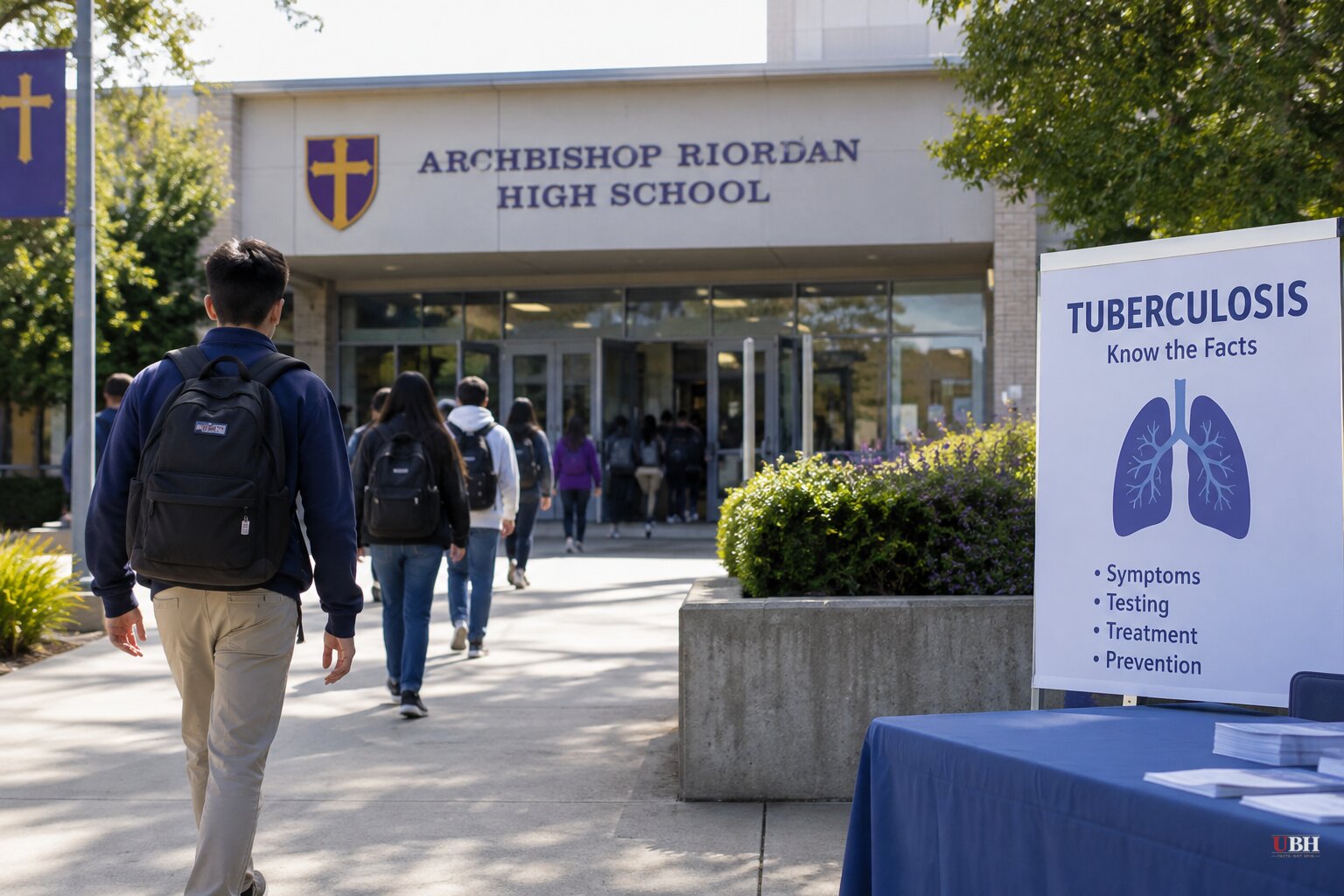
A tuberculosis outbreak hit a well-funded private high school in San Francisco. It is the kind of place almost no one expects to find the world's deadliest infectious disease.
The school is Archbishop Riordan High School. About a month before December 2025, the San Francisco Department of Public Health issued a report describing a TB case there. By March, according to physician Meyer and journalist Hahm, writing on the outbreak's one-year anniversary, that one case had ballooned into hundreds more.
The two learned of it by accident. In December 2025, Meyer was chatting with a friend whose teenager attends a rival San Francisco high school. The talk went from football to prom. "It's going great," the friend said. "Well, except for the tuberculosis."
How the index case unfolded
Parents the authors interviewed say the outbreak began with a student who had recently immigrated from Africa, a continent with high TB prevalence. That account comes from the parents. The health department's report, as described by the authors, announced one case.
In September 2025, that student, the index case or "patient zero," was evaluated by a medical provider for two weeks of cough. Cough is a common complaint among high schoolers during flu season. The student's symptoms were not attributed to TB at that first visit.
TB is a slow-burning disease. A person becomes infected by inhaling the bacteria. In about 5% of infected people, that leads to active TB, with the classic symptoms: cough, bloody sputum and night sweats.
Most infected people do not get sick right away. The immune system holds the infection in check, and the person is neither symptomatic nor contagious. That state is called latent TB. Dormant bacteria can reactivate later, a lifetime risk of about 10%.
That distinction matters for reading the "hundreds" figure. Infection and active disease are not the same thing. The authors' account does not break out how many of the hundreds had active TB and how many had latent infection.
Where TB stands in the U.S.
TB was once the single greatest cause of American mortality, responsible for a quarter of all deaths until the 1800s. Better living and work conditions cut the toll by the early 1900s. Streptomycin, developed in the 1940s, drove case rates down further. Annual U.S. TB deaths fell from roughly 20,000 in the 1950s to under 2,000 by the 1980s.
Globally, the picture is worse. The authors name overcrowding, malnutrition and limited healthcare as drivers of TB deaths. They add that, more recently, cuts to foreign aid have contributed.
Today, 77% of U.S. TB cases occur in foreign-born individuals. TB incidence in that group is 20 times higher than in U.S.-born individuals. The authors say San Francisco's epidemiology mirrors the national pattern.
Those numbers explain why TB shows up where it does. They do not make a school outbreak inevitable. A single missed diagnosis in a classroom setting is a different problem from a population-level rate, and the September visit is where the opening appeared. A two-week cough in a teenager is ordinary. TB in a teenager who recently arrived from a high-prevalence region is something a provider has to think to look for.
What a school outbreak demands
Once a case is confirmed, the health department's job is contact tracing: finding everyone who shared air with the patient, testing them and treating those infected. In a school, that can mean hundreds of students, teachers and staff. The department's report to the school community came roughly two months after the September visit, according to the dates the authors cite.
The authors say they spent months trying to understand how such an outbreak overwhelmed a prestigious Bay Area school. They sat down with several parents and a student to find out.
What remains unresolved is the final count. The public has not been given a full breakdown of how many people in the Riordan community were infected, how many developed active TB and how many are on treatment for latent infection. The San Francisco Department of Public Health, which tracked the outbreak from the first report, is the body that holds those numbers.
Sources used for this briefing
1 link from 1 independent newsroom (syndicated copies of the same report count once)
These are the sources it draws on, linked so you can verify.


