
Unbiased headlines. Facts, not spin.
Unbiased Headlines is an independently owned news organization. We bring you the facts, not opinions, written fresh from 110+ named sources. Sources linked so you can verify it yourself.
 health
Major Story (8/10)
Health Insurance Costs Set to Climb Again in 2027 as Voters Head to the Polls
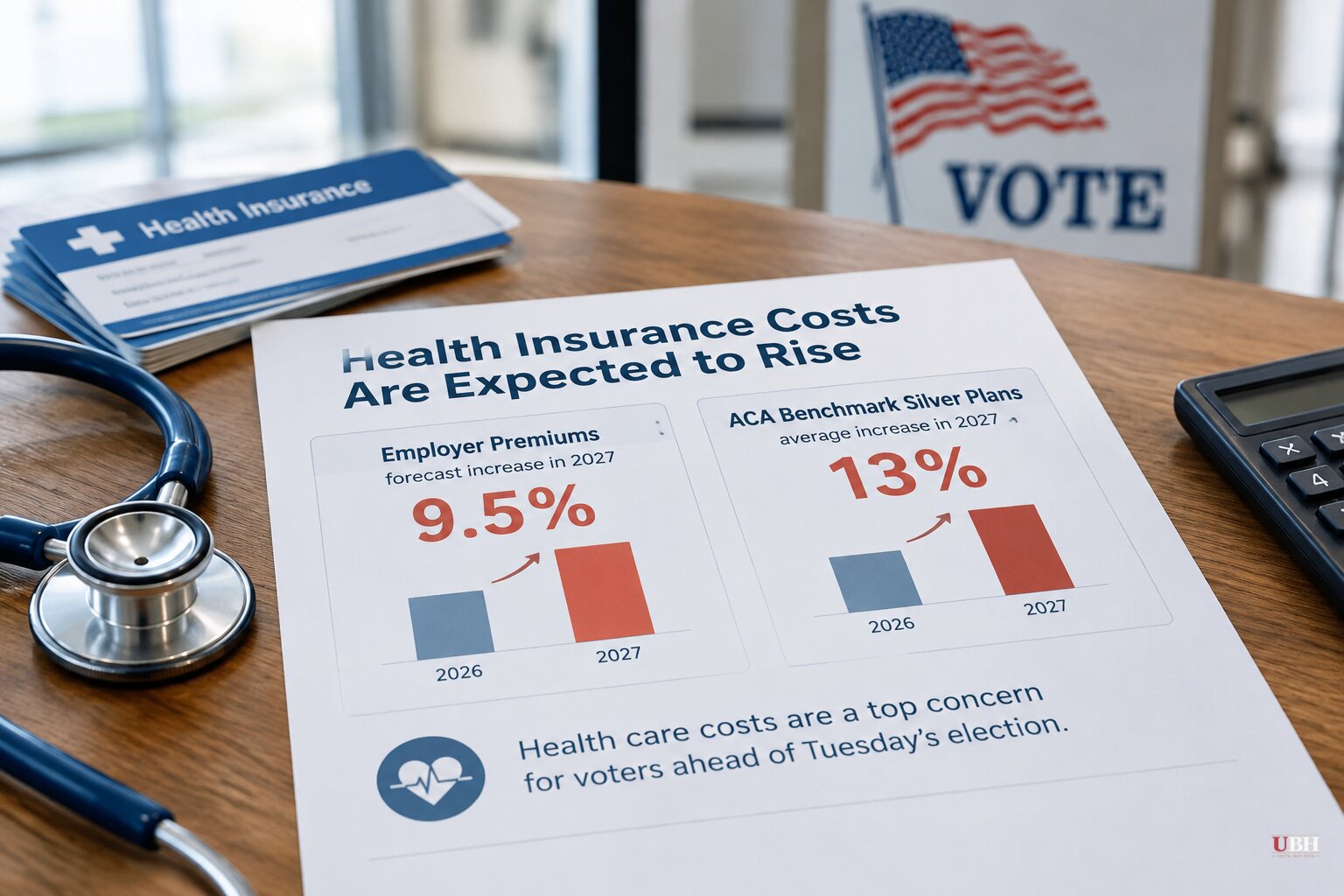
Since enhanced ACA subsidies expired at the end of 2025, the cost of health coverage has become one of the biggest pocketbook issues heading into Tuesday's midterm elections, Nov. 3. The next round of increases is already set.
A KFF analysis published Friday found finalized benchmark silver premiums on ACA plans will rise an average of 13% in 2027. That is the second straight year of double-digit increases. A Washington Post analysis of finalized and proposed rates puts the typical marketplace jump at around 15%.
Employer plans are not spared. Analysts forecast premiums for job-based coverage could rise as much as 9.5% in 2027, though experts told PBS News the final bite may come in below that.
What families already pay
In 2026, the average employer-sponsored family plan cost $28,303, up 5% from 2025, according to KFF. Workers paid about $7,470 of that, up 9% in a year.
KFF also found 44% of large firms offering benefits said they raised employee contributions. About 157 million Americans get coverage through work.
On the ACA marketplace, the average monthly benchmark premium went from $497 in 2025 to $625 in 2026, KFF found. The jump followed the expiration of enhanced premium tax credits.
Federal enrollment data show nearly 3 million people left the marketplace over a year ending in early 2026. KFF counted about 20.5 million enrolled by June. The Post reports roughly 5 million more could lose ACA coverage by the end of 2026 amid higher costs, lost subsidies and new restrictions from the Trump administration.
A KFF poll this month found a quarter of voters are "very worried" about affording care. More than a third are "somewhat worried."
Prices, not insurer markups
The economists quoted most often point at what providers charge. Zack Cooper, a Yale economist, found health spending accounted for 91% of average premium growth from 2011 to 2024. Insurer markups, meanwhile, fell from about 19% in 2011 to nearly 15% in 2024, he said.
Meredith Rosenthal, a Harvard health economist, said hospitals and drugmakers set prices with little regulation and that competition "mostly does not work very well." She noted a private-market MRI costs about double what Medicare pays.
Cooper also pointed to thin antitrust enforcement as hospitals and physician practices keep consolidating. He said tariffs and high energy prices add to provider costs.
Drug spending is climbing too. The American Society of Health-System Pharmacists reports it rose 12.7% in 2025 to $915 billion and is on track to pass $1 trillion in 2026. An AARP Public Policy Institute report found the top 25 brand-name drugs have risen an average of 81% since launch.
Insurers filing 2027 ACA rates cited labor shortages and costs tied to growing use of GLP-1 drugs.
The insurer profit argument
Not everyone accepts that insurers are bystanders. A sponsored piece from Americans for Limited Government, published by Breitbart, points to UnitedHealth Group's third-quarter net profit of $4.11 billion, up 75% from $2.35 billion a year earlier. It says UnitedHealth shed 935,000 Medicare Advantage members since the end of 2025 while pulling back benefits and plans.
The group asks "who is benefiting" and says Americans deserve a fuller explanation than the one insurers give, which is rising medical expenses and demand. Those profit figures come from that advocacy group's account. The Yale research above shows insurer markups shrinking across the longer period.
Jeffrey Tucker, writing in The Epoch Times, makes a different structural argument. He says workers cannot take their employer's health contribution as salary, and that some businesses cap headcount at 49 to stay below the employer-mandate threshold. KFF found workers at small firms pay about $9,687 toward family coverage, per Tucker's column.
Tucker also says families are dropping coverage and turning to alternatives such as crowd-sourced cost-sharing. He adds there is "no pressing political movement" to fix it. Democrats, per the Post, have discussed restoring the expired subsidies and expanding Medicare if they win Congress. The subsidies were a central issue in last year's extended government shutdown.
No quick fix
Sabrina Corlette, who co-directs Georgetown's Center on Health Insurance Reforms, told ABC News she sees no "magic bullet in the short term." She said: "I think it's [going to] get worse before it gets better."
The deductible picture is bleak as well. KFF reports the average single-coverage deductible hit $1,886 in 2025, up 43% since 2015.
For individual families, the stakes arrive before any new Congress does. Jess Settle, 39, of Rappahannock County, Virginia, paid $400 a month on the marketplace this year. Her insurer is leaving, and she needs a new plan by Dec. 31. She told the Post she doubts she can pay more.
Sources used for this briefing
7 links from 6 independent newsrooms (syndicated copies of the same report count once)
These are the sources it draws on, linked so you can verify.


