
Unbiased headlines. Facts, not spin.
Unbiased Headlines is an independently owned news organization. We bring you the facts, not opinions, written fresh from 110+ named sources. Sources linked so you can verify it yourself.
 health
Major Story (8/10)
Event date: October 29, 2026 ·
CDC Ebola Attestation Order for All US-Bound Air Passengers Starts 11:59 PM ET Tuesday as Airlines Seek Delay
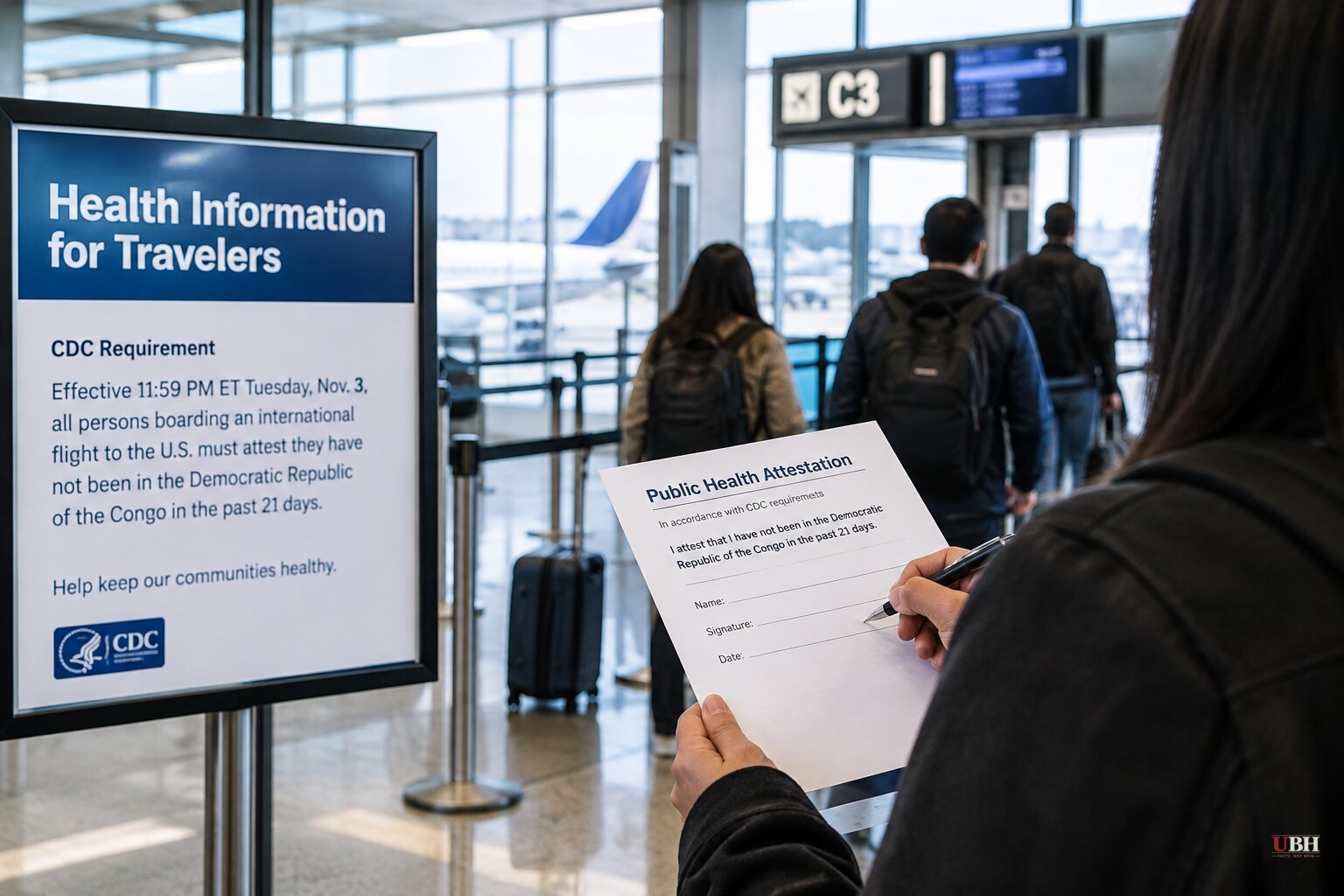
Since the DRC Ministry of Health and the World Health Organization confirmed a Bundibugyo Ebola outbreak in eastern Congo on May 15, the U.S. response has moved from travel warnings to entry restrictions to a blanket paperwork requirement. That requirement takes effect at 11:59 PM Eastern on Tuesday, Nov. 3.
The Centers for Disease Control and Prevention issued the order on Oct. 22. Assistant Secretary for Health Brian Christine signed an amended version on Oct. 28 that spells out coverage of crew members on official duty, including crew positioned on deadhead status who are not operating the flight.
Who has to sign
The order covers everyone boarding a flight to the U.S. from a foreign country. That includes American citizens, green card holders, connecting passengers and crews. It applies even to travelers who have never been near Central Africa.
Each person must attest that they have not been present in the DRC during the previous 21 days. The CDC counts calendar days, with the day of departure from the DRC as day 0. Someone who was there can board a U.S.-bound flight starting on day 22.
Presence is defined broadly. Connecting through a Congolese airport such as Kinshasa's N'djili counts, even if the traveler never leaves the plane or terminal. Flying over the country does not.
The CDC allows a paper form, an authenticated digital signature or an electronic checkbox. A gate agent may record a verbal attestation after the traveler reads the form's wording. A parent, guardian or adult in the same party may attest for others, but each person needs a recorded attestation of their own.
Anyone who refuses to attest cannot board, apart from the rare travelers the CDC exempts on humanitarian or government grounds. The CDC says willfully false information can bring criminal fines and imprisonment under federal false-statements law.
What airlines must do
Carriers must confirm every passenger has attested at or shortly before boarding, refuse boarding to anyone who has not, and keep each record for at least 42 days after the flight arrives. An operator that cannot confirm completed attestations can be denied controlled free pratique, the clearance needed to let passengers off the aircraft at a U.S. port of entry. The CDC also warns of civil and criminal penalties for noncompliance.
The order is not limited to scheduled airlines. It defines aircraft to include general aviation, cargo and private aircraft, so a business jet or charter needs attestations from everyone aboard, and a freighter's crew does too. Flights from U.S. preclearance airports abroad are covered, as are travelers only transiting the U.S.
Flights from Puerto Rico, Guam and other U.S. territories are not covered, because they are not foreign countries. Land border crossings and seaports are also outside the order.
The Department of Transportation's consumer protection office has said it will not take action against an airline for strictly following the order with travelers who cannot present an attestation.
Airlines say it is too broad and too fast
Airlines for America, which represents American, Delta, Southwest, United and JetBlue, sent the CDC a letter dated Oct. 26 asking it to reconsider. The group said it supports the CDC's public health goals. It called the requirement too broad and asked for a "more proportionate and measured U.S. response" focused on affected areas and travelers who have recently been there.
The group also asked for a later start date. "Changes to check-in systems, digital signatures, station procedures and training cannot readily be completed in the allotted time," A4A wrote.
The International Air Transport Association, which represents more than 370 airlines worldwide, has also asked the CDC to reconsider.
The public health case for acting is stated by Dr. Tyler Evans, a California infectious disease physician and CEO of Wellness Equity Alliance. "This was a step in the right direction, given the fact that we really do have to take this seriously. We have to ensure that this does not cross borders," he said. He called this "the second-largest outbreak of Ebola in history."
Why Congo, and why now
The new order is narrower in geography than earlier restrictions, which reached travelers from the DRC, Uganda and South Sudan. The CDC determined that the DRC remains the epicenter of the outbreak and carries a substantially higher risk than its neighbors. It is broader in who it touches: every foreign departure to the U.S., regardless of itinerary.
Bundibugyo disease has little documented history. Before this year it appeared in a 2007 Uganda outbreak that infected roughly 131 to 149 people and a 2012 DRC outbreak that affected about 52 to 57, according to CDC outbreak records. No approved vaccine exists for the strain.
The current outbreak passed 1,000 confirmed cases roughly 40 days after detection, compared with about 235 days for the 2018 to 2020 DRC outbreak to reach that mark. The CDC activated its Level 1 emergency response on June 26 and committed more than 500 staff, with over 120 deployed to affected countries.
What comes next
The CDC has not announced any change to the Nov. 3 start. Airlines now have roughly a day to finish check-in system changes, digital signature tools and station training. The order is set to expire Dec. 18 unless the CDC extends, amends or rescinds it sooner. Whether the agency answers A4A's request to narrow the scope will likely show up first at check-in counters on Wednesday.
Sources used for this briefing
7 links from 7 independent newsrooms (syndicated copies of the same report count once)
These are the sources it draws on, linked so you can verify.


