
Unbiased headlines. Facts, not spin.
Unbiased Headlines is an independently owned news organization. We bring you the facts, not opinions, written fresh from 110+ named sources. Sources linked so you can verify it yourself.
 health
Notable (6/10)
Athenahealth Launches Connector Letting Patients Feed Their Medical Records to Anthropic's Claude
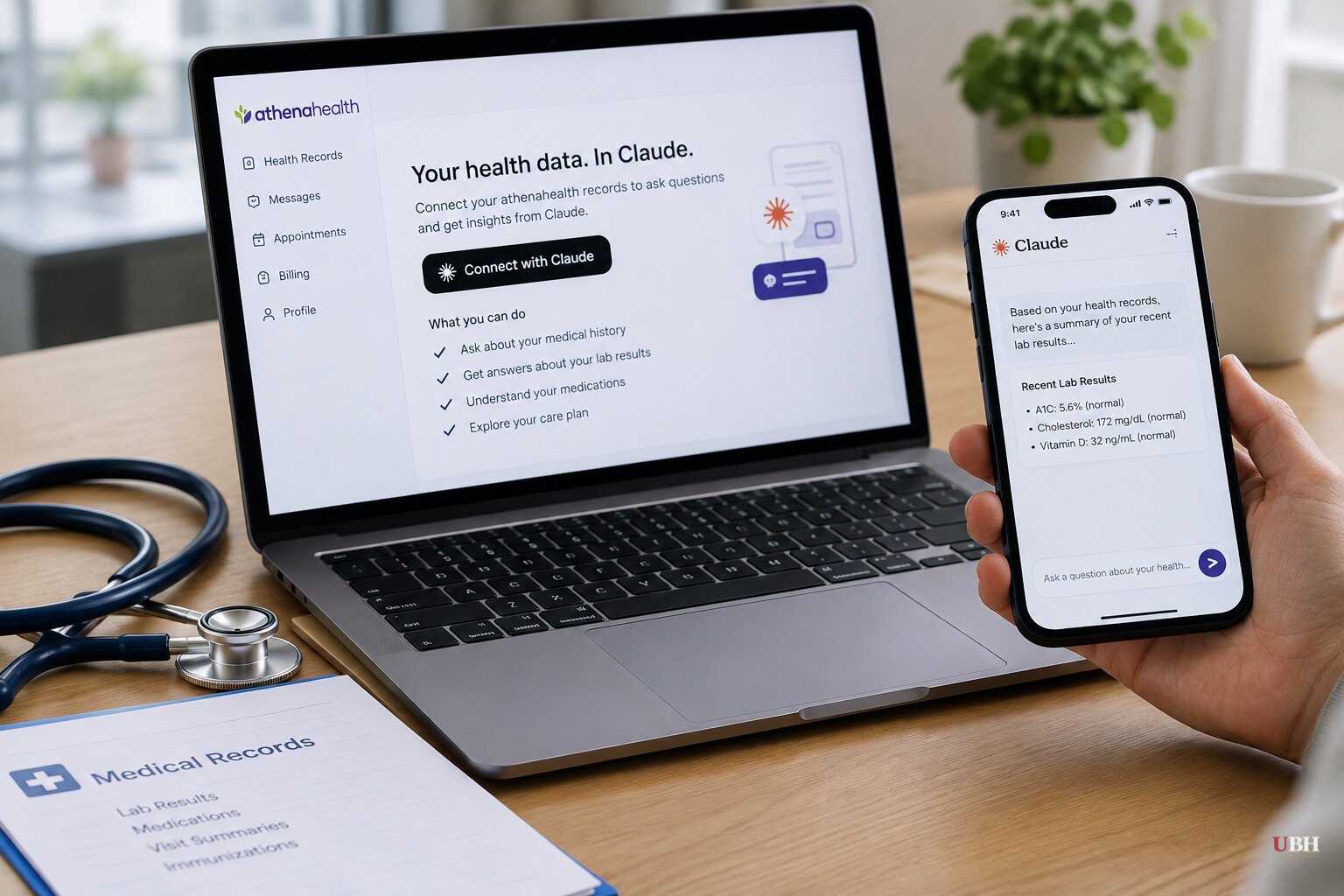
Athenahealth, the electronic health record company, has launched a tool that lets patients pipe their own medical records into Anthropic's Claude chatbot. The product is called athenaPatient MCP, and Claude Pro and Max users in the U.S. can add it from their Claude settings, according to the company's announcement on Nov. 2.
It is the first connection in what athenahealth says will be a wider opening of patient records to outside AI assistants. Claude is the starting point.
What patients get
The connector uses the Model Context Protocol, a standard that lets AI models pull structured data from authorized systems. Patients sign in with their athenahealth patient portal credentials. Those credentials are not shared with Claude, Paul Brient, athenahealth's chief product and operations officer, told Fierce Healthcare.
Once connected, Claude can draw on lab results, vitals, medications, health conditions, immunizations, visit history, diagnostic reports, allergies, procedures and care plans. A patient can ask something as simple as "What was my most recent red blood cell count?"
Access is limited to paying subscribers. Claude Pro costs $20 a month and Claude Max costs $100. Athenahealth says it serves more than 20% of the U.S. population, but not every athenahealth patient's data is exposed, and no Claude subscriber is required to opt in.
Control and data limits
Patients choose which categories of information Claude can see and can revoke access at any time, according to athenahealth. Brient said the data is encrypted in transit. "Once the connection is established and patients approve what types of data they would like to share, the rest is between Claude and the patient," he said.
Athenahealth says its agreement prohibits Anthropic from using data accessed through the connection to train its models or improve its products. Brient said the company will limit athenaPatient MCP to AI assistants that do not use patient information for training. He also encouraged patients to read the privacy and data-use policies of any service they choose.
Athenahealth is not positioning the tool as a doctor. Sam Lambson, the company's vice president of product management, data and ecosystem, said the partnership does not provide medical advice and should not replace a clinician's judgment. "Patients should contact a qualified healthcare professional with questions about diagnosis, treatment, or changes to their care," he said.
Anthropic's head of healthcare, Syed Mohiuddin, framed it as help between appointments. "Patients often have questions about their health records between visits, from what a lab result means to what to ask at their next appointment," he said.
Why now
Athenahealth cited an August 2026 Pew Research Center survey finding that 34% of U.S. adults have used AI assistants for health-related purposes, from looking up symptoms to understanding a diagnosis. People are already pasting lab results into chatbots. This tool replaces the copy-and-paste with a direct, patient-authorized pull from the official record.
The move also follows other tie-ups between tech firms and health systems. Earlier this year Microsoft teamed up with Mayo Clinic on a healthcare AI model, and Boston Children's Hospital partnered with OpenAI on an enterprise system for research, clinical and administrative teams.
The validation question
The concern that runs through the research on consumer health AI is evidence. A Nature Health paper, summarized in an Oct. 19 Digital Health Insights report, argues that chatbots from OpenAI, Amazon, Anthropic and Ant Group are becoming healthcare infrastructure with almost no independent testing.
The paper's authors found that only one of those platforms, ChatGPT Health, had faced an independent evaluation. In a test using clinician-written vignettes, it under-triaged 52 percent of emergencies. The authors found no independent evaluations of Claude for Healthcare. The companies describe internal testing, but none has published a product-specific number, according to the paper.
The authors also raise a privacy gap. Per the report on the paper, hospitals cannot refuse to send records to an app a patient picks, and HIPAA stops protecting the data once it leaves the covered entity. The leverage health systems retain, the authors argue, sits in procurement contracts, where they can demand local validation and audit rights.
That paper does not address athenaPatient MCP specifically, and it covers triage rather than record lookup. Athenahealth's design is also narrower than the platforms the paper describes: the patient pulls data and asks questions, and the tool does not book appointments or renew prescriptions. Lambson's statement that it does not give medical advice is consistent with that.
But the underlying tradeoff is plain. Patients own their health data and should be free to share it with whatever tool they trust. Once they do, protection rests on a contract between athenahealth and Anthropic and on Anthropic's own policies, not on the statutory framework that governs the record inside athenahealth's system.
What comes next
Athenahealth has not named which AI assistants will follow Claude, and Anthropic has not published accuracy figures for how Claude handles questions about real patient records. Whether other EHR vendors copy the model, and whether health systems start writing audit rights into their own contracts, will decide how much of that gap gets closed.
Sources used for this briefing
7 links from 7 independent newsrooms (syndicated copies of the same report count once)
These are the sources it draws on, linked so you can verify.


