
Unbiased headlines. Facts, not spin.
Unbiased Headlines is an independently owned news organization. We bring you the facts, not opinions, written fresh from 110+ named sources. Sources linked so you can verify it yourself.
 health
Notable (6/10)
Event date: October 28, 2026 ·
Internal memos show chemical executives discussed plastic migrating through the body in 1974, LA Times reports
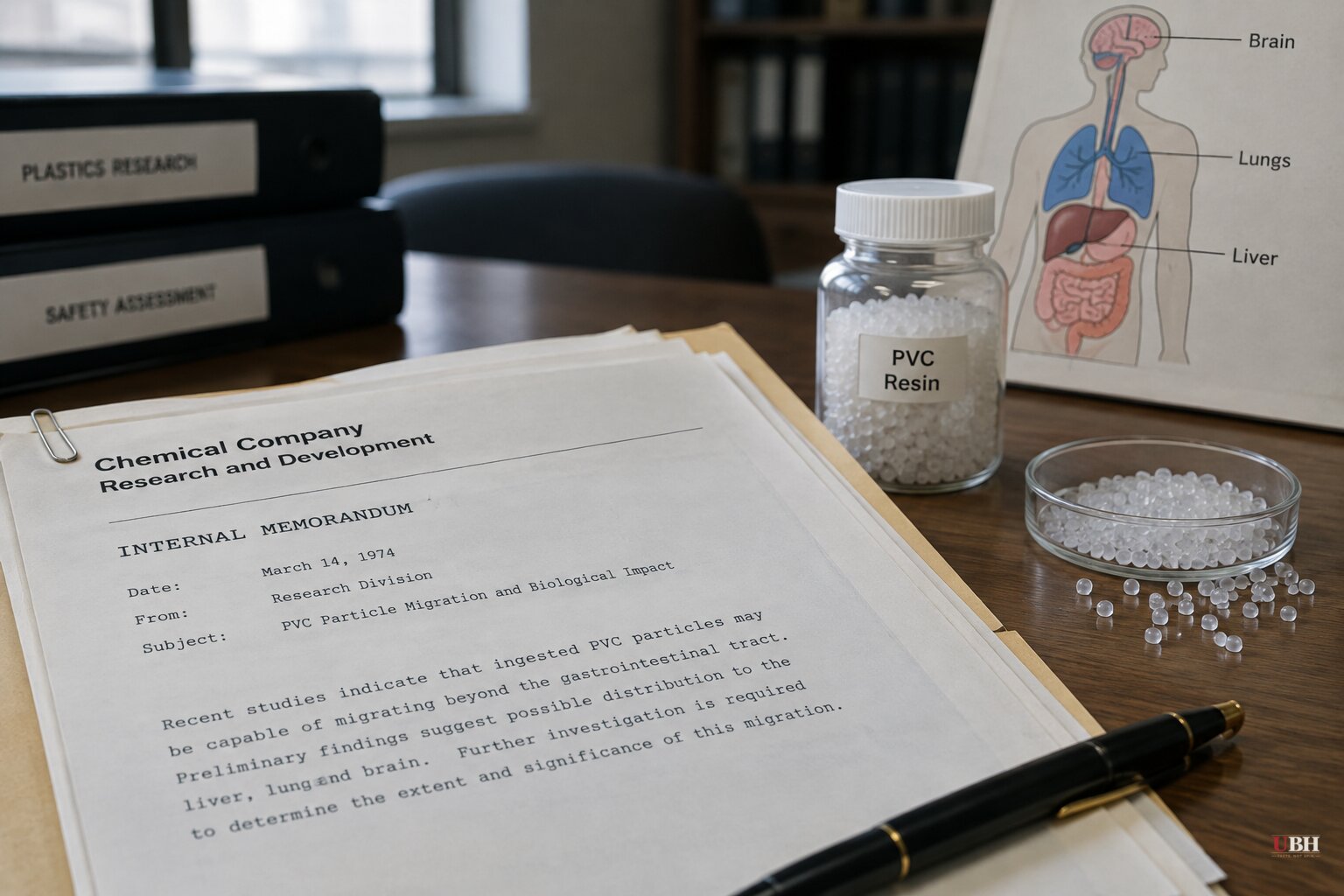
Fifty-two years ago, a German doctor stood up at a New York hotel and told a room of scientists that swallowed plastic does not stay in the gut. Chemical company executives took notes. Their memos are now public.
An investigation by the Los Angeles Times, published in late October, obtained internal correspondence among chemical company scientists and executives. The memos show the industry was aware of, and worried about, microplastic contamination of the human body for at least half a century.
The 1974 meeting
The trail starts at a scientific meeting in New York City on May 10 and 11, 1974. Gerhard Volkheimer, a gastroenterologist from Berlin, presented research showing that tiny bits of swallowed PVC (polyvinyl chloride, or vinyl) could slip through the intestinal lining of animals. The particles then traveled through blood and lymph to the brain, liver, lungs and other organs, in as little as two hours.
Volkheimer also fed human test subjects potato starch, which moves through the body much as PVC does. The starch turned up in their blood and in breast milk.
The word "microplastics" did not exist yet. It was coined in 2004.
According to the Times, government scientists in the room largely overlooked the presentation. Company scientists did not.
What the memos say
In 1975, a Union Carbide executive wrote that Volkheimer's study had "been cited often as a 'horror story' on ingesting PVC resin." He did not accept the findings. He pointed to a 1947 industry-sponsored study in which animals fed flakes of a PVC-like plastic called Geon 202 did not get sick.
The Times found that industry personnel kept referencing Volkheimer's work in internal documents through the 1970s, 1980s and 1990s. The documents surfaced during litigation and sit in archives at the University of California, San Francisco and Columbia University. The Times reported that the industry's concern included the potential effect on the plastic food packaging business.
The scientific picture today
Matthew Campen, a University of New Mexico professor of pharmaceutical research and a leading microplastics researcher, told the Times that the same process applies to any small, impermeable particle. That includes polyethylene, polypropylene and PET, the plastics that dominate today's market and the particles found in human bodies.
Researchers have linked those particles to heart disease, inflammation and cancer. Last year, scientists reported that the average human brain they studied held roughly the weight of a plastic spoon in micro- and nanoplastics.
A study published in Nature about two weeks before the Times investigation found some of the strongest evidence yet that microplastics cause biological damage. The authors wrote that their findings "challenge the prevailing paradigm of plastic inertness [and] identify a possibly overlooked mechanism for the detrimental effects of microplastics on health and the environment."
How the particles affect human health, though, remains an open question. Researchers are still working out the mechanism.
Industry pushes back
Tracey Woodruff, a Stanford professor of epidemiology and population health who reviewed the documents, said they show scientists and executives at major chemical companies knew and stayed silent while microplastics built up in human tissue. She compared it to industries that knew about greenhouse gases, asbestos and tobacco and did not act.
The American Chemistry Council, the industry's largest trade group, rejects that characterization. "Scientific debate over what the evidence shows is not silence. It is how sound science and effective policy advance," said Craig Davis, the council's senior director of plastics chemistry. He said the industry is committed to supporting independent research and policies that would advance microplastics science.
The documents do show a counterargument existed at the time. The Union Carbide executive cited a feeding study and disputed the "horror story." Whether that response was a good-faith scientific disagreement or a reason to wave off a warning is the dispute between Woodruff and the trade group.
Government scientists were also in that room in 1974, according to the Times, and the findings did not move them either.
Consumers are already adjusting
Public worry is not waiting on the science. A 2025 poll by the environmental group 5 Gyres found nine in 10 Americans are concerned about microplastics' effect on the planet and their bodies. Studies have shown coffee pods shed microplastics.
Companies are responding. Lavazza launched Tablì in the U.S. in June, a $129 machine that uses compressed coffee tablets instead of plastic-and-aluminum capsules. Its first release sold out, the company says. Keurig, which popularized plastic K-Cups in the 1990s, launched compostable AltaRounds pods and a new machine called the Alta in October. The new pods do not fit older machines.
Peter Giuliano of the Specialty Coffee Association told CNN that health worries about microplastics are one of three drivers, along with environmental concern and a sense that metal and glass feel more luxurious than plastic. CNN notes that more research is needed to establish actual harm.
What remains open
The memos establish what industry insiders knew about particle migration and when. They do not settle what microplastics do to people at the levels now found in tissue. That is the question the Nature authors and Campen's field are still working on, and it will decide whether the 1974 warning reads as a missed alarm or an unproven early hypothesis.
Sources used for this briefing
7 links from 7 independent newsrooms (syndicated copies of the same report count once)
These are the sources it draws on, linked so you can verify.


