
Unbiased headlines. Facts, not spin.
Unbiased Headlines is an independently owned news organization. We bring you the facts, not opinions, written fresh from 110+ named sources. Sources linked so you can verify it yourself.
 health
Notable (6/10)
Fresenius Signs 10-Year Deal With China's WuXi Biologics for Up to 37 Biosimilars
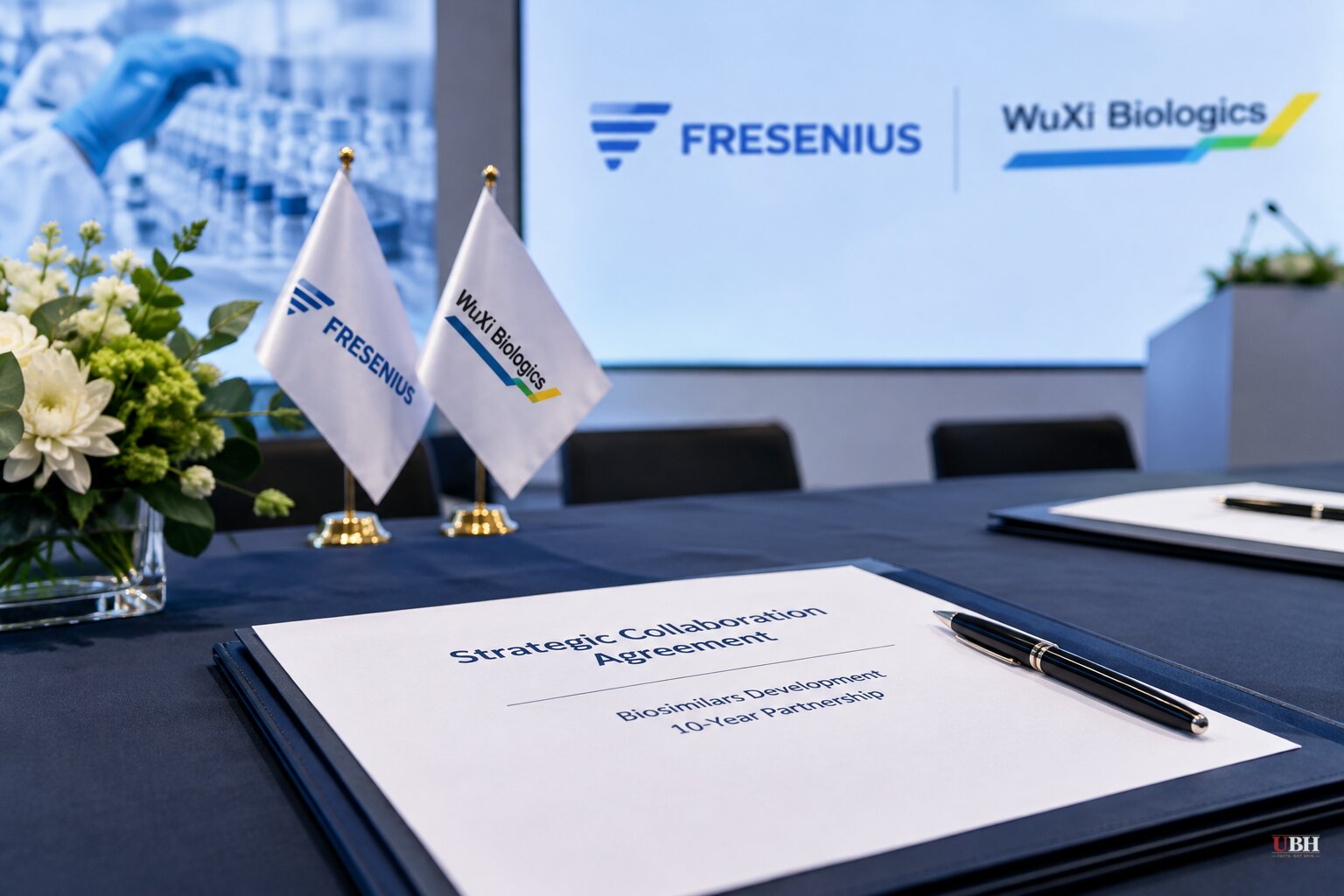
Fresenius has signed a decade-long exclusive development agreement with WuXi Biologics that gives it option rights on up to 37 biosimilar candidates. The German company announced the deal today, Nov. 2, and calls it the largest development agreement in the biosimilars industry to date.
The targets are originator drugs with more than €370 billion (about $414 billion) in combined list-price sales. If Fresenius exercises every option, its portfolio grows from 29 marketed and pipeline molecules to 66 across 13 therapeutic areas.
How the deal works
This is a fee-for-service arrangement. Fresenius picks which candidates to advance based on market size, development risk and expected returns, and pays WuXi Biologics for each one it selects.
Fresenius keeps exclusive global commercialization rights, the marketing authorizations and the full economics of any product that reaches market. It also decides where products are made, with the option of moving some to mAbxience, its Spain-based biosimilars unit. Fresenius took full control of mAbxience about a month ago.
WuXi Biologics, a Hong Kong-listed contract developer and manufacturer, will run development through its network in Europe, the United States, China and Singapore.
Fresenius disclosed no other financial terms. Jefferies analysts wrote in a Monday note that the structure appears to include no upfront or milestone payments.
"We are doubling down on our Biopharma business," Fresenius CEO Michael Sen said in the announcement. He called it "a disciplined, scalable way to potentially triple our portfolio while retaining economic ownership, strategic control and the flexibility to allocate capital to the most compelling opportunities."
The first two targets
Development will start with polatuzumab vedotin and teprotumumab.
Polatuzumab vedotin is Roche's antibody-drug conjugate Polivy, used in diffuse large B-cell lymphoma. Roche reported Polivy sales of CHF 1.47 billion in 2025, up 38% at constant exchange rates.
Teprotumumab is Amgen's Tepezza, a thyroid eye disease therapy. Amgen reported U.S. Tepezza sales of $1.758 billion in 2025, down 4% from 2024.
Polivy would be Fresenius's first ADC in a portfolio built on antibodies and other proteins. Its six U.S. biosimilars reference Humira, Prolia, Xgeva, Stelara, Neulasta and Actemra.
What the €370 billion figure means
The headline number is the combined sales of the brand-name drugs, not the size of the biosimilar market. European Biotechnology Magazine pointed out that the figure should not be equated with the future market available to biosimilars.
There is also a near-term cost. The magazine reported that spending on selected programs will weigh on the biopharma unit's short-term profitability, while the products are meant to add revenue and earnings later. Fresenius aims to double its biosimilar revenue to nearly €2 billion, according to the same account.
The competition is Sandoz. Sandoz is expanding under its "Bio100" initiative, and its biosimilars revenue grew 17% in the third quarter of 2026, driven by North America.
The China question
The deal puts a German drugmaker's growth plan in the hands of a Chinese-headquartered developer at a moment when Washington is treating Chinese biotech as a security issue.
According to Tech Times, WuXi AppTec, a legally separate company that shares brand heritage with WuXi Biologics, was placed on the Pentagon's 1260H list of "Chinese military companies" less than five months ago. Tech Times reports that WuXi Biologics itself has not been designated. It also reports that the Office of Management and Budget must publish its formal list of "biotechnology companies of concern" under the BIOSECURE Act by December 2026.
The argument for Fresenius is straightforward. WuXi Biologics is a separate legal entity from the designated company, Fresenius keeps control of commercialization and manufacturing location, and it pays only for programs it chooses. Tech Times describes the company as betting that WuXi Biologics' separate identity holds.
That bet is untested. Tech Times says the open question is whether WuXi Biologics remains a viable U.S. partner after December. Fresenius has not said how it would respond if the company were named.
Washington has been escalating against Chinese biotech elsewhere. The Department of Homeland Security has moved to block imports from BGI Group, BGI Genomics and MGI Tech, alleging they source materials from Xinjiang or work with the regional government on forced labor involving Uyghurs and other persecuted groups. The Treasury Department has also proposed new limits on U.S. investment in Chinese biotechnology.
BGI rejects the allegation. "We firmly oppose all forms of forced labor," the company said, adding that it has not engaged in any. China's Ministry of Commerce called the listings "political manipulation" and "bullying under the guise of 'protecting human rights,'" and said China "will take necessary measures to firmly safeguard its interests."
Those actions involve different companies and a different legal basis than the WuXi Biologics deal, and no source links them to it. They show the direction of U.S. policy as Fresenius commits to a ten-year relationship.
What comes next
Fresenius reports third-quarter earnings on Nov. 4, the first chance for analysts to press management on the deal's costs and on regulatory exposure. The OMB list due in December will show whether WuXi Biologics appears on it.
Until then, Fresenius holds options, not commitments. It has paid for no candidate beyond the two it named as first priorities.
Sources used for this briefing
7 links from 7 independent newsrooms (syndicated copies of the same report count once)
These are the sources it draws on, linked so you can verify.


