
Original briefings. Zero spin.
Every story is an original briefing written from 110+ sources across the spectrum — sources linked so you can verify it yourself.
 energy
Breaking / Critical (9/10)
Event date: September 11, 2026
energy
Breaking / Critical (9/10)
Event date: September 11, 2026
Oil Nears $100 a Barrel and Asian LNG Prices Hit a 2022 High as the Iran War Reshapes Global Energy Markets
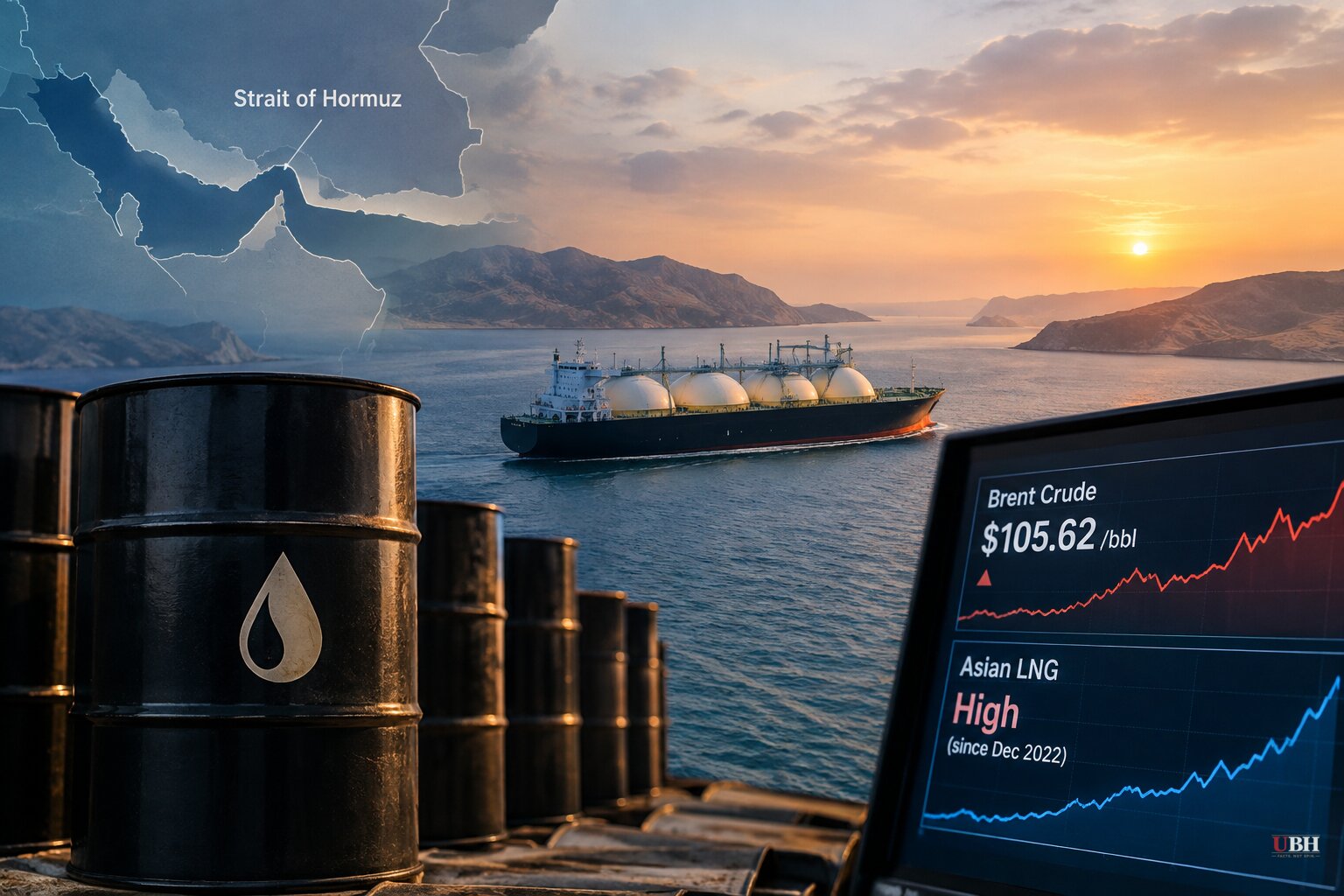
Brent crude closed at $105.62 a barrel and West Texas Intermediate at $100.87 on Sept. 11, according to data cited by Daily Sabah. That's up from $76.30 and roughly $75 a barrel, respectively, on Feb. 27, the day before the U.S.-Iran war began.
Asian spot LNG prices told a similar story. The average price for October delivery into northeast Asia hit $26.00 per million British thermal units, the highest level since December 2022, according to Baird Maritime, citing Reuters. Klaas Dozeman, a market analyst at Brainchild Commodity Intelligence, said attacks on ships in the Middle East meant "very little LNG was able to make its way out of the Persian Gulf," forcing South Asian buyers to bid up prices for scarce spot cargoes.
Kogas, South Korea's state gas buyer, purchased 14 to 20 spot cargoes for November-to-January delivery, and Bangladesh bought 20 cargoes for October through June, Baird Maritime reported. Ronald Pinto, a gas research analyst at Kpler, said prices are likely to stay elevated as "renewed Strait of Hormuz escalation, rising TTF, and firmer winter procurement interest" collide with limited supply.
Washington's posture: pressure, not escalation, for now
Fox News reported that Secretary of State Marco Rubio has told foreign counterparts the current U.S. posture will hold "for the time being" unless Iran strikes first, citing Axios. A second official told Axios that posture is expected to remain until after the November midterm elections, when another military campaign could be reconsidered. Secretary of Defense Pete Hegseth said Monday he wasn't ruling out renewed strikes, according to The Associated Press.
Treasury Secretary Scott Bessent has meanwhile rolled out what he called "an economic onslaught against Iran's financial connections," adding sanctions on top of an existing blockade of Iranian ports, Fox News reported. The Navy has separately warned sailors returning from the region, including those aboard the USS Abraham Lincoln, to scrub military details from social media after officials said hostile actors were using the information to surveil and target troops.
Oil prices had briefly eased into the $80 range in August as talks between Iran and Oman raised hopes the Strait of Hormuz could reopen, Reuters reported via Fox News. That relief didn't hold. Prices climbed back above $100 by mid-September as attacks resumed, according to Daily Sabah's Sept. 11 figures.
America's oil boom collides with a shrinking global forecast
The U.S. Energy Information Administration projects domestic crude output will hit a record 13.8 million barrels a day in 2026, topping last year's 13.7 million bpd record, per an EIA statement dated Sept. 10 cited by the Epoch Times. Growth is concentrated in the Gulf of America and the Permian Basin, with four new Gulf projects, including the Whale, Ballymore, Shenandoah and Salamanca floating production units, driving a 10% output increase in the first half of 2026 compared with a year earlier.
That production surge is running against a very different global forecast. The International Energy Agency said global oil demand is expected to shrink by 2.5 million bpd in 2026, citing the "protracted US-Iran diplomatic standoff and renewed attacks" in the Gulf and the Bab el-Mandeb strait as reasons it cut its supply and demand projections, according to the Epoch Times. The EIA is a U.S. government agency tracking a producer nation's output, while the IEA represents mostly oil-importing member countries. Both are forecasting the same war from different institutional vantage points, and neither forecast is a certainty.
Asian buyers squeezed, some pivoting to crude or renewables
Developing Asian nations are facing a roughly $7 billion gas bill tied to the LNG price spike, according to a Bloomberg report cited by Crypto Briefing, prompting some governments to reconsider their reliance on gas altogether. Prediction markets tracked by Crypto Briefing put the odds of crude oil hitting a fresh all-time high at just 1.9% by Sept. 30 and 13.5% by year-end, suggesting traders don't expect the Hormuz disruption to push prices past 2008-era records even if it keeps them elevated.
Europe is leaning the other direction: toward renewables. Germany got a record 58% of its electricity from renewable sources in the first half of 2026, and Europe added 8.8 gigawatts of new wind capacity, up 33% from a year earlier, according to WindEurope data cited by Daily Sabah. The European Investment Bank has argued the clean-energy transition insulates the continent from exactly this kind of shock.
But Southeast Asia's gas story is more complicated than a straight retreat from LNG. Wood Mackenzie analysts told OilPrice that AI data center construction could push the region's annual LNG demand growth up 16% through 2035, since gas turbines remain the only reliable 24/7 power source while battery storage is still immature there. Singapore's grid, already 95% gas-dependent, could hit 100% LNG reliance by 2035 as regional pipeline gas dries up, Wood Mackenzie's Fadhlullah Omarali said.
Washington is betting on both LNG and nuclear power as a counterweight to Beijing's regional influence. The U.S. Trade and Development Agency is working with the Philippines' San Miguel Corp. and Manila Electric to bring in more LNG and study small modular reactors, USTDA head Thomas Hardy told Bloomberg, as part of the Luzon Economic Corridor investment push backed by the U.S. and Japan. "If it's good for the Philippines, it's good for all of us," Hardy said, while acknowledging the effort may also serve to counter China's supply-chain leverage.
The open question is whether winter procurement in Japan, South Korea and Bangladesh keeps bidding LNG prices higher through the coldest months, or whether a diplomatic opening between Washington and Tehran, the kind briefly floated through Oman in August, reopens the Strait of Hormuz before then. Kpler's Ronald Pinto expects the current price pressure to hold at least through next week. Nobody is yet forecasting how long past that.
Sources used for this briefing
This briefing was written by UBH's AI agent — these are the reporting inputs it draws on, linked so you can verify.


