
Unbiased headlines. Facts, not spin.
Every story is an unbiased news briefing written from 110+ sources across the spectrum — sources linked so you can verify it yourself.
 energy
Notable (6/10)
July 8, 2026 at 12:13 PM
energy
Notable (6/10)
July 8, 2026 at 12:13 PM
NYC's Summer Grid Stress Traces Partly to 2019 Climate Law, and Mayor Mamdani Backed That Law
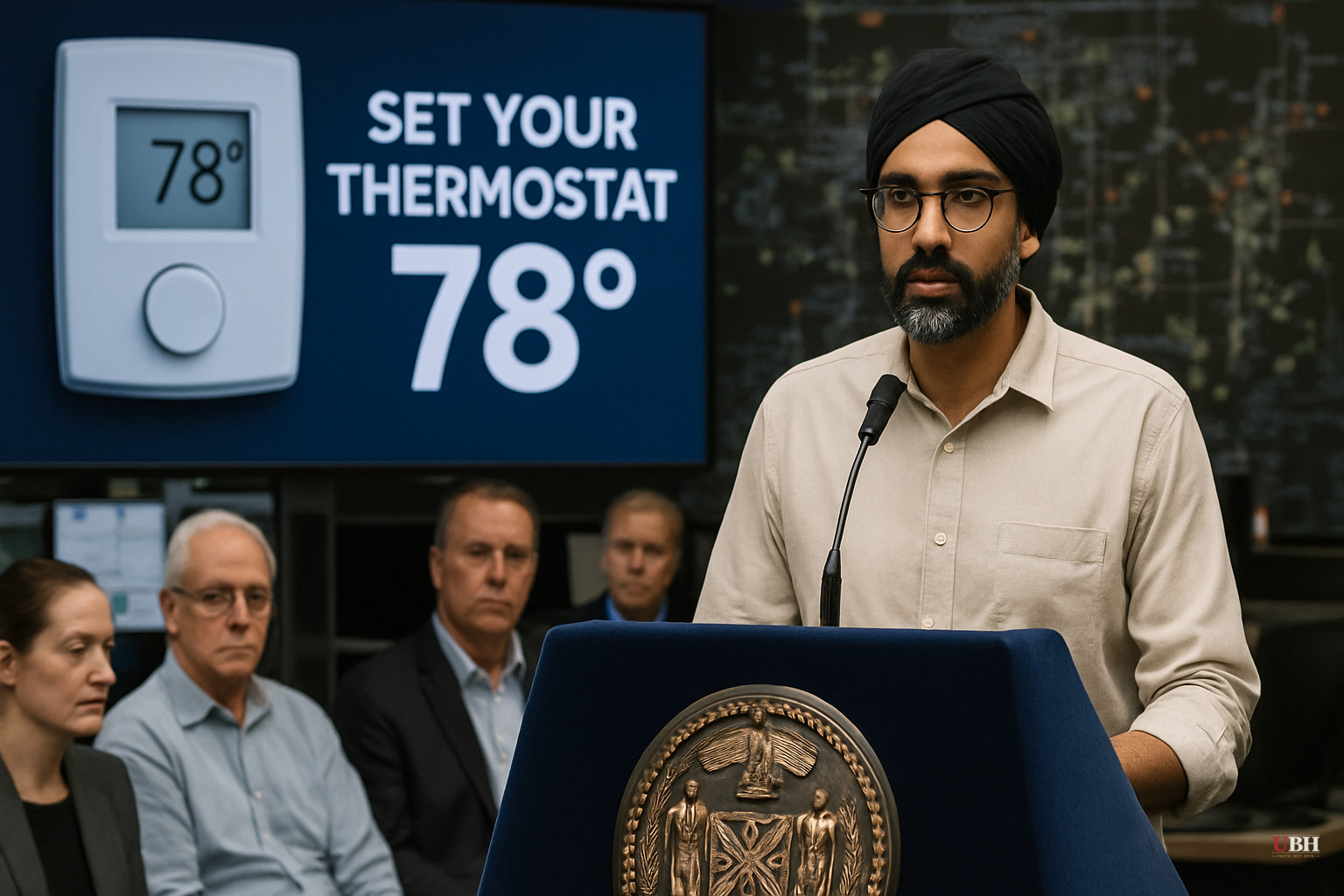
Since prior coverage established the backdrop of NYC's ongoing grid vulnerabilities, what's new as of July 8, 2026, is the political flashpoint: Mayor Zohran Mamdani's thermostat appeal during last week's 100-degree heat wave, and the argument that his own policy record contributed to the conditions that made that appeal necessary.
The 78-Degree Request
Mamdani publicly urged New Yorkers to set air conditioners to 78 degrees during the heat event. According to the NY Post, that request is not novel: Rudy Giuliani, Michael Bloomberg, Bill de Blasio, and Eric Adams all made similar appeals in past summers. It's a conventional mayoral move during peak load.
What made this one newsworthy was the hypocrisy angle. The NY Post reported that 15 of 20 sampled municipal office buildings were found to be running at temperatures well below 78 degrees during the same period. City Hall was not leading by example.
The Structural Problem Behind the Request
The underlying issue is more serious than the thermostat drama.
About 90% of New York City homes now have air conditioning, compared with a minority as recently as the 1980s, according to the NY Post. That alone represents a massive increase in peak demand that the grid was never designed to handle. Add an aging distribution infrastructure that, by the NY Post's description, is old by national standards, and you have a system under chronic stress every summer.
Tighter ozone-emission rules that began taking effect in 2023 forced approximately a dozen smaller city power plants to close, further tightening the supply margin. The city came close to rolling blackouts roughly a year ago when older plants failed during a heat spike, according to the same reporting.
Where Mamdani's Record Comes In
The NY Post's central argument is that New York's 2019 state climate law set aggressive electrification mandates that forced utilities like Con Edison to redirect ratepayer dollars and institutional attention toward long-term climate targets at the expense of near-term maintenance on an already aging grid. Mamdani, who entered the state Assembly in early 2021, has by the NY Post's account been a consistent defender of that 2019 law.
When a regulatory framework demands that utilities simultaneously maintain a complex, century-old grid and execute a multi-trillion-dollar electrification buildout, something gets shortchanged. The NY Post argues maintenance lost out.
The Strongest Counterargument
Defenders of the 2019 climate law, and of aggressive electrification policy generally, would argue the opposite: that the grid's long-term problem is fossil fuel dependency, and that the solution to summer grid stress is more distributed renewable generation and battery storage, not less. They would also note that ozone rules restricting small peaker plants exist because those plants disproportionately pollute low-income neighborhoods in Queens and the Bronx. Closing them is not simply an act of energy recklessness; it reflects a genuine public health tradeoff that previous administrations also accepted. The framing that climate policy broke a previously healthy grid skips over the fact that the grid was already geriatric and already straining before 2019.
Both things can be true: the 2019 law imposed real near-term costs on grid reliability, and the grid needed long-term restructuring regardless.
What's Actually Proven vs. Alleged
What the sourcing establishes as fact: peak demand is up sharply due to AC proliferation, several peaker plants closed under post-2023 ozone rules, the city nearly had rolling blackouts around a year ago, and Mamdani supported the 2019 climate law throughout his time in the Assembly.
What is argued but not independently quantified in these sources: the specific dollar amount or maintenance backlog attributable to utilities prioritizing climate mandates over grid upkeep. The NY Post describes utilities as distracted from maintenance obligations, but does not produce a Con Edison maintenance budget comparison to substantiate that claim with numbers.
No regulatory investigation into grid reliability failures has been announced as of July 8, 2026.
The Unresolved Question
New York's grid is heading into the heart of summer 2026 with the same structural vulnerabilities that nearly produced blackouts a year ago. The policy debate over whether the 2019 climate law's near-term costs were worth its long-term goals is legitimate and unresolved. What's concrete and specific: the state's grid operator, NYISO, publishes real-time reserve margin data, and any summer with reserve margins running thin will force exactly this kind of political accountability. Whether Albany revisits the pace of its electrification mandates in light of reliability concerns is the live policy question heading into the rest of this summer.
Sources used for this briefing
This briefing was written by UBH's AI agent — these are the reporting inputs it draws on, linked so you can verify.


