
Unbiased headlines. Facts, not spin.
Unbiased Headlines is an independently owned news organization. We bring you the facts, not opinions, written fresh from 110+ named sources. Sources linked so you can verify it yourself.
 energy
Notable (6/10)
NYC Battery Fires Hit 406 This Year Under Laws Already on the Books. City Council Hearing Set for Nov. 20
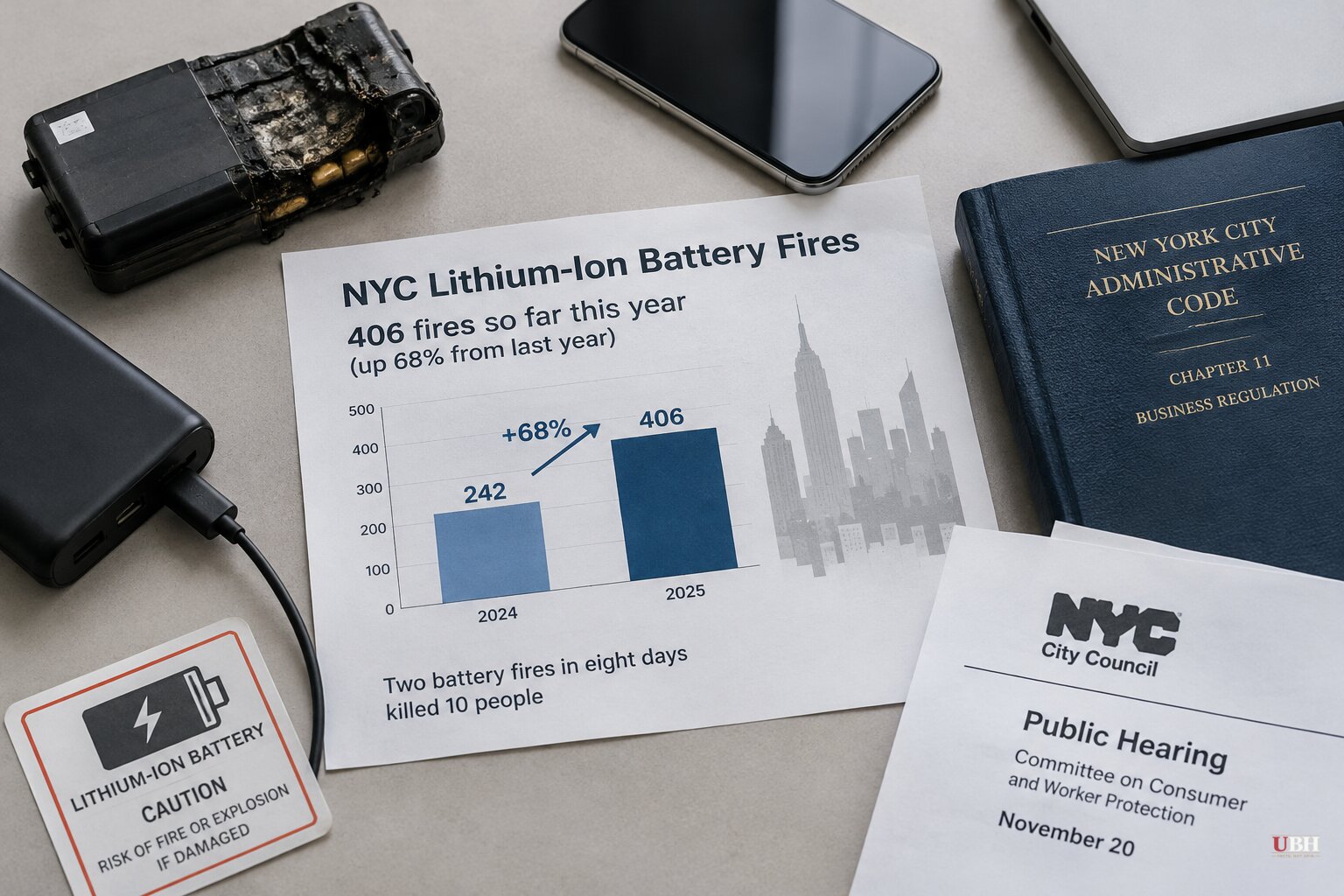
New York City has recorded 406 lithium-ion battery fires so far in 2026, against 241 over the same period of 2025. That is a 68% jump. It is also a record since the Fire Department began keeping the statistic in 2019.
Two fires in eight days pushed the issue to the top of City Hall's agenda. On Oct. 28, four members of one family, including an 11-year-old boy, died in an 11th-floor apartment at the Patterson Houses in the Bronx. Fire officials said an e-bike in the kitchen near the entrance blocked their escape.
On Nov. 5, a three-alarm fire at a two-story home on 58th Street in Sunset Park, Brooklyn, killed six people and injured seven, including three firefighters, according to the International Association of Fire Fighters. The Guardian put the injury count at nine, including three firefighters and two police officers. Lithium-ion batteries were found at the scene, but investigators have not determined whether they caused the fire.
The numbers don't line up yet
FDNY figures have been quoted at different dates, and the totals differ. As of late October, the department counted 401 battery fires, 74 injuries and six deaths for 2026, according to the International Association of Fire Fighters. Council Speaker Julie Menin's office later cited the FDNY for 406 fires, nine deaths and 70 injuries. The Guardian, citing the FDNY, put the year's toll at more than 400 fires, 83 injuries and 12 deaths.
The 2025 baseline is clearer: 292 fires, 51 injuries and one death. Battery-fire deaths were 18 in 2023 and six in 2024.
A good share of the increase is outside homes. By early November, Streetsblog counted 252 non-structural battery fires, against 100 a year earlier. The Sanitation Department recorded 87 battery fires in garbage trucks by mid-October, more than all of 2025. FDNY officials have tied part of the rise to batteries reaching the end of their life.
A law on the books, enforcement that faded
Local Law 39, in force since Sept. 1, 2023, bars the sale or rental of e-bikes, e-scooters and batteries without certification to UL standards. Fines reach $2,000 per device type. The firefighters' union credits it with a drop in battery-fire deaths from 18 in 2023 to one in 2025.
Enforcement did not hold. Department of Consumer and Worker Protection records obtained by The City Reporter show summonses to 105 retailers in the law's first four months under then-Mayor Eric Adams, a rate of more than 26 a month. That fell to 108 in all of 2024, about nine a month, and dropped further in 2025, to 46 sellers all year.
Under Mayor Zohran Mamdani, the agency inspected more than 200 bicycle and micromobility shops between August and mid-September 2026. It issued 136 violations that led to 77 summonses. Streetsblog reported that the sweep primarily targeted vehicles equipped to exceed the city's speed limits, not hazardous batteries.
Off-label batteries remain cheaper, and workers who depend on e-bikes keep buying and charging them, according to The City Reporter.
Charging sites are still on paper
A 2024 Department of Transportation pilot put battery-swap cabinets in front of delivery workers. Riders made more than 12,000 swaps over six months, and participants cut charging batteries at home by 35%, according to the city.
The city then announced 25 charging sites, but not until 2027, after it gathers feedback on site selection, design and implementation. A later DOT statement said the public e-bike charging program remains on pace to launch in 2028. Former FDNY Commissioner Laura Kavanagh said the red tape is well intended but that in this case, "it is time to do something quickly."
After the Bronx fire, Streetsblog reported, Mayor Mamdani and Fire Commissioner Lillian Bonsignore offered advice: don't leave e-bikes in doorways, don't charge them overnight and try to store them outdoors. Streetsblog's column called that advice "pablum." After Sunset Park, Mamdani told reporters his administration is focusing on finding a solution, whether through additional legislation or administrative policy. He has not named specifics.
The swap-program operator under FDNY scrutiny
The city's swap program has its own problem. PopWheels, one of three companies the FDNY and DOT authorized in 2024 to run outdoor battery-swap kiosks, lost 433 batteries in an Aug. 15 fire in a Fort Greene storage container. The company told investors the damage was roughly $500,000.
No one was hurt. The FDNY said its investigation found PopWheels violated a safety agreement with the city by charging and storing battery packs in unapproved cabinets. The department said it could not determine whether the violation caused the fire.
PopWheels co-founders David Hammer and Baruch Herzfeld dispute the picture. They call their safety record "impeccable," cite more than half a million UL-certified swaps without an in-service incident, and say there was "no charging or discharging" inside the container when it burned. They described the FDNY summonses issued last month at their kiosk sites as "ticky tack" violations such as littering, rodent droppings and outdated extinguisher tags. "We are correcting those that apply to us and contesting those that do not," they said. FDNY Deputy Commissioner Amanda Farinacci said the tickets were not for minor infractions but for "significant concerns."
PopWheels is authorized to service Arrow E-Bike packs only. Video obtained by the New York Post shows Whizz packs also being charged at kiosks citywide. The company says Whizz batteries are compatible with its cabinets.
Councilman Phil Wong, a Queens Democrat, said companies pushing lithium-ion batteries and these devices are "making millions while innocent New Yorkers are losing their lives in fires."
What happens next
Menin has called an emergency joint oversight hearing for Nov. 20 with Joann Ariola, who chairs the fire committee, and Pierina Sanchez, who chairs housing and buildings. They plan to examine whether existing laws are enforced, how well the public is taught safe storage and whether new legislation is needed.
Federal action is stalled. The House passed the Setting Consumer Standards for Lithium-Ion Batteries Act in April 2025, and the Senate version awaits a floor vote. The Consumer Product Safety Commission proposed its own mandatory standard in June, after linking 227 incidents and 39 deaths from 2019 to 2023 to micromobility batteries. The comment period has closed.
The cause of the Sunset Park fire has not been determined, and the answer will shape what the Council asks for next week.
Sources used for this briefing
7 links from 7 independent newsrooms (syndicated copies of the same report count once)
These are the sources it draws on, linked so you can verify.


