
Unbiased headlines. Facts, not spin.
Unbiased Headlines is an independently owned news organization. We bring you the facts, not opinions, written fresh from 110+ named sources. Sources linked so you can verify it yourself.
 finance
Breaking / Critical (9/10)
Event date: November 6, 2026 ·
Nvidia Falls 9.3% to $181.60 as S&P 500 Posts Worst Day Since April 2025
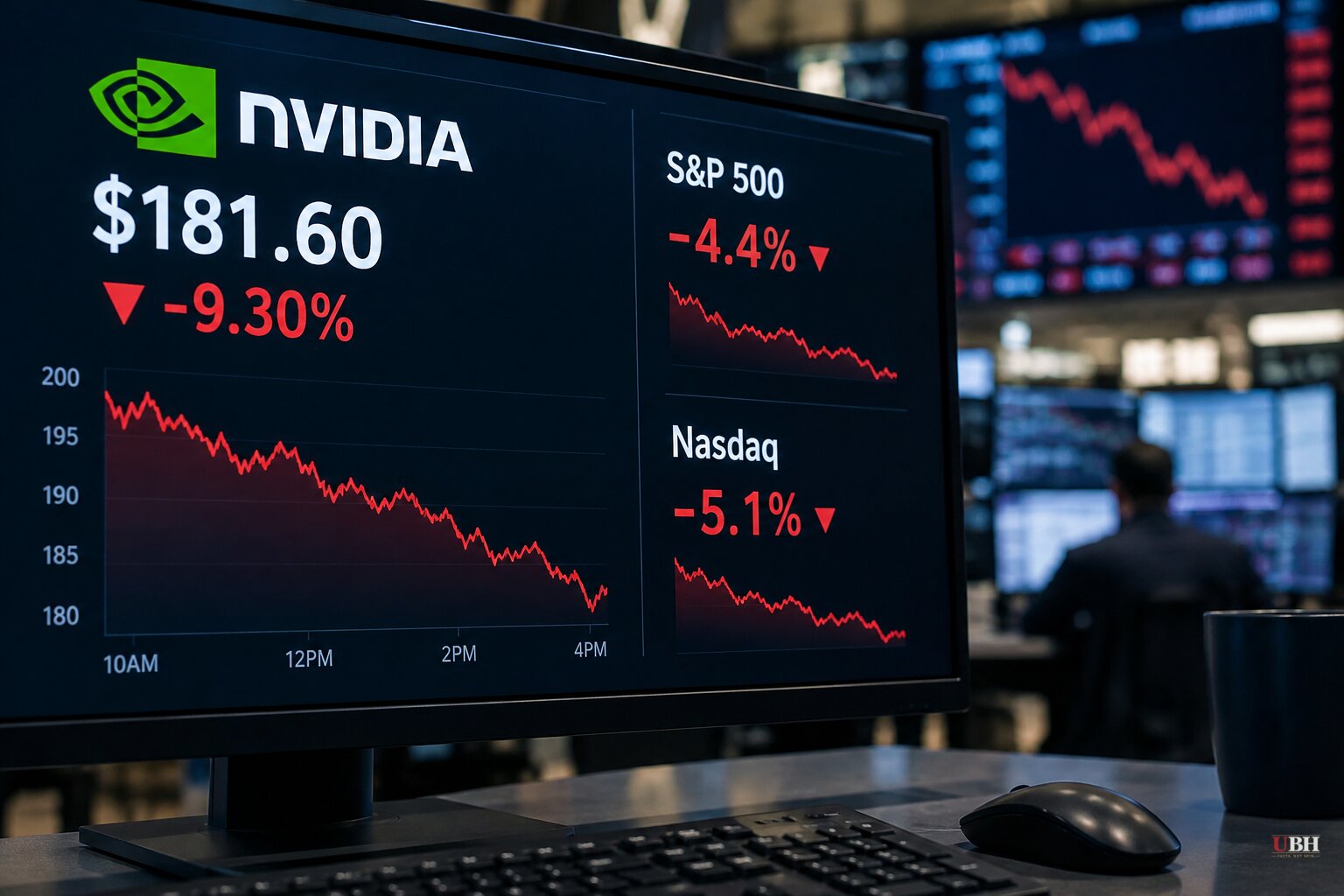
Nvidia's stock closed Thursday, Nov. 5, at $181.60, down 9.26% on the day. It is the chipmaker's lowest close since April.
The shares sit roughly 24% below the October record of $243.37 and about 11% below their 200-day moving average of roughly $204.66. The drop erased Nvidia's remaining 2026 gain. The stock is now down 2.6% for the year, after annual gains of roughly 39%, 171% and 239% in the previous three years.
A rout across the market
Nvidia was not alone. The S&P 500 fell 4.4% Thursday, its worst day since President Donald Trump's "Liberation Day" tariffs hit markets in April 2025. The Dow Jones Industrial Average lost 1,833 points, or 3.4%.
The Nasdaq composite dropped 5.5% and finished 11.9% below the all-time high it set last month. That is correction territory. Nvidia was the heaviest single weight on the S&P 500.
Other chip names took bigger hits. AMD, Micron and Marvell each fell roughly 17%, and the semiconductor index lost about 12%.
The selloff spilled into Asia on Friday. Japan's Nikkei 225 fell more than 6% at the open and was down 5.7% at 57,576.63 by midday. South Korea's Kospi dropped 7.4%, with Samsung Electronics down 7.9% in morning trading.
What investors are pointing to
No single cause has been established. Several pressures overlap.
Tuesday's midterm elections are one. Democratic wins included candidates who opposed data-center expansion in Texas and Georgia. That raised the prospect that governments could force pauses on new construction. UBS estimated that if pauses spread, delays could hit a substantial share of the U.S. data-center capacity planned for 2028.
AP reported that voters across party lines say they are wary of AI and dislike the power-bill increases tied to data centers. Fewer data centers would mean fewer AI chip purchases, along with less demand for electricity and equipment.
Financing is another. AI stocks have swung for months on worries that building data centers is getting too expensive as borrowing costs rise. In mid-October, CoreWeave, a computing-power provider that leans heavily on Nvidia GPUs, fell more than 15%. In late October, Alphabet and Amazon reported free cash flow under pressure from AI capital spending.
Melius Research cut its Nvidia price target to $315 from $420 while keeping a Buy rating. The firm pointed to how Nvidia's customers will pay for their buildouts. "The amount of paper is so large it has become the primary risk," Melius wrote.
The bubble argument, in the analysts' own words, holds that AI stock prices ran too high. Bearish analysts also cite custom-silicon competition, lost China market share, stressed "neocloud" customers and rising implied default risk.
The case that the business is fine
Nvidia's reported numbers are not weak. Fiscal second-quarter revenue was $96.2 billion, up 106% from a year earlier, including $89 billion from data centers.
One analysis put the stock at roughly 23 times forward earnings, with analysts expecting about 95% earnings growth in fiscal 2027. One analyst says customer demand still exceeds Nvidia's production capacity. Ark Invest reportedly bought Nvidia shares during the retreat.
Trading indications Friday pointed to a rebound of more than 4% in premarket. Those were premarket indications, not a regular-session close. Seeking Alpha counted this as Nvidia's sixth straight weekly decline, after its worst monthly drop of the year in October.
The wealth hit
Jensen Huang's estimated fortune fell $15.1 billion Thursday to $150.9 billion. He dropped from ninth to 13th on the Bloomberg Billionaires Index.
The rest of the chip sector shows the selling was not uniform. Intel fell 28.58% Thursday, its worst day since the 1970s. The cause there was the company's own fourth-quarter guidance of 25 cents a share on $15 billion to $16 billion in revenue, against expectations of 43 cents and $17.1 billion. Intel cited a plant shutdown in Israel and soft PC demand.
The technical picture
TradingKey's analysis flags support between $175 and $180. It says a decisive break below $175 risks a further 10% to 12% slide toward $160 to $165. That is one analyst's technical read, not a forecast anyone has to meet. TradingView described $200 and the 200-day average as the recovery markers.
What comes next
Nvidia reports fiscal third-quarter results after the market closes Tuesday, Nov. 17. The company previously guided to revenue of $108 billion, plus or minus 2%, excluding China data-center compute sales.
Investors will watch for any change in AI capital-spending plans at Microsoft, Amazon and other big customers. They will also watch for any word on U.S. export controls. Whether the data-center pauses voters and local officials are now discussing turn into real project delays remains unsettled. Nvidia's results and guidance will show how much of that risk shows up in its order book.
Sources used for this briefing
7 links from 7 independent newsrooms (syndicated copies of the same report count once)
These are the sources it draws on, linked so you can verify.


