
Unbiased headlines. Facts, not spin.
Unbiased Headlines is an independently owned news organization. We bring you the facts, not opinions, written fresh from 110+ named sources. Sources linked so you can verify it yourself.
 finance
Major Story (8/10)
Event date: November 6, 2026 ·
Kospi Hits Circuit Breaker, Nikkei Falls 5.7% as AI Selloff Spreads Across Asia
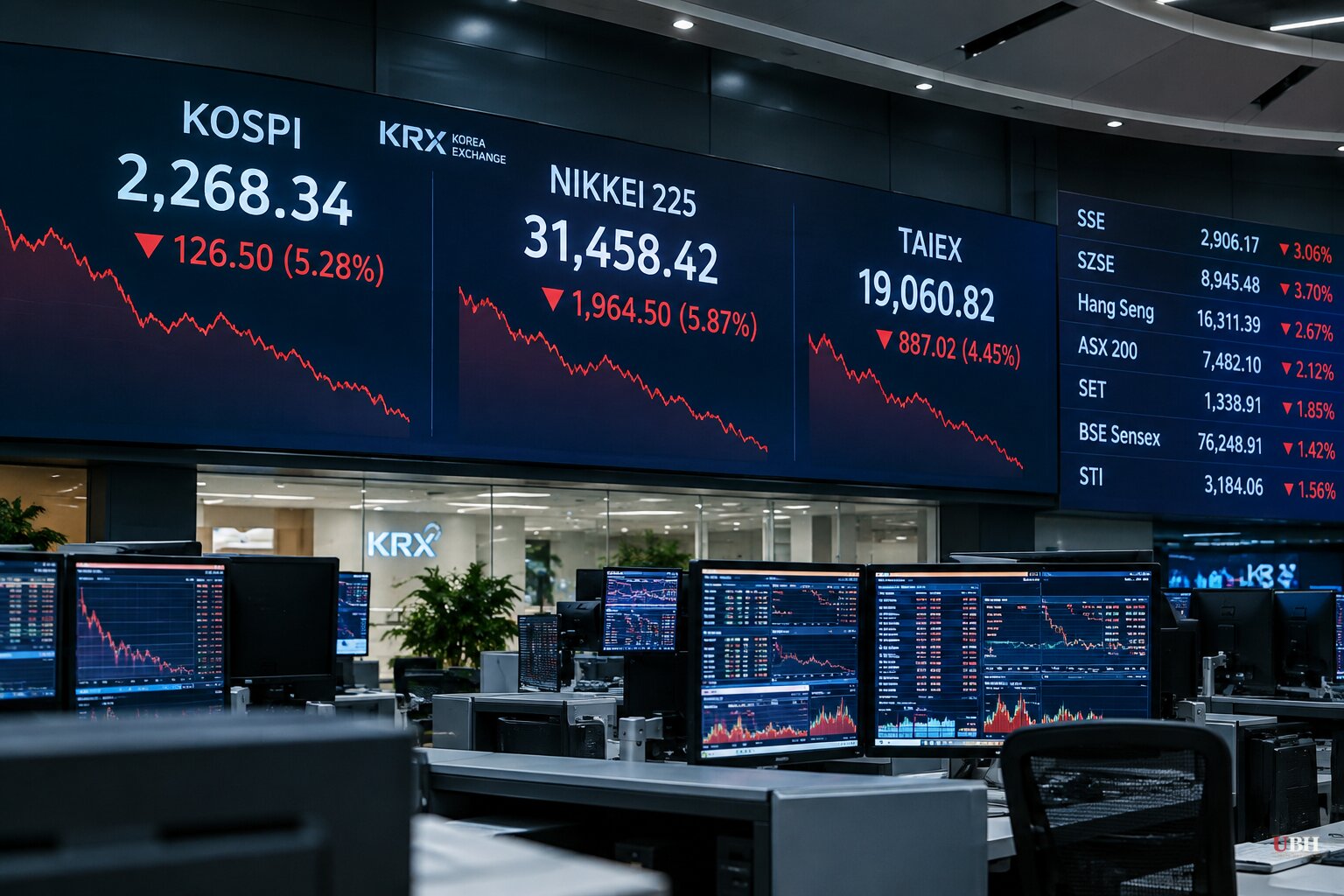
Thursday's AI-led rout on Wall Street hit Asia hard on Friday, Nov. 6. Chip-heavy markets took the worst of it.
South Korea's Kospi fell as much as 8.8% in early trading, which triggered a circuit breaker. It finished the session down about 6%. Samsung Electronics and SK Hynix each plunged more than 6%, according to one report. An earlier report from early trading put their losses at more than 9%.
Japan's Nikkei 225 tumbled 5.7%. Taiwan's benchmark sank 6.2%, its biggest drop in more than a year, dragged down by Taiwan Semiconductor Manufacturing Co. The MSCI Asia Pacific Index declined 4.2%.
What is driving the selling
The trigger was Thursday in New York. The S&P 500 fell 4.4%, its worst day since the April 2025 tariff meltdown. The Nasdaq 100 dropped 6.4% and lost $2.3 trillion in value, its worst session since March 2020. A gauge of chip giants tumbled 12%, with Nvidia, Qualcomm and Arm among the biggest decliners.
The Philadelphia Semiconductor Index is down almost 16% this week, on track for its worst week since April 2025.
The stated reason is politics. Investors fear that Democrats, after sweeping Congress in the midterms, will push tighter regulation of the AI industry and the data centers that power it.
The Texas example is specific. Newly elected Democratic Gov. Gina Hinojosa has called for an immediate moratorium on data center development. Bloomberg reported that her win, along with other Democratic gubernatorial victories, could leave half of proposed U.S. AI data center additions exposed to stricter local scrutiny.
Earlier in the week, markets had bet the opposite way. Investors first wagered that the Democratic sweep would hasten an end to the Iran war. That trade was overwhelmed by the data center fears. U.S. oil climbed above $91 a barrel after jumping 2.7% on Thursday.
Strategists see more pain, and some see a bargain
Anna Wu, founder of Floodlines Research, called it a "blue trade" panic pricing in policy risk. She said there is "plenty of chip and equipment exposure still to unwind" and that sentiment "could weaken further until the chip side gets a reason to rally."
Michael O'Rourke of JonesTrading said the data center slowdown "is going to be real" and that the earnings estimates behind chip valuations "are no longer valid." "Investors have no idea where those estimates will reset," he said. They are de-risking until clarity returns, "which won't be for some time."
Goldman Sachs' stock trading desk was flooded with calls from investors asking how much deeper the selloff could go. Buyers were scarce, with long-only investors frozen again.
Not everyone reads it as a fundamentals problem. Claudio Piron, who runs Asia FX and rates strategy at Bank of America Global Research, said Taiwan's currency has the strongest link in Asia to AI-themed ETFs. That means its slide reflects investors unwinding positions more than any economic weakening. He pointed to large current-account surpluses in South Korea and Taiwan as "substantial" support. He called current levels an opportunity to go long the won and the Taiwan dollar, and he projects dollar-won at 1,330 by year-end.
Peter S. Kim, global strategist at KB Financial Group, called the Kospi's drop an entry point for patient buyers.
Futures on the Nasdaq gauge gained 0.7% in early Asian trade, and 0.9% in a later report. That was a sign markets may be starting to stabilize, not a recovery.
Money looks for somewhere else to go
The rout is already changing how some investors position in Asia. Aberdeen Investments favors markets driven by domestic growth, including India and Vietnam, and sees upside in Chinese technology firms. Allianz Global Investors is looking at healthcare and consumer companies.
Hao Hong, chief investment officer at Lotus Asset Management, is long Hong Kong equity futures and long precious metals. He is betting against oil and petrochemical firms. A Hong Kong gauge tracking mainland companies gained 5.2% in a recent week, its best since March 2025.
Rajeev De Mello of Gama Asset Management said he expects investors to diversify and cut their AI concentration. That would support China and other markets "where valuations are less demanding." He added that India's dependence on imported energy remains a headwind.
India's numbers show the shift. Global investors have pulled a record $29 billion out of Indian stocks in 2026. The reasons cited were the market's limited AI exposure, expensive valuations and higher energy prices.
Since early October, Indian equities have risen nearly 10%. Tech-heavy Asian markets have fallen more than 7% over the same stretch. The Nifty 50 trades at about 17.5 times forward earnings, down from 21 at the start of the year. The MSCI Asia Pacific Index trades at about 10 times.
Uday Kotak, founder of Kotak Mahindra Bank, said in a Diwali-eve address Thursday that global companies had borrowed heavily for AI plans, producing "significant overvaluation in many cases." "If that reverses, India could benefit from reverse flows as it builds its own AI capability," he said. The Sensex rose more than 2% Thursday on lower crude prices and the midterm result.
What comes next
It is unclear whether the data center restrictions that spooked investors will become actual policy. Hinojosa has called for a moratorium in Texas, but no source describes one in force. Until that is clear, strategists such as O'Rourke say chip earnings estimates have no reliable anchor.
Sources used for this briefing
7 links from 5 independent newsrooms (syndicated copies of the same report count once)
These are the sources it draws on, linked so you can verify.


