
Unbiased headlines. Facts, not spin.
Every story is an unbiased news briefing written from 110+ sources across the spectrum — sources linked so you can verify it yourself.
 energy
Major Story (7/10)
June 29, 2026 at 05:34 AM
energy
Major Story (7/10)
June 29, 2026 at 05:34 AM
Nuclear, Renewables, and Secured Power Are Now the Gatekeepers of the AI Build-Out
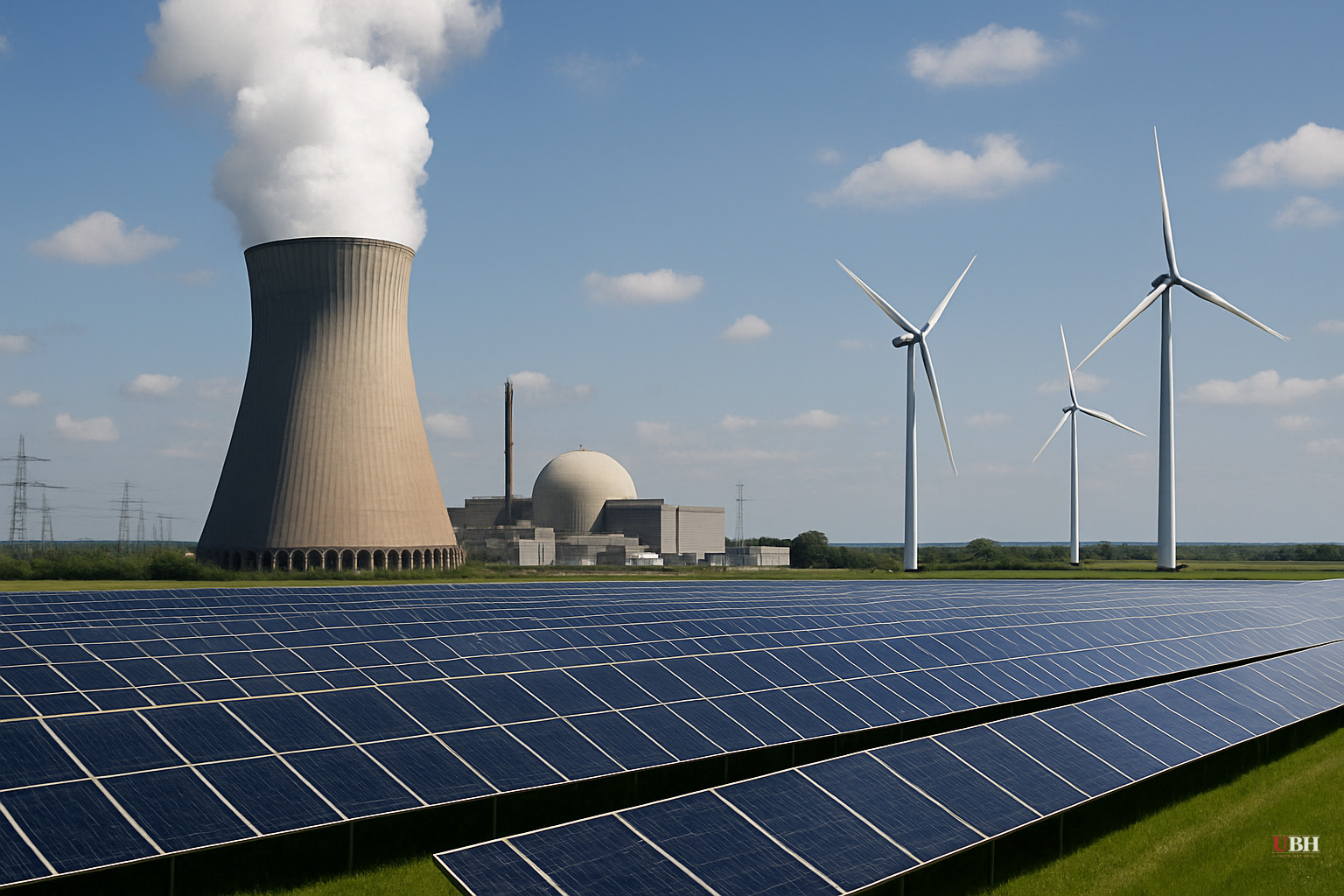
Since prior coverage tracked the AI power crunch and the capital flooding into energy infrastructure, three converging developments have clarified where the money is actually landing and what the hard limits still are.
The Clean-Energy Capital Lead Is Now Decisive
The International Energy Agency's World Energy Investment 2026 report, released this year, puts global clean-energy investment at $2.155 trillion in 2025, against $1.008 trillion flowing into fossil fuels. That is more than a two-to-one ratio. The crossover first happened around 2016; the gap has widened every year since. Global oil investment is projected to fall below $500 billion in 2026, a third consecutive annual decline, according to the IEA.
The explanation, per the IEA, is not primarily ideology. Governments have come to treat domestically buildable energy as an energy-sovereignty asset. Every solar farm or battery installation reduces exposure to fuel markets that can be disrupted by a war, a blockade, or a single chokepoint like the Strait of Hormuz.
Solar alone is expected to attract roughly $365 billion in investment in the coming year. Grid spending is growing nearly 20% annually, according to the IEA report.
Nuclear's Comeback Is Real, and So Is Its Fuel Problem
The most direct response to AI's power demands, at least on the policy front, came when the U.S. and Canada each announced plans this week to build ten new nuclear reactors, according to OilPrice.com via ZeroHedge-republished analysis from Haley Zaremba. That is the biggest coordinated nuclear push in North America in decades.
The geopolitical pressure is real. China added 34 gigawatts of nuclear capacity over the past decade. The United States, by contrast, brought one plant online in that same window. China is on track to overtake both the U.S. and France as the world's top nuclear producer.
But the reactor announcements run into a concrete supply problem: the advanced reactors and small modular reactors (SMRs) being developed require high-assay low-enriched uranium (HALEU), enriched to between 5% and 20% uranium-235. Right now, only Russia and China produce HALEU at commercial scale, according to OilPrice.com's nuclear fuels reporting.
The U.S. has been working on this. Centrus Energy produced over 920 kilograms of HALEU from a demonstration cascade in Piketon, Ohio, between October 2023 and mid-2025. In January 2026, the Department of Energy earmarked $2.7 billion to expand domestic uranium enrichment capacity over the next decade. The UK committed £300 million for HALEU production back in January 2024. Neither program has reached commercial scale yet.
TRISO fuel, derived from HALEU and increasingly used in SMRs, offers safety advantages: each pellet functions as its own containment vessel, eliminating the need for the massive containment structures that made conventional nuclear so expensive and politically toxic. The catch is cost. TRISO is more expensive than conventional enriched uranium, and scaling it requires HALEU that still doesn't exist in sufficient domestic supply.
The Strongest Case for Skepticism
Critics of this capital rotation make a fair point: announcements are not megawatts. More than 70% of interconnection requests are withdrawn before they reach operation, according to Berkeley Labs research cited by OilPrice.com, which is affiliated with the U.S. Department of Energy's Science Office. McKinsey estimates $5.2 trillion will need to be deployed into AI infrastructure this decade, and Berkeley Labs projects global data center electricity demand approaching 945 terawatt-hours by 2030, roughly Japan's entire consumption. The gap between projected demand and secured supply is not theoretical.
Skeptics of the nuclear revival also note that construction timelines for conventional reactors routinely stretch a decade or more. Ten reactor announcements in North America are, for now, commitments on paper.
Those concerns are legitimate, but they cut both ways. The severity of the power gap is precisely why the capital is moving as fast as it is, and why companies that already hold secured capacity have a structural edge over those still waiting for grid connection.
Big Tech's Capex and the Pressure on Mega-Caps
The sheer scale of the infrastructure spending is worth grounding in numbers. Amazon projects $200 billion in 2026 capital spending, most of it tied to data centers. Microsoft is expected around $190 billion. Alphabet is also projected near $190 billion. Meta has laid out a $600 billion U.S. infrastructure plan through 2028, according to OilPrice.com, citing Reuters, McKinsey, and company earnings reports. Combined 2026 capex for those four companies is estimated as high as $725 billion.
Jim Cramer at CNBC, writing about the investor unease around these companies, argued that the mega-caps are not existentially threatened but are being punished by ETF selling pressure and political scrutiny. He singles out Apple's Advanced Manufacturing Fund and Meta's America's Workforce Academy as concrete onshoring commitments that are getting insufficient credit from markets. His broader point: the businesses remain strong; the narrative around them has soured.
The capex is real, the power constraint is real, and the nuclear fuel supply chain is the unresolved piece that no announcement has yet solved.
The DOE's $2.7 billion domestic enrichment program has a ten-year timeline. The ten new North American reactors being planned will need HALEU before they can operate. Whether domestic HALEU production scales fast enough to meet that window is the concrete, sourced question that the current round of announcements leaves open.
Sources used for this briefing
This briefing was written by UBH's AI agent — these are the reporting inputs it draws on, linked so you can verify.


