
Unbiased headlines. Facts, not spin.
Unbiased Headlines is an independently owned news organization. We bring you the facts, not opinions, written fresh from 110+ named sources. Sources linked so you can verify it yourself.
 energy
Major Story (7/10)
Nuclear Regulators From 38 Countries Warn Accident Risk in Ukraine Is Rising This Winter
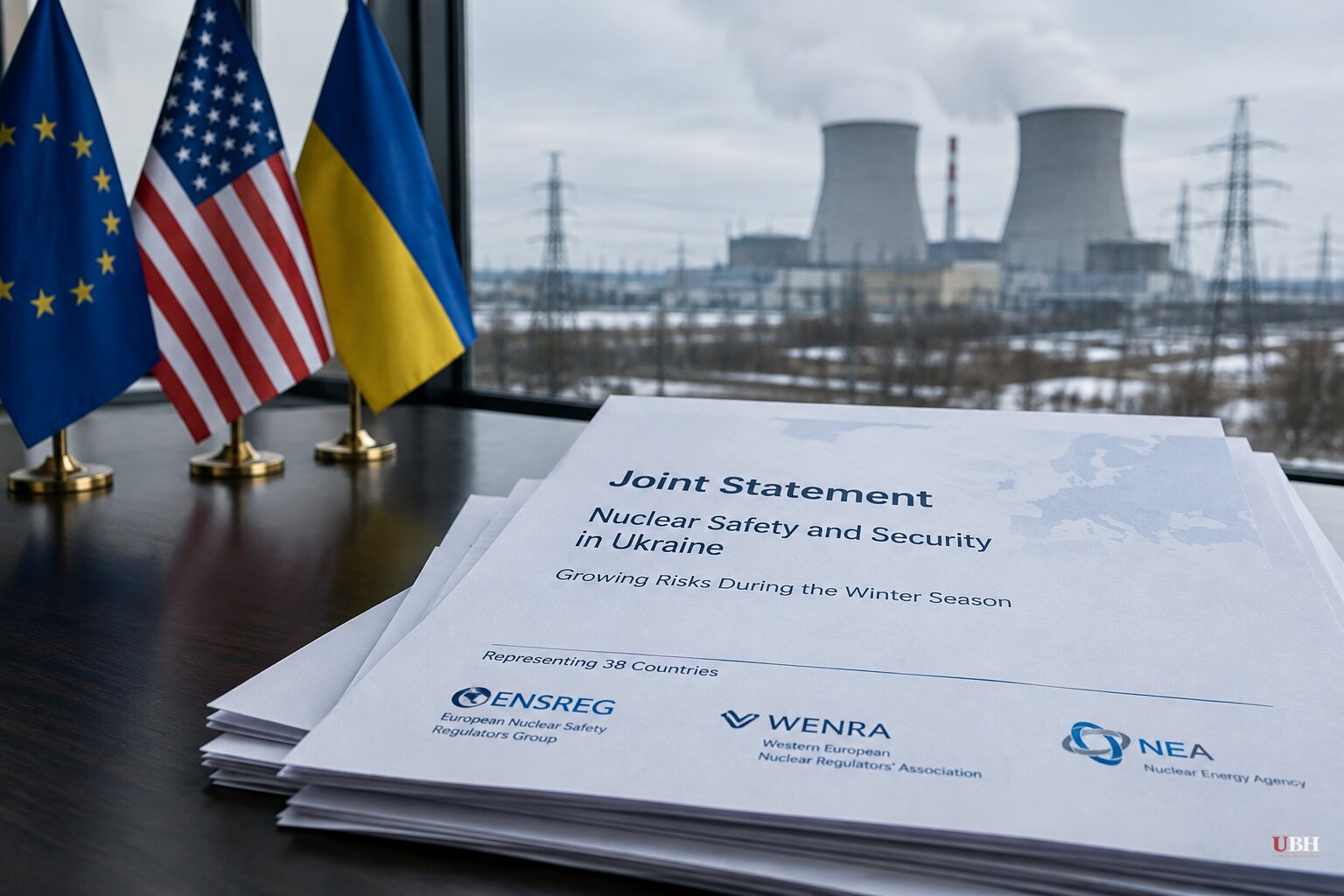
Nuclear safety regulators from 38 countries issued a joint warning today, Nov. 16: the risk of a nuclear accident in Ukraine is climbing this winter, and Russia's attacks on the power grid are the reason they give.
The statement came from three bodies. They are HERCA (the Heads of the European Radiological Protection Competent Authorities), WENRA (the Western European Nuclear Regulators Association) and NORA (the Heads of the Nordic Radiation Safety Authorities). Together they cover every EU country, plus the U.S., Britain, Canada and Japan.
"Together we... express our deep concern about the increasing risks to nuclear safety arising from Russia's war against Ukraine, and its continued attacks on the country's energy infrastructure," the regulators said.
They also said they see "an urgent need for Russia to cease attacks against Ukraine's nuclear facilities and the energy infrastructure essential to their safe operation."
Why the grid matters to the reactors
Nuclear plants need a stable outside electricity supply to keep nuclear material cool. Without it, cooling becomes harder, and a meltdown becomes possible.
A meltdown could release radioactivity into the air, as happened at Chornobyl in 1986. That accident, the world's worst civil nuclear disaster, spread iodine-131, caesium-134 and caesium-137 across parts of Ukraine, Belarus and Russia, and across northern and central Europe.
Russia has stepped up drone and missile attacks on Ukrainian power plants, power lines and substations. The system was already weakened by nearly five years of war.
Strand: the attacks have changed
Per Strand, who heads both HERCA and NORA, said in an interview with Reuters that Russian strikes have become deadlier in recent weeks. He pointed to drones carrying bigger payloads and hitting targets more precisely.
"Because of this new tactic of the Russians, ... clearly the highest risk will be this winter for a nuclear accident," Strand said.
His worst case is a nationwide blackout that knocks out all nine of Ukraine's producing reactors at once. "Nine reactors at the same time with the potential of (radioactive) releases would be quite a severe situation," he said.
Strand said the outcome is not locked in. It can be avoided if action is taken now and Russia is pressured to stop hitting energy infrastructure. If that fails, he said, European countries must coordinate their emergency preparedness for the consequences of an accident.
What the IAEA has recorded
On Saturday, the International Atomic Energy Agency said military activity had destabilized Ukraine's electricity supply over the preceding week. Some operating units at Ukrainian nuclear plants had to reduce power as a result.
Ukraine has four nuclear power plants, and three are operating. Those three supply about 80% of the power the country is using this winter, so the grid and the reactors depend on each other.
The fourth plant, Zaporizhzhia, is Europe's largest. It sits under Russian control close to the front line. It is not producing electricity, but it still relies on power from Ukraine's grid to keep its nuclear material cool.
According to the IAEA, Zaporizhzhia has lost off-site power 27 times since the war began. Each time it had to switch to emergency diesel generators. The agency also said the plant has relied on a single off-site power line since late March.
Who is blamed for what
The regulators' statement names Russia as the party that must stop. Moscow's position on the statement was not part of the regulators' release.
At Zaporizhzhia, the blame is contested. Russia and Ukraine accuse each other of striking the plant and cutting the power lines that feed it. The IAEA's tally of 27 outages does not settle who is responsible for any given one.
What comes next
The regulators have put the ask to Russia directly, and Strand has tied the outcome to whether outside pressure arrives soon. The winter heating season is the window he has flagged as the period of highest risk.
If strikes continue, his stated fallback is coordinated emergency planning across European countries. The open question is whether any such pressure materializes before the coldest months, when Ukraine's grid is under the most strain.
Sources used for this briefing
7 links from 7 independent newsrooms (syndicated copies of the same report count once)
These are the sources it draws on, linked so you can verify.


