
Unbiased headlines. Facts, not spin.
Unbiased Headlines is an independently owned news organization. We bring you the facts, not opinions, written fresh from 110+ named sources. Sources linked so you can verify it yourself.
 energy
Notable (6/10)
Europe Has Drawn Down 10% of Its Summer Gas Injections as EU Storage Falls to 70.5%
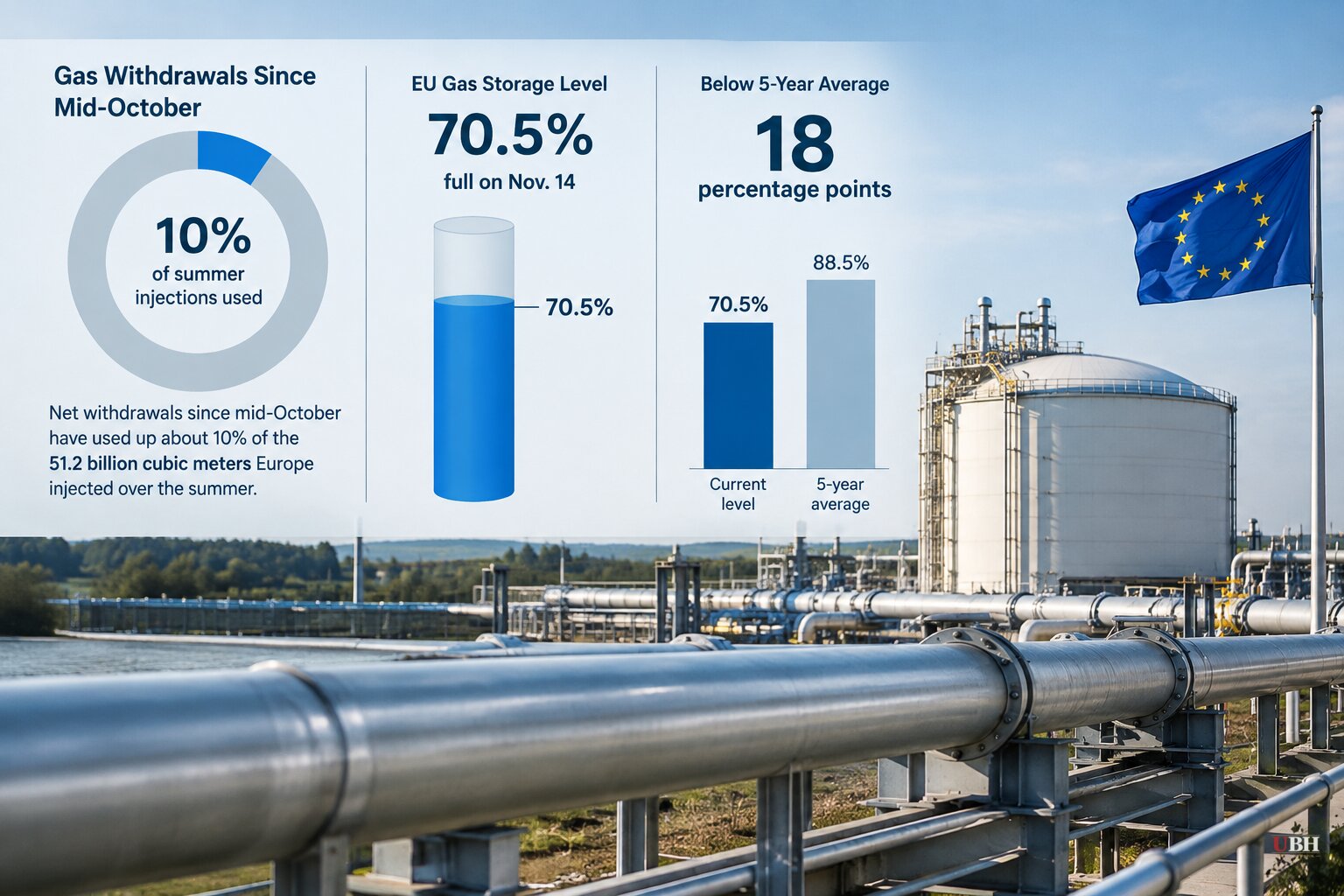
Europe has already burned through roughly a tenth of the gas it stored this summer, and the heating season is only weeks old.
Net withdrawals have reached about 10% of the 51.2 billion cubic meters injected into storage since spring, according to data from Gas Infrastructure Europe (GIE). Withdrawals began in mid-October and picked up toward early November. They have eased over the past week.
Storage at the lowest level since 2013
EU storage was 70.55% full as of Nov. 14, per GIE. That is 18.01 percentage points below the five-year average for the date and 11.45 points below a year ago.
The EU holds about 77.3 billion cubic meters, which is 13.3 billion less than last year and the lowest for that date since 2013.
Storage peaked this autumn at 74.96%. Less than three weeks later, total withdrawals were running 1.8 times the five-year average. Net withdrawals since Oct. 28 have approached 5 billion cubic meters, more than double the five-year average.
The pace has cooled in November. More than 5 billion cubic meters came out between Nov. 1 and Nov. 14, but that is below the same stretch in 2016.
A missed target, even the lowered one
European Commission rules call for storage to reach 90% at some point between Oct. 1 and Dec. 1 each year. Member states get up to 10 points of leeway if filling proves difficult.
To meet the requirement this season, a net 68 billion cubic meters had to go into storage. The Commission was prepared to lower the goal to 80% in case of a mild winter. European countries did not reach even that.
Operators struggled to fill storage after the Iran war halted nearly all Qatari shipments, according to Oilprice.com's reporting. They paid heavy prices for LNG and competed with Asian buyers for spot cargoes. Much of Qatar's LNG remains trapped behind the Strait of Hormuz.
The benchmark European gas price hit a four-year high at the end of October as temperatures dropped and withdrawals accelerated. Prices slid in Amsterdam trading early Monday, Nov. 16, on milder weather and record U.S. LNG flows, Oilprice.com reported.
Germany's storage operators sound the alarm
INES, the association of German gas storage operators, warned last week that "gas supply in Germany may not be fully secured during the coming winter in the event of extremely cold temperatures." The group said it sees "an urgent need to strengthen the strategic framework for winter preparedness."
That is a warning about a cold-weather scenario, not a forecast of shortages. No official has announced rationing or emergency measures in the data reviewed.
Why the drawdown is so fast
There is disagreement about the cause. Russian outlet EADaily argues that traders are tapping gas bought cheaply in spring and summer, when prices did not exceed $700 per thousand cubic meters, instead of buying at more than $1,000 now. It notes that EU LNG imports in November are 5% below a year ago and Norwegian supply is down 2%.
Alexey Grivach, deputy director of the National Energy Security Fund and an associate professor at the Financial University under the Russian government, does not rule out that traders are using the cheaper gas. He says there are other reasons as well. In his view, traders now face a higher risk of regulatory fines for missing the storage-filling standard.
EADaily also says the start of the heating season has been cooler than last year. It reports that EU governments are hoping for a Middle East de-escalation and more LNG. Meteorologists, it adds, are forecasting a warmer winter.
That hope has burned Europe before. EADaily says expectations of an early supply recovery this summer pushed buyers to hold back, leaving storage low and prices higher in the fall. Competition with Asia continues, with January deliveries to Northeast Asia trading at $1,050 per thousand cubic meters, according to the same outlet.
What comes next
The Dec. 1 end of the Commission's filling window is two weeks away. Storage is 70.5% full against a 90% rule and an 80% fallback, so the EU is on course to finish well short of both.
Whether Europe gets through the winter comfortably now depends on temperatures and on when Qatari cargoes can move again. If either disappoints, net withdrawals that are already more than twice the five-year norm will keep draining a cushion that is the thinnest in 13 years.
Sources used for this briefing
7 links from 5 independent newsrooms (syndicated copies of the same report count once)
These are the sources it draws on, linked so you can verify.


