
Unbiased headlines. Facts, not spin.
Unbiased Headlines is an independently owned news organization. We bring you the facts, not opinions, written fresh from 110+ named sources. Sources linked so you can verify it yourself.
 energy
Major Story (7/10)
Harvard Study Estimates 403 Hyperscale Data Centers Used 68 to 99 TWh in a Year, Up to Michigan's Level
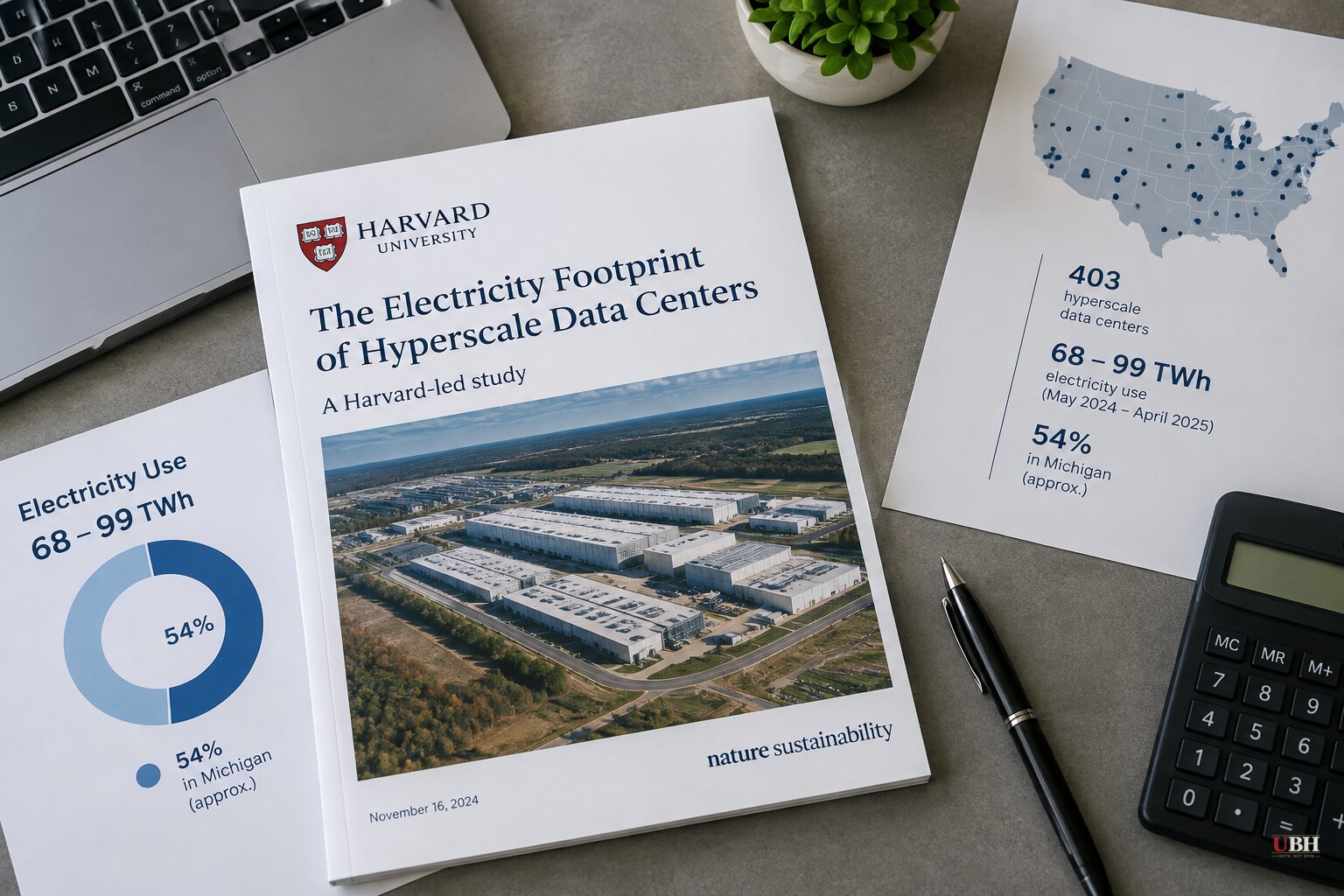
A Harvard-led study published today, Nov. 16, in Nature Sustainability puts the first facility-level numbers on what America's largest data centers consume and emit since the AI boom began.
The researchers identified 403 hyperscale data centers using satellite imagery and commercial facility records. They estimated each site's electricity use from May 2024 through April 2025 under a range of operating scenarios.
The total came to between 68 and 99 terawatt-hours, depending on how hard the facilities were running. A central figure of about 82 TWh equals roughly 1.8% of total U.S. electricity consumption, according to the study. At the high end, that approaches what states such as Indiana, Michigan and Tennessee use in a year.
What the numbers show
About 54% of the electricity attributed to the facilities came from fossil fuels, with natural gas supplying around 38% and coal about 15%. The researchers matched each site to its regional grid and used 2023 Environmental Protection Agency data to assign emissions.
That produced an estimate of 25.7 million metric tons of carbon dioxide. The authors say that is two to three times higher than a peer-reviewed estimate for 2018, before the AI buildout.
Geography drives the result. Virginia, Oregon, Ohio and Iowa together accounted for more than half of the electricity use. Virginia alone accounted for about a quarter. On emissions, Virginia, Iowa and Ohio made up about half the total.
Oregon shows why demand and emissions are different measures. Its data centers emitted less carbon per unit of power because more of their supply came from non-fossil sources. In Ohio, roughly 80% of electricity generation is fossil-fired, according to the Energy Information Administration.
The study also found about a quarter of data center demand sits in grid regions dirtier than the national average.
Nobody is officially counting
Federal and state governments do not track data center electricity use separately from the rest of the power sector. Operators often treat facility-level consumption as proprietary, and neither they nor utilities have to publish it.
That is why a university team had to reconstruct the picture from satellites and grid records. Licensing limits on the commercial dataset meant the researchers could not publish facility names, addresses or owners.
Jon Koomey, an energy researcher who was not part of the study and has worked on Lawrence Berkeley National Laboratory's recurring data center energy reports since 2007, said a peer-reviewed accounting is more rigorous than back-of-the-envelope calculations. He noted that some figures sit behind nondisclosure agreements and are never seen.
The limits of the estimate
This is a model, not a meter reading. The sample is verified, grid-powered hyperscale sites only. It leaves out hundreds of possible facilities the researchers could not confirm, and it excludes sites running on on-site generators.
Nor is it a measure of AI alone. Not every facility studied runs AI workloads, and the researchers could not separate AI from cloud storage and other services. Koomey noted that hyperscalers were growing fast before the AI boom.
The data is also aging quickly. The average facility in the study draws about 40 megawatts. Lead author Gianluca Guidi said some campuses now proposed are substantially larger, with developers building sites of hundreds or even thousands of megawatts. At least 250 more data centers have come online since the study window closed, according to Cleanview data cited by The New York Times.
Harvard's own release says demand and emissions are likely much higher today than during the study period.
Calls for disclosure
Senior author Francesca Dominici, director of the Harvard Data Science Initiative, said the goal is to give policymakers, investors and developers better information. "Decisions about where data centers go and how they're powered are critical environmental and public health decisions, and they should be made with good data," she said. She compared the carbon total to the emissions of a state like Michigan or a small European country.
Dr. Vanessa Kerry, director of global and climate health policy at Harvard's Chan School, went further. "The companies building AI have plenty of money to do better," she said. She urged them to invest in new clean power and publish energy use and emissions for every data center.
The same day, negotiators at the UN COP31 talks in Antalya, Turkey, launched a voluntary pledge for companies and countries to power data centers with clean energy and disclose power and water use and emissions. UN climate chief Simon Stiell said, "We cannot ask people to accept higher bills, more planet heating pollution and deeper inequality today in exchange for promises of a better tomorrow."
The pledge is voluntary. An advocacy group, Climate Action Against Disinformation, says in a new report that the biggest tech companies' electricity use rose 240% between 2022 and 2025.
What comes next
The Harvard team has built a public explorer tool, called Never Just a Building, aimed at communities hosting these facilities. Dominici said the next phase of research will focus on the direct health effects of air pollution tied to data center power use.
Whether any government will require facility-level disclosure remains open. For now, utilities and regulators are planning grid expansions around data center demand without a public, metered dataset to check it against.
Sources used for this briefing
8 links from 7 independent newsrooms (syndicated copies of the same report count once)
These are the sources it draws on, linked so you can verify.


