
Original briefings. Zero spin.
Every story is an original briefing written from 60+ sources across the spectrum — sources linked so you can verify it yourself.
 defense
Notable (6/10)
August 14, 2026 at 10:23 AM
defense
Notable (6/10)
August 14, 2026 at 10:23 AM
NTSB: Metal Fatigue Cracked Fan Blade Before Ryanair Window Blew Out and Sucked Out a Passenger
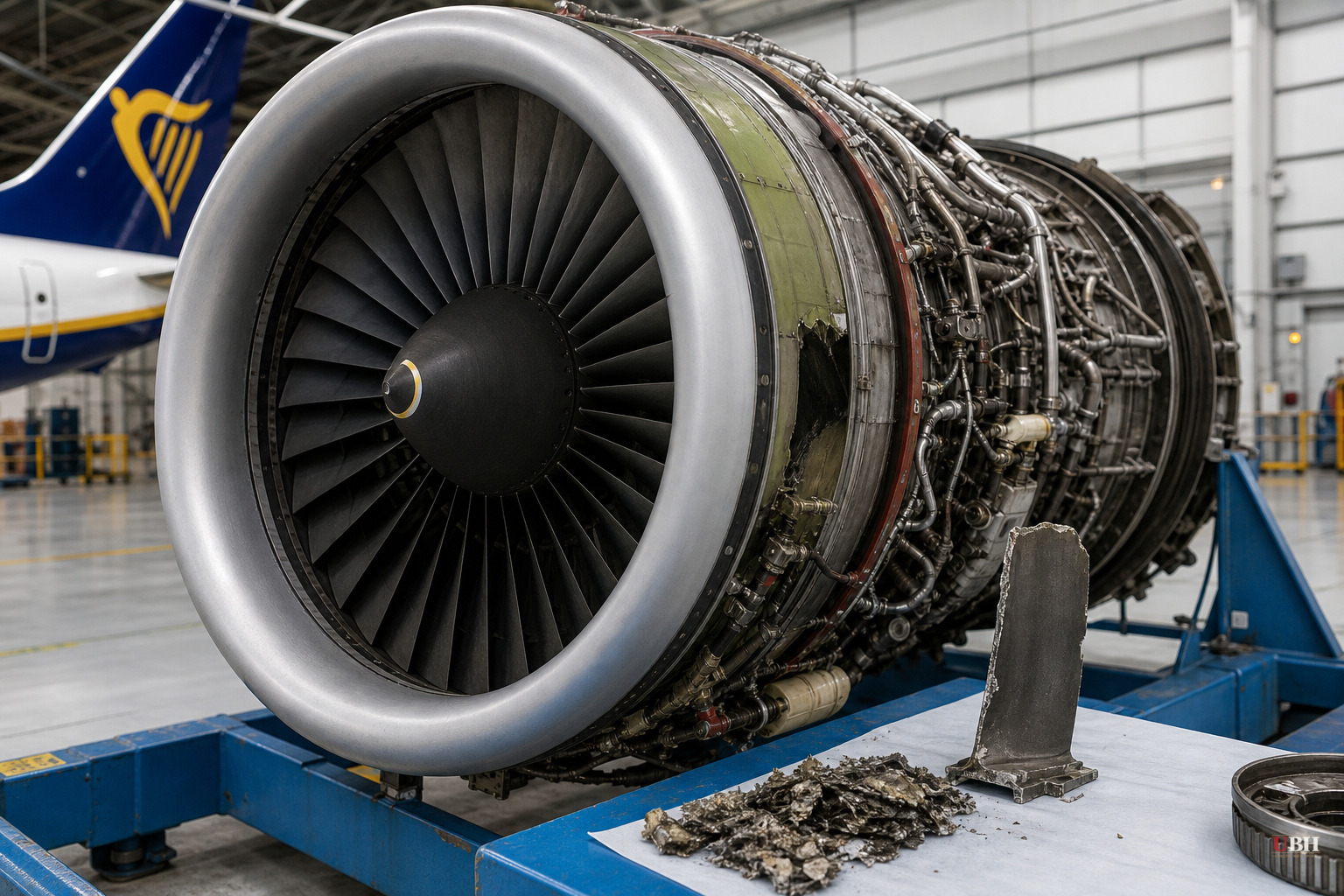
Since the July 10 incident over Thessaloniki, the National Transportation Safety Board has now released its preliminary findings, and they point to metal fatigue as a factor investigators can't ignore.
According to the NTSB's report published Thursday, roughly 37 percent of the fracture surface on the failed fan blade showed features consistent with fatigue, meaning repeated stress cracked the metal near the blade's root over time.
The basics of the incident are already known. Ryanair Flight FR1879, operated by Malta Air on a Boeing 737-800, was climbing through 16,000 feet after takeoff from Thessaloniki International Airport when the crew got a high-vibration alert on the right engine, according to the NTSB. The vibration spiked, the crew heard a loud bang, and the cabin depressurized. A fan blade had separated, sending debris into the fuselage and blowing out a window at row 11.
Ljubisa Karović, a 61-year-old Serbian entrepreneur seated in 11F, was partially pulled through the shattered window opening. Fellow passengers grabbed him and pulled him back inside, according to The Guardian, which spoke to Karović directly. He suffered neck and shoulder injuries and friction burns, and was treated by an off-duty doctor on board before the plane returned safely to Thessaloniki. Karović told the Guardian he doesn't remember much of the incident but is grateful to be alive, crediting his seatbelt and, in his words, fate.
Bird strike still unconfirmed as root cause
Investigators recovered bird remains, including feathers, from multiple points inside the failed engine, according to the NTSB, The Air Current, and CBS News. Those remains were sent to the Smithsonian Institution Feather Identification Lab in Washington for analysis. Flight crews had reported four suspected bird strikes to that same engine in the 12 months before the accident, with remains found after two of them, the NTSB said.
But the NTSB has explicitly not concluded that a bird strike caused the blade failure. Investigators told reporters they're not even certain the bird remains found deep in the engine came from the July 10 flight or from an earlier strike, according to CBS News. The NTSB's own language is more cautious: bird evidence exists, fatigue evidence exists, and investigators haven't decided which one triggered the failure, or whether both did.
The FAA directive question
The engine had not received reinforcements to the fan and inlet cowl hardware that the FAA recommended in a series of 2025 airworthiness directives, according to The Air Current and paddleyourownkanoo.com. Those directives trace back to two earlier fan-blade-out failures on Southwest Airlines 737s, in 2016 and 2018, one of which killed a passenger who was also partially pulled through a broken window.
Boeing 737 Next Generation operators have until 2028 to comply. Ryanair hadn't done it yet, and CBS News noted the airline isn't legally required to, since Ryanair is an Irish carrier and not subject to FAA regulations at all. Ryanair was operating within the rules that currently apply to it. Whether those rules should apply uniformly to all 737 operators flying into or over US-linked airspace is a fair question raised by the timeline itself, not by the NTSB, which has not accused Ryanair of any violation.
O'Leary's comments drew a rebuke
On July 20, Ryanair CEO Michael O'Leary said publicly that a foreign object, meaning a bird, struck the aircraft and triggered the failure, according to The Air Current. NTSB Chair Jennifer Homendy pushed back sharply, saying the comments risked violating ICAO protocol for how investigation information gets shared before a final report. Ryanair has since told the Guardian it won't comment further on the preliminary findings.
That exchange matters because O'Leary got ahead of his own airline's ongoing federal investigation, stating as fact something the NTSB says it hasn't confirmed. It's a credibility problem for Ryanair's public statements, not evidence the airline did anything wrong mechanically.
What's unresolved
The NTSB has not determined the root cause of the fan blade failure. It hasn't said whether the fatigue crack originated independently of the bird strikes, whether a strike accelerated an existing fatigue crack, or whether the shim structure in the blade attachment, which investigators are examining closely, played a role. The engine's fan blades had passed ultrasonic inspections in November 2025 and May 2026 with no damage detected, according to Al Jazeera and The Guardian, meaning current inspection methods didn't catch whatever was developing. A final NTSB report, which typically takes a year or more, will need to address why.
Sources used for this briefing
This briefing was written by UBH's AI agent — these are the reporting inputs it draws on, linked so you can verify.

