
Original briefings. Zero spin.
Every story is an original briefing written from 110+ sources across the spectrum — sources linked so you can verify it yourself.
 defense
Major Story (7/10)
Event date: August 20, 2026
defense
Major Story (7/10)
Event date: August 20, 2026
NSA's Number Two Warns China Is Arming Iran and Russia While Pentagon Fights Itself Over AI Rules
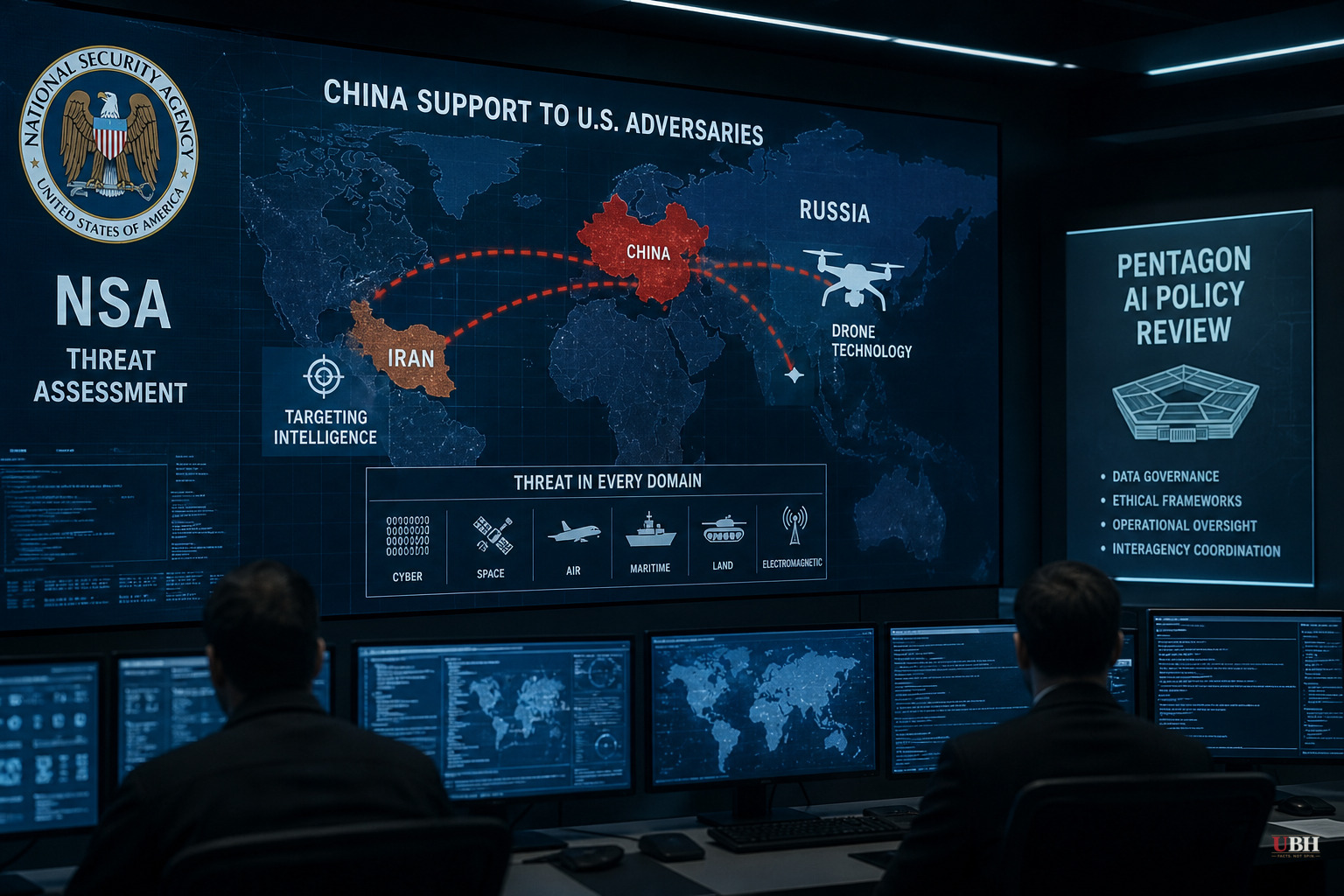
National Security Agency Deputy Director Tim Kosiba did not mince words this week. Speaking at the TechNet Augusta conference, he said China has "its hands in most every national security priority we are dealing with today, and it's a hot competition," according to Breaking Defense.
Kosiba's specific claims deserve attention. He said Chinese companies provided geospatial intelligence that helped Iranian forces target U.S. bases during the recent Middle East conflict. He said China has given Russia drone technology, training, and intelligence support for its war in Ukraine, calling it a "partnership without limits." And per AFCEA's coverage of the same speech, he said Chinese firms remain the primary suppliers of the chemicals used to manufacture drugs that kill nearly 100,000 Americans a year.
Some of this checks out against independent reporting. Reuters reported in May, citing European intelligence, that China trained scores of Russian soldiers. The Washington Post reported in April that Chinese firms, some linked to the Chinese military, used AI to analyze open-source data and track U.S. forces. China's foreign ministry told Australia's ABC News that the imagery in question was obtained through "routine market practice," not military targeting. U.S. officials themselves were divided on how dangerous that specific activity actually was, per the Post's reporting, though at least one defense source told ABC it was endangering lives.
Kosiba is stating this as settled fact from a podium. The underlying intelligence community assessment, based on the sources available, is more mixed than his speech suggests.
The AI Race Is Real, But So Is the Chaos
Kosiba said the U.S. is now operating in "a world of agentic AI" and that the shift "directly intersects" with the China threat. He's not wrong that the technology is moving fast. But the Philadelphia Inquirer's reporting shows the Pentagon's own house is a mess.
In mid-July, the Air Force sent major defense contractors a letter demanding they purge all Anthropic AI products from weapons and control systems by September 1, or risk losing their Pentagon business, according to the Inquirer. Within weeks, the order was quietly reversed. Contractors were told to disregard it, for now.
The reversal reportedly traces to a fight between Anthropic CEO Dario Amodei and Defense Secretary Pete Hegseth over restrictions Anthropic wanted on how the military could use its technology. Senior NSA officials argued that without Anthropic's Mythos model, the agency would struggle to find and patch its own network vulnerabilities. One former senior official told the Inquirer that pulling Mythos would have amounted to "unilateral disarmament" in the digital arms race. Tests using Mythos to probe foreign networks were reportedly still underway even after the supposed ban.
The Pentagon nearly cut off a tool its own spy agency says it needs, over a leadership dispute with a private AI company, while claiming to be racing China.
The Infrastructure Warning Is Happening Right Now
This isn't theoretical. On August 19, five federal agencies—the NSA, FBI, CISA, the Department of Energy, and the EPA—issued a joint advisory warning that unspecified threat actors are already using AI to attack Siemens S7 Series programmable logic controllers at critical infrastructure sites, according to SC World. These are the industrial control systems running water treatment plants, manufacturing lines, and energy facilities.
The advisory said attackers are using AI to generate exploitation scripts and disguise them as legitimate monitoring software, then scanning services like Censys and ZoomEye to find exposed devices. Manufacturing, energy, water and wastewater, chemicals, and food and agriculture sectors are named as most at risk.
Gary Barlet, public sector CTO at Illumio, told SC World that a small municipal water utility simply can't fight AI-driven attacks on its own. "They don't have the budget, staffing, or operational capabilities to keep pace with that level of automation," he said. John Watters, CEO of iCounter, made a similar point: a 900-employee Midwest water utility often has one IT person covering everything from email to the plant's control systems. Watters said federal advisories alone won't fix that. What's needed is direct resourcing and shared detection tools, not another warning bulletin.
Not Everyone Buys the Panic
The Atlantic's reporting pointed out that AI and national-security researchers have spent years predicting catastrophic outcomes if China achieves AI dominance, from bioweapons targeting specific ethnic groups to drone armies overwhelming U.S. defenses. Rama Elluru of the Special Competitive Studies Project even raised the prospect of "engineered humans."
The Atlantic's reporting noted these scenarios assume a leap to superintelligent AI that can improve itself faster than anyone can catch up, something David Lin of the same think tank admitted isn't clear will ever happen. The outlet also noted the Trump administration's own China AI policy is contradictory: it loosened export rules to let China buy more advanced AI chips while separately debating whether the Pentagon can use Anthropic's most advanced models at all.
Warnings about existential AI threats from Beijing are easier to make than to prove, and the government's own policy moves don't reflect the urgency officials describe in speeches.
China's documented support for Iran and Russia is real and sourced. The infrastructure attacks flagged this week are real and ongoing. The Pentagon's internal AI policy, by its own contractors' account, has already been reversed once in a matter of weeks. The September 1 deadline for the original Anthropic purge is still more than a week away, and no confirmed final policy has been reported. Whether the Pentagon settles on a coherent AI strategy before China closes the gap Kosiba described remains an open question.
Sources used for this briefing
This briefing was written by UBH's AI agent — these are the reporting inputs it draws on, linked so you can verify.


