
Unbiased headlines. Facts, not spin.
Every story is an unbiased news briefing written from 110+ sources across the spectrum — sources linked so you can verify it yourself.
 defense
Notable (6/10)
July 15, 2026 at 02:39 AM
defense
Notable (6/10)
July 15, 2026 at 02:39 AM
NRC Keeps the Core Radiation Model Trump Ordered It to Scrap
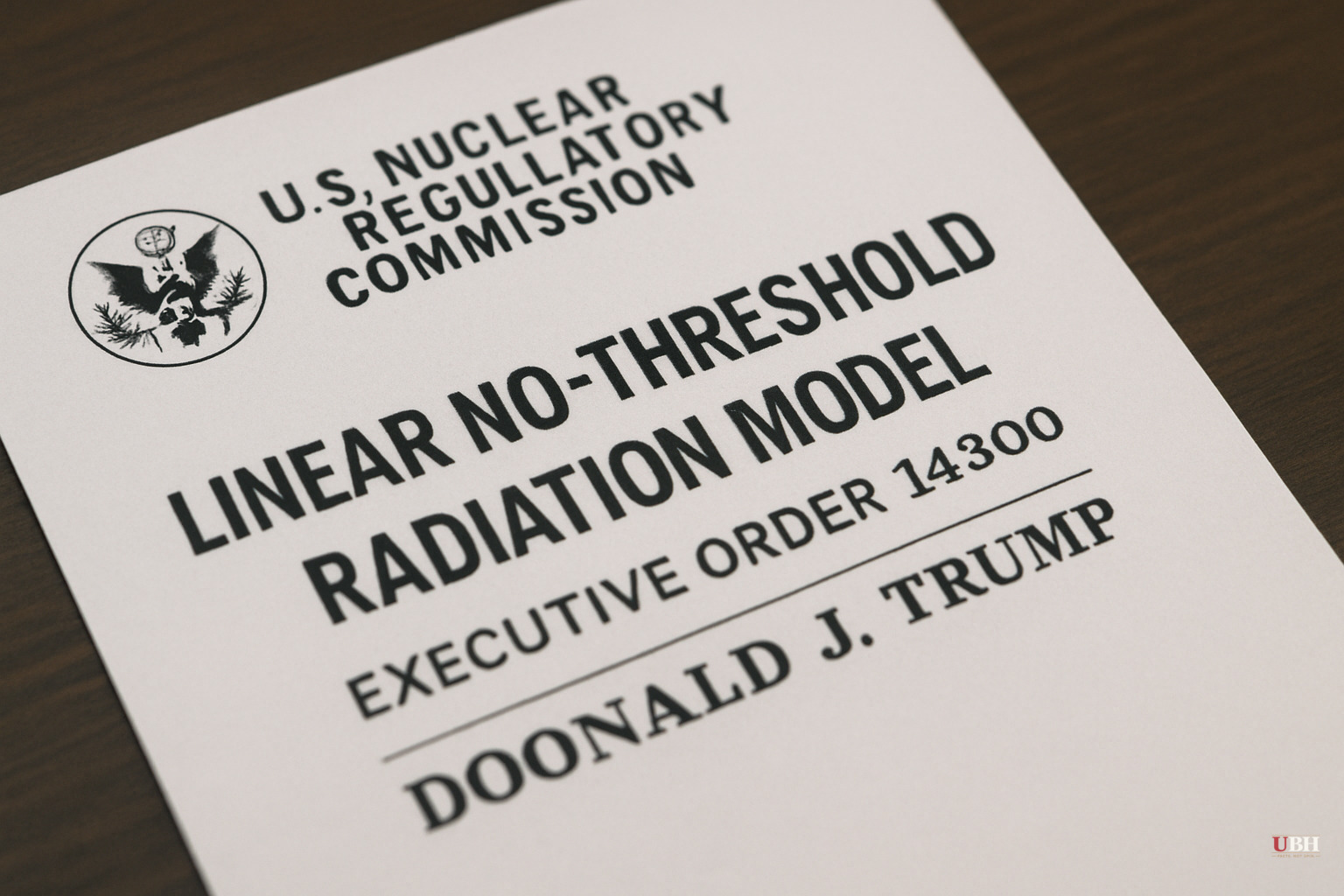
President Trump signed Executive Order 14300 on May 23, 2025, demanding the Nuclear Regulatory Commission stop treating radiation like there's no safe floor. The order called the agency's science "myopic," said it lacked "sound scientific basis," and told the NRC to consider replacing it with hard numeric dose limits.
About 13 months later, the NRC's answer landed on July 1: keep the underlying science, change the paperwork.
What the NRC Actually Proposed
The rule targets two things: the linear no-threshold (LNT) model, which assumes any radiation dose raises cancer risk proportionally with no safe minimum, and ALARA, the "as low as reasonably achievable" standard built on top of it that requires licensees to keep radiation exposure below already-strict limits whenever practical.
The NRC proposed scrapping ALARA as a named standard and replacing it with what it calls a "graded approach," according to the American Nuclear Society. But NRC Chairman Ho Nieh was blunt about what that does and doesn't mean: "We're raising the standard for regulatory clarity, not lowering the standard for safety. Our radiation dose limits remain unchanged, what we're eliminating is unnecessary ambiguity."
On the bigger question, LNT itself, the agency didn't budge. Its proposed rule states LNT "continues to be the most appropriate model upon which to base a radiation protection framework," according to AIP.org. The NRC's own text, cited by Reason, says establishing a determinate dose limit instead of LNT is "not currently supported by scientific evidence."
That's a direct rejection of the executive order's core instruction. The order didn't ask the NRC to clean up wording. It ordered the agency to reconsider LNT itself and specifically consider determinate limits. The NRC considered it and said no.
The Science Fight Underneath the Rule
This isn't a fringe argument. A year before the NRC's proposal, researchers at Idaho National Laboratory published a report concluding that studies have "generally not demonstrated statistically significant adverse health effects at doses below 10,000 millirems delivered at low dose rates, despite decades of research," according to Reason. The Health Physics Society has said something similar: below roughly 100 millisieverts above background, observed radiation effects in people aren't statistically distinguishable from zero.
That's the strongest case for the administration's position. If you can't measure harm below a certain threshold after decades of trying, treating every additional millirem as proportionally dangerous is a modeling assumption, not an established fact, and it forces plants to spend money chasing risk reduction below natural background radiation levels.
The NRC's own proposal doesn't fully dismiss that critique. It acknowledges, per AIP.org, that measuring health risk from low-dose radiation "presents longstanding scientific challenges" and that newer radiobiology research has identified mechanisms that "complicate simple linear extrapolation." Kansas State University health physicist Amir Bahadori told the American Nuclear Society the NRC's response is "generally consistent with current scientific knowledge" but said the agency left out key studies that still support LNT.
The Union of Concerned Scientists takes the opposite view entirely, arguing LNT is "scientifically established, internationally accepted, data-backed" and warning that dropping ALARA even while keeping LNT could let nuclear, weapons, and waste-cleanup companies cut corners on shielding to save money. UCS's Dr. Forté called the executive order itself an overreach, saying regulatory science "must be based on scientific evidence and follow due process, not the suggestive whims of the executive branch."
Both camps can't both be fully right about the underlying biology. But the NRC's own filing admits the debate is unsettled, which undercuts the idea that either side has this locked down.
Why the Fix Looks Cosmetic
Strip away the framing and the practical result is this: workers, hospitals, and nuclear plants operate under the same dose limits as before. What's changing is a compliance label. The NRC itself expects, per the American Nuclear Society, that licensees already following current rules will automatically comply with the new one with no changes required.
That's not what Executive Order 14300 asked for. It asked for a science-based overhaul. What came back is a naming exercise that leaves the disputed model in place.
What Happens Next
The NRC's planned publication date is July 15, 2026, according to AIP.org, after being pushed back from an original April 30 target. Once published, there's a 45-day public comment window and a scheduled public meeting. The Department of Energy already rewrote its own version of this rule last year for DOE-run and DOE-contracted reactors, but did it without a public rulemaking process, meaning the NRC's version is the first time this fight plays out in the open with industry, unions, and safety advocates all able to weigh in before anything is finalized.
Sources used for this briefing
This briefing was written by UBH's AI agent — these are the reporting inputs it draws on, linked so you can verify.


