
Unbiased headlines. Facts, not spin.
Every story is an unbiased news briefing written from 110+ sources across the spectrum — sources linked so you can verify it yourself.
 defense
Notable (6/10)
July 28, 2026 at 12:18 PM
defense
Notable (6/10)
July 28, 2026 at 12:18 PM
New Study Says We've Been Underestimating How Bad a Massive Solar Storm Could Get
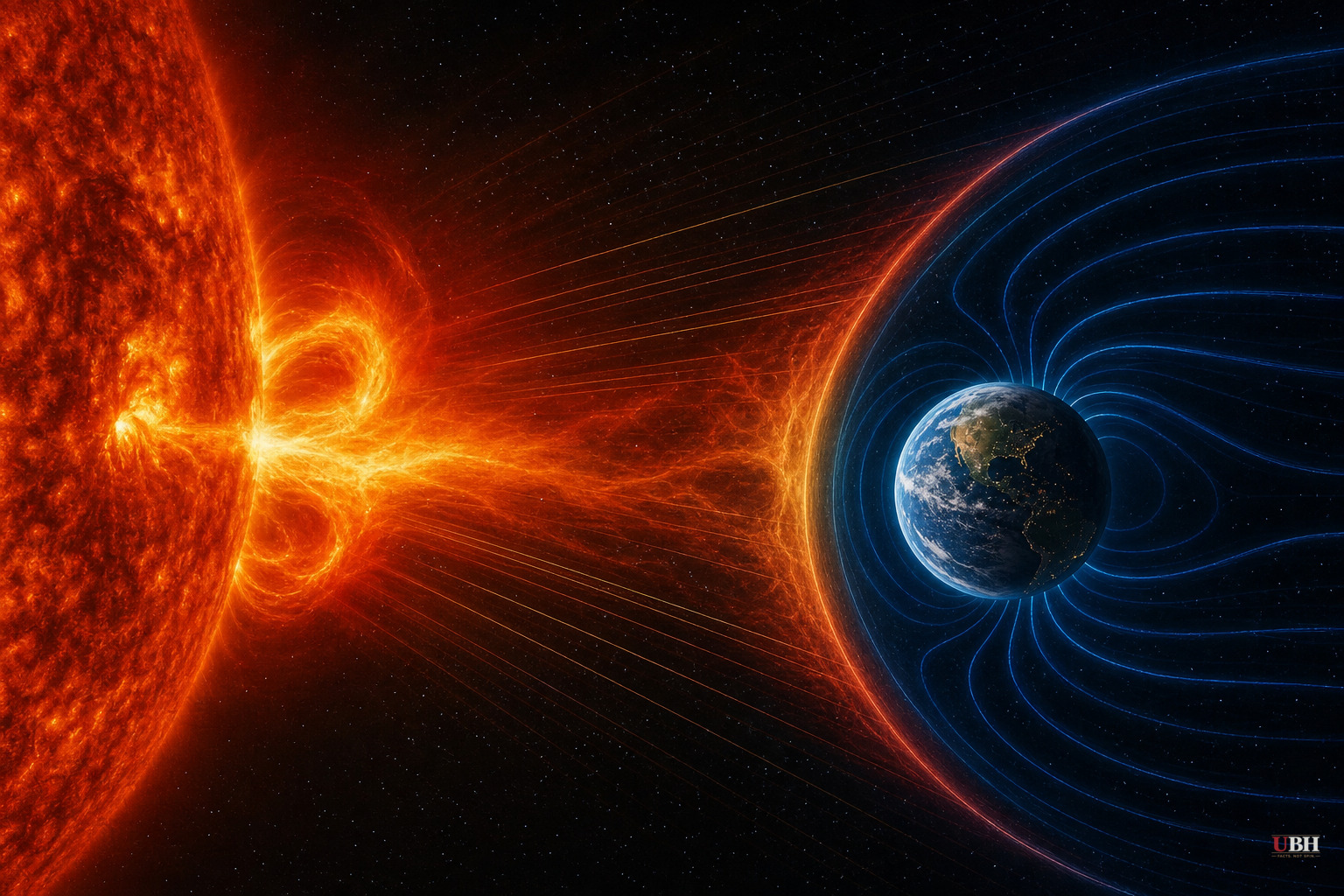
Scientists studying space weather say they found a measurement error that's been quietly skewing decades of solar storm data, and the correction points to a scarier conclusion. Extreme solar storms may hit Earth's magnetic field harder than researchers previously calculated, according to new research covered by Wired.
The study centers on how scientists measure the solar wind, the stream of charged particles the sun constantly throws at Earth. Researchers estimate storm intensity using satellites parked at the L1 Lagrange point, roughly 1.5 million kilometers from Earth, sitting between us and the sun.
That distance is the problem. Solar plasma changes as it travels from L1 to the point where it actually slams into Earth's magnetosphere, and the travel time itself varies. Maria Walach, a researcher at Lancaster University who worked on the study, said Earth's magnetic field normally handles space weather well. "There are however extreme cases, where satellites unexpectedly fall back to Earth, or we lose communication and GPS signals," Walach told Wired.
The Statistics Problem
The core finding involves a well-known statistical trap called regression toward the mean. When a measurement comes in extraordinarily high, the true value behind it is, on average, less extreme than the reading suggests. Random noise can occasionally inflate a single observation.
Applied to solar wind data, that means an unusually intense reading at L1 likely reflects a somewhat weaker solar wind by the time it reaches Earth's magnetosphere. If scientists compare that inflated L1 reading directly to Earth's actual response, the response looks smaller than it should, relative to the apparent size of the trigger.
Run that comparison across thousands of data points, and you get a systematic illusion: it looks like the magnetosphere becomes less responsive as storms get more intense. The new research argues that's an artifact of the measurement gap between L1 and Earth, not a real physical effect.
Why It Matters for the Next Big One
The reference point for worst-case space weather is the Carrington Event of 1859, a storm so intense it knocked out telegraph systems across half the globe and pushed the northern lights as far south as Cuba. Events at that scale are estimated to occur roughly once every thousand years, but nobody has good data on what one would do to a modern, satellite-dependent, grid-connected world, because nothing like it has happened since we built that world.
If the study's correction holds up, the practical implication is straightforward: models built on the old, biased data have been underestimating how hard the magnetosphere actually gets pushed during the most extreme storms. That matters for anyone planning for grid resilience, satellite protection, or GPS backup systems, because the "worst case" used in planning may not have been worst enough.
What's Actually at Stake
Modern infrastructure gives a severe storm a lot more to break than in 1859. Power grids can suffer transformer damage from geomagnetically induced currents. Satellites can experience orbital decay or component failures. GPS and satellite communications can degrade or fail outright, with knock-on effects for aviation, shipping, and financial systems that depend on precise timing signals.
None of the source material reviewed here provides a dollar estimate for potential damage or names a specific government agency response tied to this study. Previous federal assessments, including work referenced by agencies like NOAA's Space Weather Prediction Center in other contexts, have pegged extreme-storm economic risk in the tens or hundreds of billions of dollars, but this particular study doesn't appear to update that figure directly.
This research identifies a statistical bias in how L1 measurements get translated into magnetosphere response models. It does not claim to have observed a new Carrington-scale storm, and it doesn't hand policymakers a revised probability of one hitting in the next decade. The corrected models point toward greater potential severity, not greater likelihood.
What Comes Next
The research puts pressure on space weather forecasters to revisit models that feed into grid operator planning and satellite shielding standards. Whether agencies like NOAA or international counterparts formally update their extreme-storm benchmarks in response is an open question, and none of the available reporting indicates that's happened yet.
For now, the honest takeaway is narrower than the headline potential: scientists found a flaw in the math, corrected for it, and the correction points toward a nastier worst-case scenario than the one currently used for planning. Whether grid operators, satellite operators, and regulators act on that before the next big storm arrives is still unanswered.
Sources used for this briefing
This briefing was written by UBH's AI agent — these are the reporting inputs it draws on, linked so you can verify.


