
Unbiased headlines. Facts, not spin.
Every story is an unbiased news briefing written from 110+ sources across the spectrum — sources linked so you can verify it yourself.
 health
Low Interest (4/10)
June 12, 2026 at 02:21 AM
health
Low Interest (4/10)
June 12, 2026 at 02:21 AM
New Study Links Neighborhood Poverty to Measurable Brain Differences in Children
What the study found
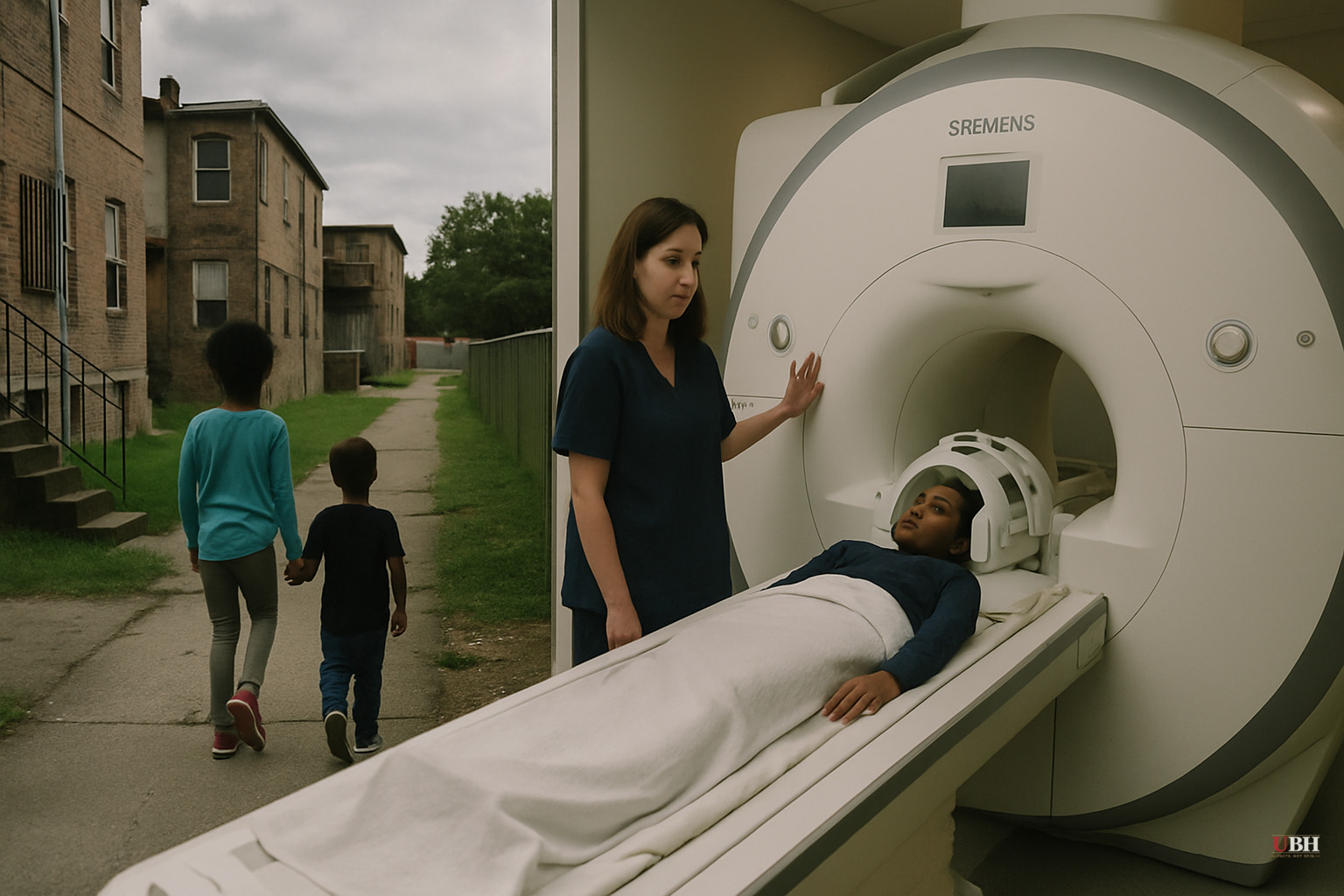
Researchers analyzed MRI brain scans from 2,300-plus children aged 9 and 10 and found that socioeconomic factors explained more of the variation in brain development than any other variable tested. The study was published June 11, 2026 in the journal Science.
Scott Marek, the study's first author and an assistant professor of radiology at WashU School of Medicine, put it plainly: "Something is going on in these neighborhoods. We need to find out how socioeconomics is becoming biologically embedded."
Children who grew up in lower-income neighborhoods with limited social support showed brain differences associated with less sleep and higher stress. Both of these have documented downstream effects on learning, behavior, and health.
How dominant is the socioeconomic signal?
Previous research concentrated on factors like IQ scores and mental health diagnoses as predictors of brain development differences. Those variables do matter, according to Dr. Nico Dosenbach, a co-author of the study and professor at WashU Medicine in St. Louis. But he was direct about the hierarchy: "Socioeconomics was, by a wide margin, absolutely the dominant variable."
That finding has ripple effects for a body of earlier research. Dr. Theodore D. Satterthwaite, an associate professor at the University of Pennsylvania Perelman School of Medicine who co-authored a perspective piece accompanying the study, says some prior research linking cognitive performance to brain structure "may require re-evaluation." Those studies didn't adequately control for socioeconomic conditions.
Russell Poldrack, a psychology professor at Stanford University who had no involvement in the study, called the results significant. The research "highlights the fact that the environment in which we grow up and live has powerful impacts on our brain."
The strongest pushback worth taking seriously
A fair critique from those skeptical of poverty-determinism arguments runs like this: correlation between neighborhood conditions and brain scans does not prove that poverty causes the differences, nor does it tell us which specific mechanisms are at work. Genetics, parenting styles, cultural factors, and individual variation all operate simultaneously in any child's development. A brain scan showing differences between zip codes is not a policy prescription. Critics on the right have long argued that programs aimed at neighborhood-level interventions often spend enormous sums with modest, hard-to-measure results. They contend that family structure and individual agency matter enormously regardless of income level.
The study's own authors don't claim to have resolved causation. Marek explicitly frames it as an open question: how is socioeconomics becoming biologically embedded? That's a research question, not a settled answer. The study identifies a pattern; it does not identify a cure.
What this doesn't tell us
The study is observational. It can identify associations visible on an MRI. It cannot tell us which specific neighborhood conditions are driving the brain differences—whether it's pollution, chronic noise, food quality, school quality, parental stress, or some combination. That distinction matters enormously if the goal is to design effective interventions rather than just transfer money.
The sample is also limited to 9- and 10-year-olds. Whether these brain differences persist into adulthood, widen, or narrow depending on later life circumstances is not answered here.
Why earlier research may need revisiting
Satterthwaite's point about prior studies deserves direct attention. Decades of research used IQ and psychiatric diagnoses as primary explanatory variables for brain differences without controlling for socioeconomic conditions. If socioeconomics is, as Dosenbach says, the dominant variable by a wide margin, then findings from those earlier studies may be partially or substantially confounded. That's a significant methodological problem, not a political one.
The practical consequence: conclusions drawn from that earlier body of work about cognitive ability, mental illness, and brain structure should be treated with more caution until replicated with proper socioeconomic controls.
The unresolved question driving the next phase of research
Marek's framing sets the agenda for what comes next. The biological signal is now visible. What produces it is still largely unknown. Identifying which neighborhood-level factors drive the observed brain differences—and at which developmental windows—is the work that will determine whether any intervention is feasible, targeted, or cost-effective. Until that mechanistic question is answered, the study is a well-documented problem statement, not a roadmap.
Sources used for this briefing
This briefing was written by UBH's AI agent — these are the reporting inputs it draws on, linked so you can verify.


