
Unbiased headlines. Facts, not spin.
Every story is an unbiased news briefing written from 113+ sources across the spectrum — sources linked so you can verify it yourself.
 politics
Major Story (7/10)
October 2, 2026 at 04:49 PM
politics
Major Story (7/10)
October 2, 2026 at 04:49 PM
New Mexico Asks Judge to Order Meta to Pay Up to $40 Billion Over Facebook Privacy Verdict
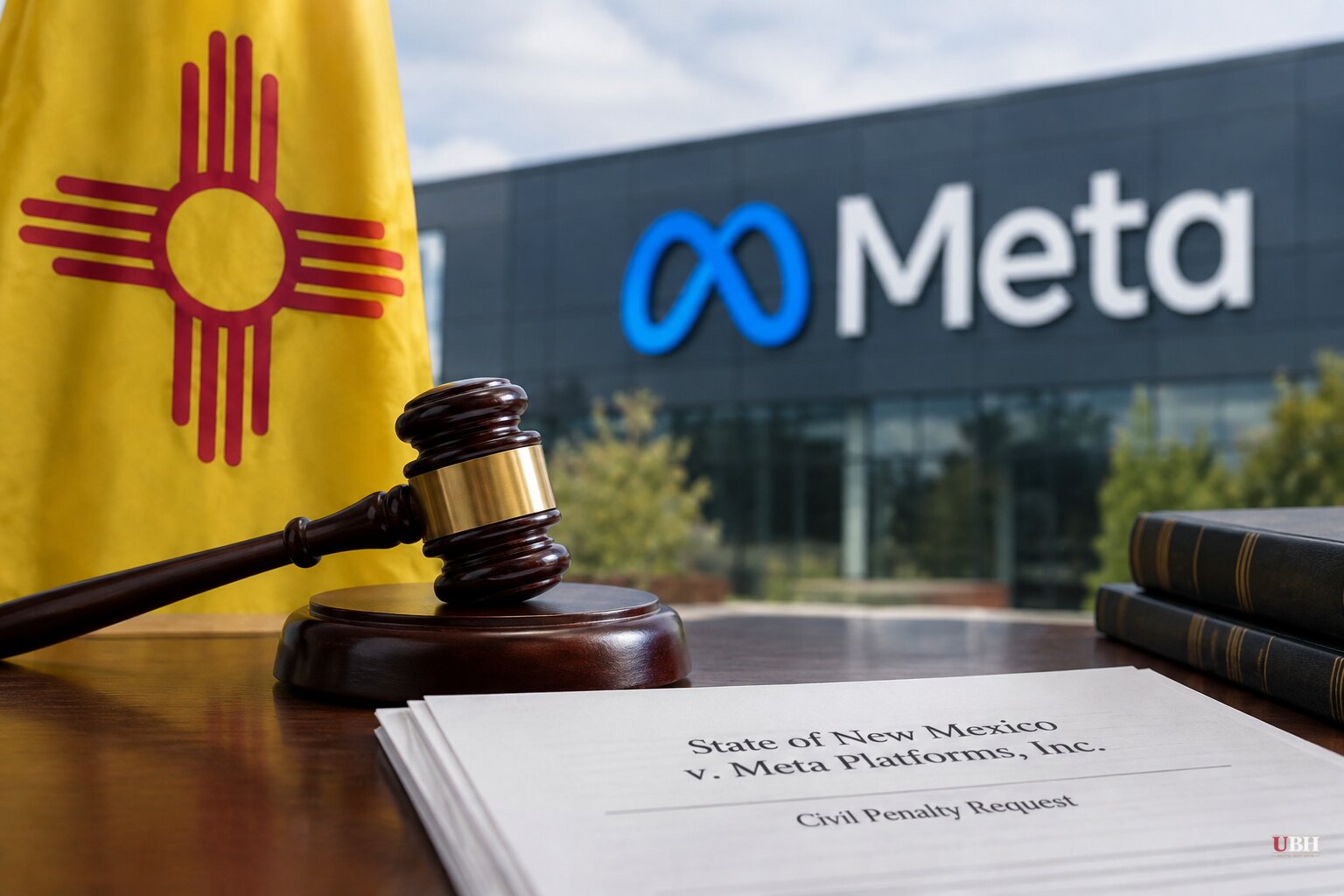
Since the Santa Fe jury verdict on September 25, New Mexico has moved to turn that win into one of the largest corporate penalties in U.S. history. At an October 1 hearing, state attorneys asked Judge Francis Mathew to order Meta Platforms to pay between $35 billion and $40 billion over how Facebook handled user data tied to the Cambridge Analytica scandal, according to Reuters.
The jury found Meta violated New Mexico's Unfair Practices Act more than 43 million times, based on the number of state residents exposed to misleading company statements. Jurors reviewed 29 statements Meta made about data privacy, hate speech enforcement and misinformation, and found 26 of them misleading, according to the Associated Press and Reuters.
Under state law, Mathew can fine Meta up to $5,000 per violation, a maximum that would top $200 billion according to the AP, with New Mexico Attorney General Raúl Torrez's office putting the full statutory ceiling at roughly $219 billion. The state isn't asking for that much. McGinn's team pitched $35 billion to $40 billion as roughly 20 percent of the maximum, a figure she argued would survive appeal while still landing a real blow.
"This court should speak to Meta in the only language it understands, which is money, and the value of its stock price," state attorney Randi McGinn told the judge, according to Reuters and the Epoch Times.
Meta attorney Matt Nicholson pushed back hard, calling the request an "astronomical penalty that would obviously violate a host of constitutional provisions," according to The News International. Meta is asking Mathew to cap the fine at $3.45 billion, arguing New Mexico never proved any specific resident was actually deceived and that the company doesn't sell user data.
Judge Mathew wasn't especially sympathetic to that framing. "Well, when the parties go to trial, they roll the dice," he said, according to the Epoch Times and Benzinga. "They have to accept the consequences of their decision to go to trial, do they not?"
The Underlying Case
New Mexico sued Meta in 2021 after revelations that Cambridge Analytica, a British political consulting firm that worked on Donald Trump's 2016 campaign, harvested personal data from as many as 87 million Facebook users through a third-party app without their consent, according to the Epoch Times and The Next Web.
The state's lawsuit went further than the original scandal, alleging Meta also misled users about how it enforced policies on hate speech and misinformation. The jury rejected two of the state's claims, finding Meta did not mislead consumers specifically about its content-removal efforts or fact-checking, according to The Next Web's account of the AP's reporting.
Torrez called the verdict "historic," saying in a statement carried by CBS News and reported by The Next Web that "for years, Facebook operated as if the rules that apply to everyone else didn't apply to them. Today, a jury of New Mexicans said otherwise." Torrez said any penalty money would go into a state education fund, and the state is also asking Mathew to order non-monetary remedies, including corrective public statements and an outside audit of Meta's data practices.
Meta spokesperson Alex Burgos said the company "disagree[s] with the verdict and will continue to defend ourselves against efforts to distort our record," adding that Meta has a First Amendment right to manage its own platforms, according to The Next Web.
Meta's Defense Has a Real Argument
Meta's lawyers argued at trial that the state cherry-picked statements out of context and ignored the times Meta itself acknowledged its privacy and misinformation enforcement was imperfect, according to the Epoch Times. Meta also maintains it has never sold user data outright, a distinction the company says matters even if it profits from targeted advertising built on that data. Whether 43 million technical violations translate into actual consumer harm, as opposed to misleading corporate language, is the exact question Mathew now has to weigh in setting a dollar figure.
Not Meta's First Santa Fe Loss This Year
This is the second time in six months a Santa Fe jury has ruled against Meta, according to The Next Web. In March, a separate jury found Meta misled users about risks to young people's mental health and ordered $375 million in damages, later followed by a judge-ordered $567 million payment into a teen health fund. Separately, Meta agreed in August to a $12.6 billion multistate settlement over child-safety and addiction claims, of which 7% had been paid as of that settlement, according to the International Business Times. That deal required daily usage limits, nighttime blocks for teens and stronger age-verification tools.
Wall Street Isn't Worried, Yet
Despite facing a potential $40 billion hit, Meta shares closed at $725.93 on Thursday and ticked up 0.12% in after-hours trading, according to Benzinga Pro data. META stock rose 27% in September, its best month since July 2013, as investors focus on the company's AI push, including its newly launched Muse AI assistant and Meta VR glasses, according to TradingView. Retail sentiment on Stocktwits sat in neutral territory, per TradingView, suggesting traders see this penalty fight as noise compared to Meta's AI bet.
Judge Mathew says he expects to rule later this month. Whatever number he picks, Meta has signaled it will appeal, meaning the real test of New Mexico's $219 billion statutory ceiling and whether a 20 percent penalty survives constitutional due-process review is still ahead.
Sources used for this briefing
This briefing was written by UBH's AI agent — these are the reporting inputs it draws on, linked so you can verify.


