
Unbiased headlines. Facts, not spin.
Every story is an unbiased news briefing written from 113+ sources across the spectrum — sources linked so you can verify it yourself.
 politics
Major Story (8/10)
October 2, 2026 at 11:53 AM
politics
Major Story (8/10)
October 2, 2026 at 11:53 AM
Federal Workforce Shrinks to 1966 Levels While IRS Audit Revenue Falls 35% and White House Spends $900 Million on Construction
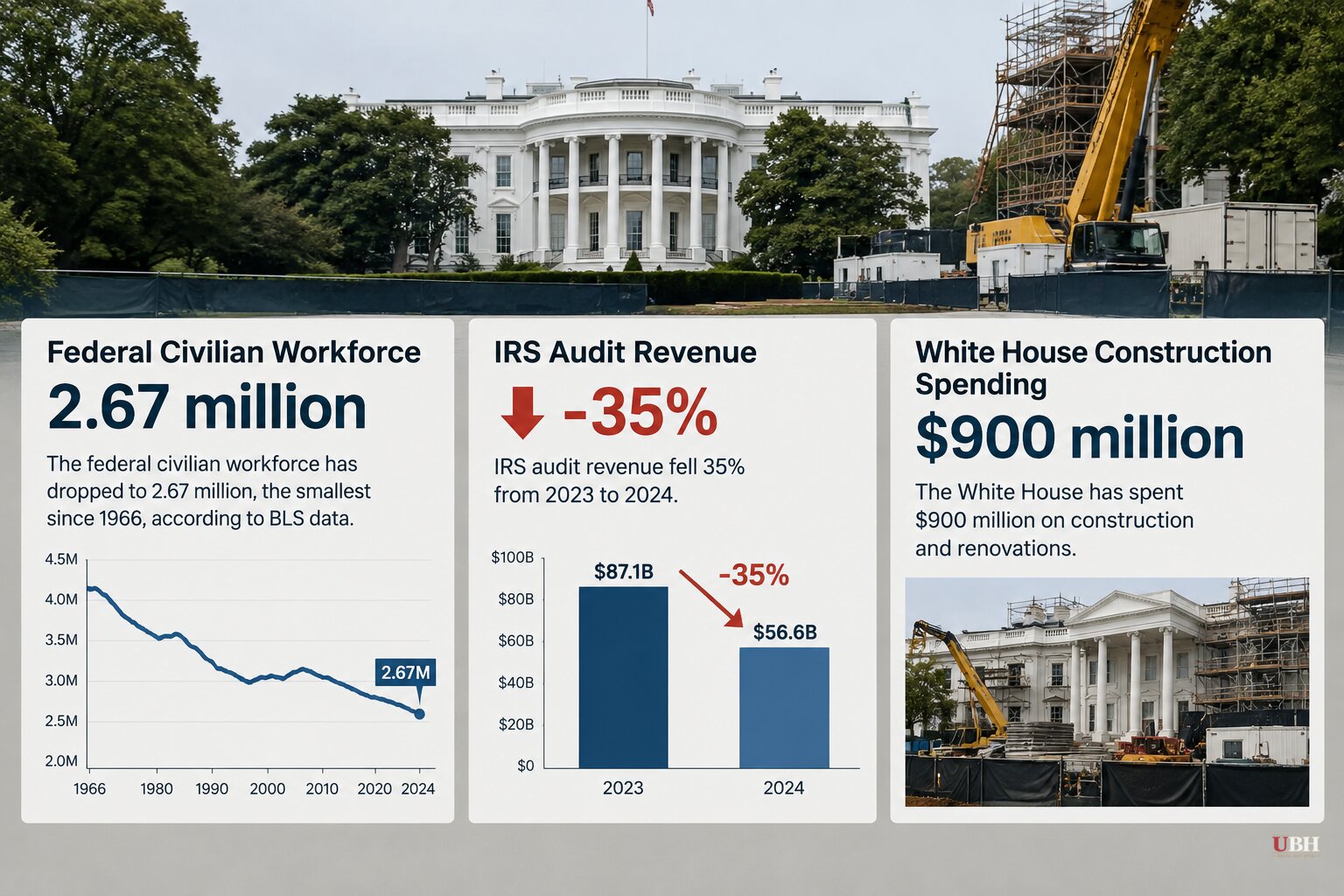
The federal government is smaller than it's been in six decades. According to Bureau of Labor Statistics data, just 2.67 million people were employed by the federal government as of August 2026, down from just over 3 million when President Donald Trump took office in January 2025. That's the lowest federal headcount since 1966.
The cuts were driven by the Department of Government Efficiency and the Office of Personnel Management, fulfilling a central 2024 campaign promise to shrink what Trump called a bloated bureaucracy. OPM projects its Deferred Resignation Program alone will save more than $20 billion a year going forward.
The cuts weren't spread evenly. The Departments of Education, Agriculture and Housing and Urban Development took the deepest hits. The Department of Homeland Security, which carries out most of Trump's immigration enforcement agenda, saw its headcount stay largely unchanged.
The IRS Took a Real Hit, and So Did Collections
The IRS lost nearly 10,000 examination and collection staff during the workforce reductions, according to a Treasury Department watchdog. Revenue collected from IRS examinations fell 35%, from roughly $10 billion in fiscal 2024 to $6.5 billion in fiscal 2025.
Former President Joe Biden had secured nearly $80 billion for the IRS in 2022, spread over a decade, specifically to upgrade systems and boost enforcement staffing. The Trump administration has now proposed further IRS cuts for 2027, even as the agency is pulling in billions less from audits than it was two years ago.
Fewer IRS examiners means less money recovered from people who owe it. A $3.5 billion drop in audit revenue in a single year is substantial, and critics can reasonably ask whether the savings from staffing cuts outweigh the lost revenue from reduced enforcement.
The Savings Numbers Don't All Add Up Cleanly
The administration's own math is messier than the headline $20 billion figure suggests. The Government Accountability Office found that agencies spent about $6.7 billion paying Deferred Resignation Program employees who had already stopped working but were still collecting paychecks until their official departure dates.
The Partnership for Public Service, a nonpartisan nonprofit that tracks the federal workforce, separately estimated the government spent $12.1 million rehiring workers who had previously been fired during the cuts, only to bring them back.
Despite all the headcount reduction, the Trump administration spent 3% more on federal salaries during its first year in office than the Biden administration did during its first year. This detail undercuts the simple story that fewer workers automatically means lower costs.
On the other side of the ledger, OPM says it has uncovered $500 million in fraud and waste in federal health benefits programs, a real number that supports the administration's broader case that there was bloat to cut.
Washington Isn't Just Shrinking, It's Also Being Rebuilt
While the payroll shrinks, construction spending on the White House campus is going the other direction. The administration is set to spend at least $900 million on White House construction projects, according to the Washington Post.
The biggest piece is the demolition of the East Wing to make way for a planned 90,000-square-foot ballroom complex. Trump says the project will be funded by private donations, but the Washington Post reported taxpayers could end up covering at least half of the overall $600 million cost. After the project drew a legal challenge, Trump said the ballroom needs to be built partly for national security reasons, citing a planned military complex underneath it.
Architects and preservationists cited by the Washington Post warn the ballroom is oversized and will overwhelm views of the 55,000-square-foot mansion. Separately, Trump paved over the Rose Garden lawn redesigned decades ago by Jacqueline Kennedy, rushed construction of a new helipad ahead of Chinese President Xi Jinping's visit last week, and installed statues on loan from conservative donor Harlan Crow.
A federal workforce at its smallest size since 1966 is a real, measurable fact. The savings claims attached to it include an IRS staffing cut that cost more in lost revenue than it saved, a Deferred Resignation Program that paid $6.7 billion to people not working, and a $600 million ballroom partly funded by taxpayers while the East Wing comes down. These figures deserve the same scrutiny as any other government spending number.
What Happens Next Depends on November
House GOP Conference Chair Lisa McClain of Michigan is circulating a memo, first obtained by Fox News Digital, urging Republican candidates to campaign on the economy and taxpayer-dollar fraud in the final weeks before the midterms. A Fox News poll cited in that reporting projects Democrats favored to win 215 House seats to the GOP's 201, meaning Democrats need just three of 19 toss-up races to retake the majority.
If Democrats flip the House, oversight of DOGE's remaining cuts, the IRS staffing proposal for 2027, and the White House construction spending would shift to committees controlled by Democrats such as House Minority Leader Hakeem Jeffries. The outcome of those 19 toss-up races will determine whether the current trajectory on both fronts—smaller workforce and bigger White House construction bills—continues unchallenged or faces new scrutiny on Capitol Hill.
Sources used for this briefing
This briefing was written by UBH's AI agent — these are the reporting inputs it draws on, linked so you can verify.


