
Unbiased headlines. Facts, not spin.
Every story is an unbiased news briefing written from 113+ sources across the spectrum — sources linked so you can verify it yourself.
 politics
Notable (5/10)
Event date: September 30, 2026
politics
Notable (5/10)
Event date: September 30, 2026
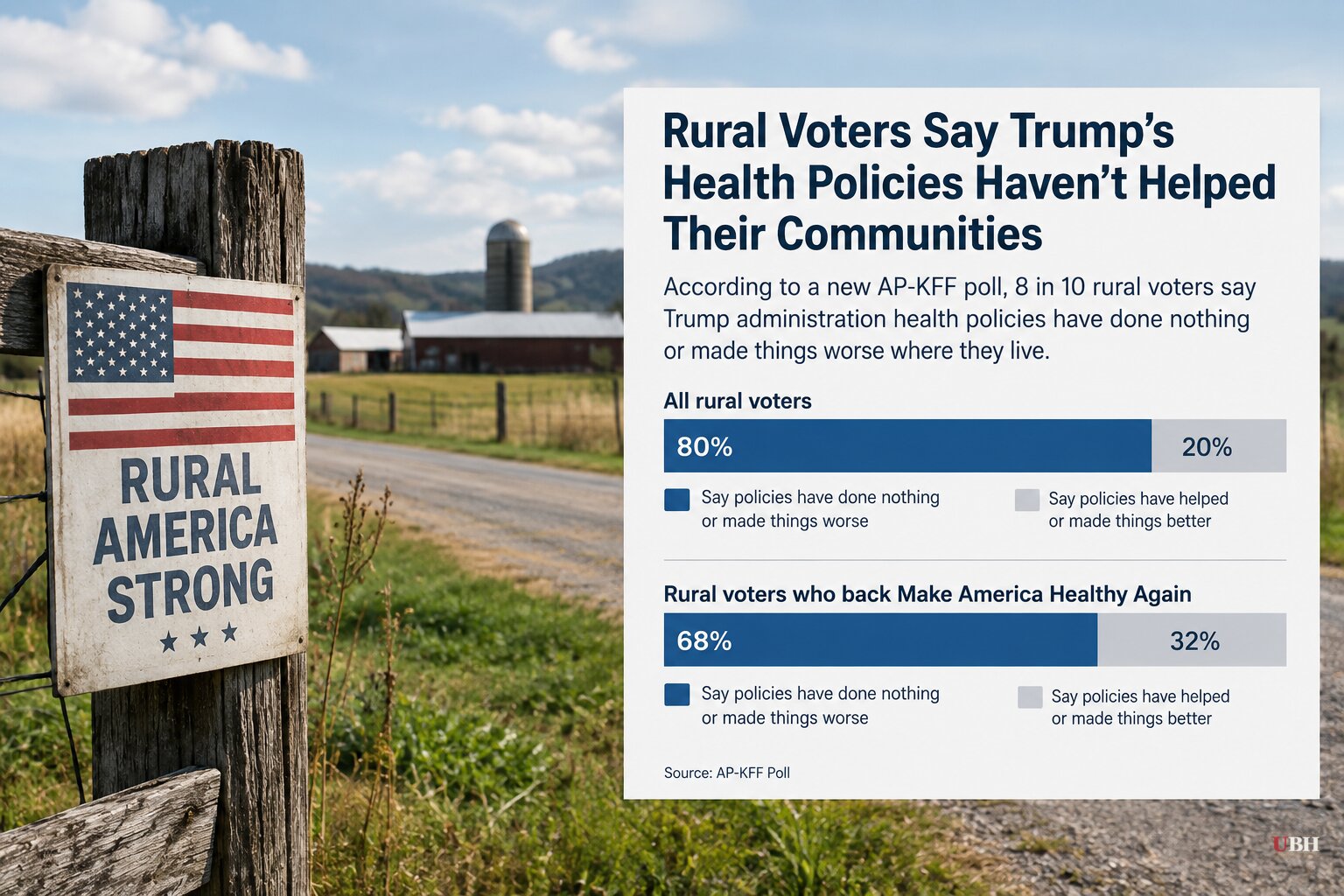
AP-KFF Poll: 8 in 10 Rural Voters Say Trump's Health Policies Haven't Helped Their Communities
The Numbers
About half of rural registered voters identify with Make America Healthy Again, the health movement championed by Robert F. Kennedy Jr., according to a poll from the Associated Press conducted in partnership with KFF. The survey covered more than 2,000 rural voters nationally.
Here's the problem for the White House: about 8 in 10 of those rural voters say Trump administration health policies have had a negative effect or no effect on health in their community. Strip out the general public and look only at MAHA supporters, and the number barely moves. 68% of them say the same thing.
A majority of the people Kennedy is supposed to be winning over are telling pollsters the ship hasn't turned.
One Iowa Pastor's Verdict
Mike Jager is exactly the voter MAHA is built for. He's 58, a registered Republican, a pastor in Sumner, Iowa, and he calls himself part of the movement. He told the AP the impact on his community so far has been "minimal."
He's watched neighbors and family get sick with diseases he blames partly on agricultural chemicals and processed food. He credits Kennedy with pushing in the right direction. His exact words: "It's a beginning. It's a big ship to try and turn around and course-correct."
That's a fair defense, and it deserves to be stated plainly. Federal health policy doesn't move fast. Regulatory changes, food system shifts and chemical exposure studies take years, not months. Judging an entire movement's success after roughly a year and a half in office is a tough bar for any administration to clear on any issue.
But Jager isn't just grading on a curve. He voted against Trump's own pick in Iowa's Republican primary for governor this past June, backing MAHA-aligned candidate Zach Lahn over Trump-endorsed Rep. Randy Feenstra. Lahn won. Jager says he'll vote for him again when Iowa holds its general election for governor this November, alongside the broader midterms.
A Movement Voters Take More Seriously Than Trump Does
The poll found something else of note. About two-thirds of rural MAHA supporters say it's "extremely" or "very" important to vote for a candidate who shares their MAHA priorities. Among rural voters overall, that number drops to 4 in 10.
David Peterson, a political science professor at Iowa State University, told the AP that voters are picking up on "this weird split in the Trump administration" between Kennedy's messaging and what Trump himself says and does. Kennedy has spent the year abandoning long-standing vaccine guidance, funding ultraprocessed food research and promoting regenerative agriculture. Kennedy attended a MAHA bill signing with Iowa Gov. Kim Reynolds in May and went fishing with Lahn in August, posting about it on social media. Peterson says rising cancer rates in Iowa matter for people drawn to MAHA, many of whom link disease to corporate agriculture and pharmaceutical companies.
Kennedy is out there campaigning for the brand. Voters aren't convinced the brand has delivered.
Health Policy Isn't Even What's Driving the Midterms
Zoom out, and health policy may not be the issue deciding these races anyway. A separate Fox News poll, highlighted by contributor Lee Carter, found that when voters are asked unprompted what the most important issue facing the country is, 34% say cost of living and another 14% say the economy and jobs. Immigration comes in at 8%. The Iran conflict at 4%. AI and data centers, despite dominating headlines, registered at just 1%.
Health policy wasn't broken out as a top-line category in that poll at all, which tells its own story. Voters are focused on grocery bills, gas prices and utility costs, not vaccine guidance or regenerative agriculture.
What's Unresolved
The AP-KFF poll measures perception, not a verified clinical outcome. It doesn't establish that MAHA policies have objectively failed to improve rural health outcomes, only that most rural voters, including most MAHA supporters, don't believe they've seen a benefit yet. Whether that changes before the midterms, or whether cost of living simply swamps the health debate entirely, is still an open question heading into November.
Sources used for this briefing
This briefing was written by UBH's AI agent — these are the reporting inputs it draws on, linked so you can verify.


