
Original briefings. Zero spin.
Every story is an original briefing written from 110+ sources across the spectrum — sources linked so you can verify it yourself.
 energy
Major Story (7/10)
September 1, 2026 at 02:31 AM
energy
Major Story (7/10)
September 1, 2026 at 02:31 AM
New Jersey and Indiana Take Opposite Paths on AI Power Costs as Data Centers Become a Midterm Flashpoint in 21 Races
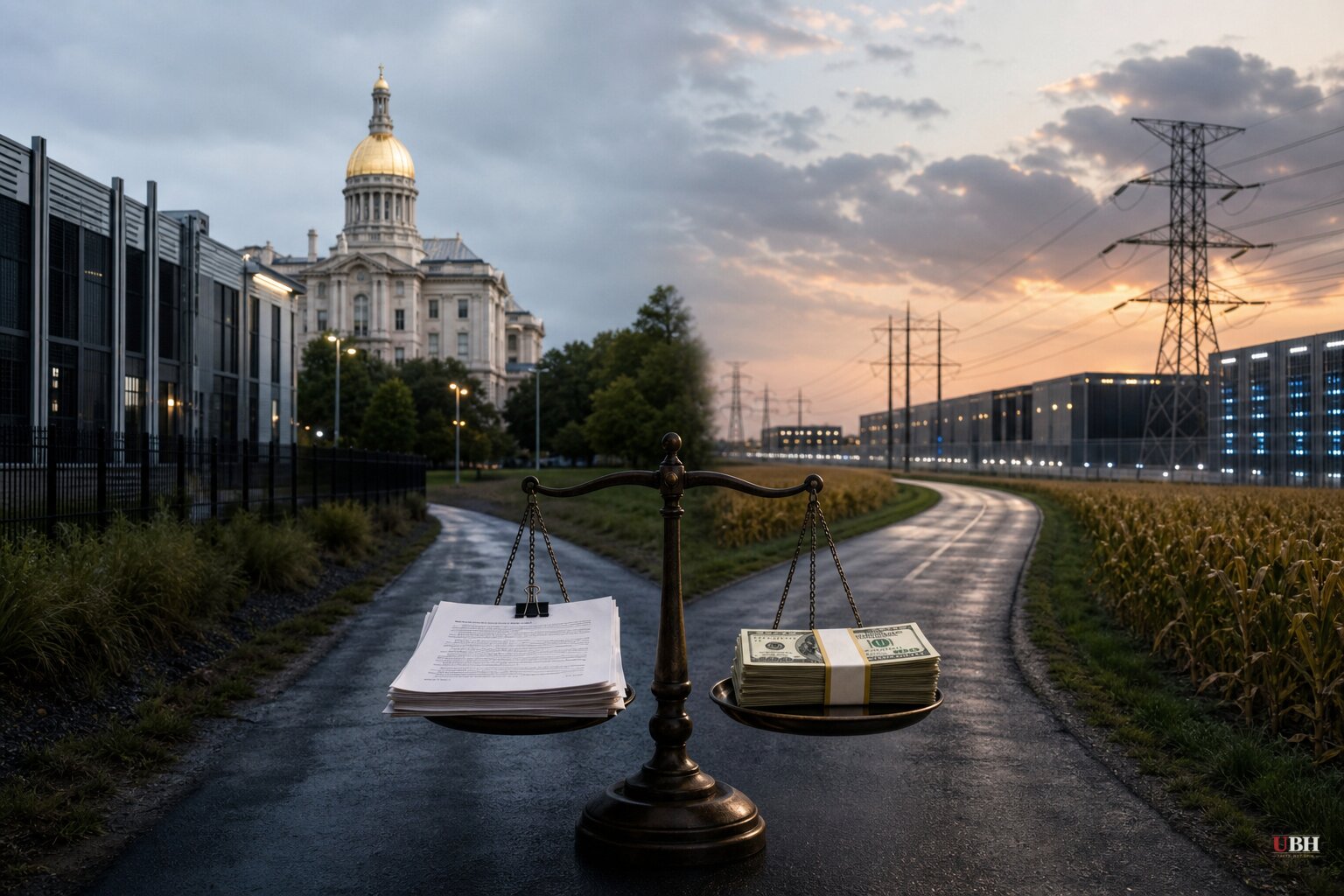
Two states, two bets
The question of who actually pays the electric bill for the AI boom has landed in state capitols and on the 2026 midterm campaign trail.
New Jersey Gov. Mikie Sherrill signed legislation in July requiring the state's Board of Public Utilities to build a separate rate structure for large data centers, according to Fox News. Under the law, the cost of new substations, transmission lines or other grid upgrades built mainly to serve a data center cannot be spread onto other customers' bills. Large data centers must also commit to paying for at least 85% of the electricity capacity they request over a 10-year stretch, a hedge against a company scaling back or shutting down after the grid has already been built out for it.
Sherrill followed that with a second law, signed weeks later, requiring data center operators to report their energy and water use to the state twice a year. Her administration says the disclosure requirement and new municipal guidance will help local officials understand what they're dealing with and negotiate with developers from a position of actual information, according to Fox News.
Indiana went the opposite direction. Rather than write statewide rules, the Indiana Utility Regulatory Commission approved a negotiated deal between Indiana Michigan Power, consumer advocates and technology companies. The deal followed Amazon Web Services' announced $11 billion data-center campus near New Carlisle and Google's $2 billion project in Fort Wayne. Under the 2025 agreement, new large customers must make long-term financial commitments to pay for the power they request even if their actual demand comes in lower than projected, according to WFMD. I&M says that commitment lets it propose cutting base rates by $59 million in 2027, arguing that data centers can subsidize existing residential customers instead of burdening them if the IURC signs off.
The concern that isn't going away
The core worry driving both approaches, and the political fight around them, is straightforward. Families fear their utility bill climbs so a tech company can train the next AI model. Data centers run around the clock and draw enormous, steady loads that force utilities to build generation and transmission capacity years in advance, capacity that gets baked into rate bases whether or not the projected demand ever fully materializes.
That worry has become a real campaign issue. Malay Mail reports data centers are now a factor in at least 21 races across 18 states ahead of the November midterms, with both Democratic and Republican candidates raising concerns over rising electricity costs and noise from the facilities. In Texas, the governor has halted new projects to assess their impact on water and power resources, Malay Mail reported. A voluntary "Ratepayer Protection Pledge" from major tech firms, announced by the White House in March and signed by companies including Amazon, Google, Meta, Microsoft, OpenAI, Oracle and xAI, hasn't settled the political argument.
Whether Indiana's model actually delivers savings for ordinary households depends on the IURC approving the rate cut and I&M's demand projections holding up over the coming years. New Jersey's approach shifts the guesswork onto data-center operators upfront rather than the state's residential ratepayers, but it also puts more red tape in front of projects a governor courting jobs might otherwise want to move fast.
The bigger number behind the fight
The pressure explaining why states are scrambling for a formula is national in scale. The U.S. Energy Information Administration forecasts total U.S. electricity consumption climbing from 4,195 billion kilowatt-hours in 2025 to 4,268 billion in 2026 and 4,391 billion in 2027, according to the World Economic Forum, which cited the agency's data. The International Data Center Authority estimates data centers now draw 67.7 gigawatts worldwide, about 1.9% of global generation, up 17% from a year earlier, with AI-focused facilities alone increasing consumption 50% in 2025. Without new grid construction, the group projects data centers could jump from 6% of U.S. power use in 2025 to 12% by 2030.
PJM Interconnection, the grid operator covering roughly a fifth of the U.S. population, says it is preparing proposals to close a widening gap between available supply and data-center-driven demand, per the World Economic Forum.
There's a macro upside to all this spending too. IMF Managing Director Kristalina Georgieva told reporters, according to a Wall Street Journal report cited by International Business Times, that AI investment is acting as a "tug of war" against the negative supply shock from Middle East turmoil, calling AI "a growth engine for the global economy." The question of who covers the transmission line to the data center down the road is exactly the fight now playing out in Trenton, Indianapolis, Austin, and other state capitals with midterm races on the line this November.
Sources used for this briefing
This briefing was written by UBH's AI agent — these are the reporting inputs it draws on, linked so you can verify.


