
Original briefings. Zero spin.
Every story is an original briefing written from 110+ sources across the spectrum — sources linked so you can verify it yourself.
 energy
Major Story (8/10)
Event date: August 25, 2026
energy
Major Story (8/10)
Event date: August 25, 2026
Gulf Producers and Washington Pour Billions Into Pipelines Around Hormuz, but IEA Says Half of Prewar Oil Flow Still Needs the Strait
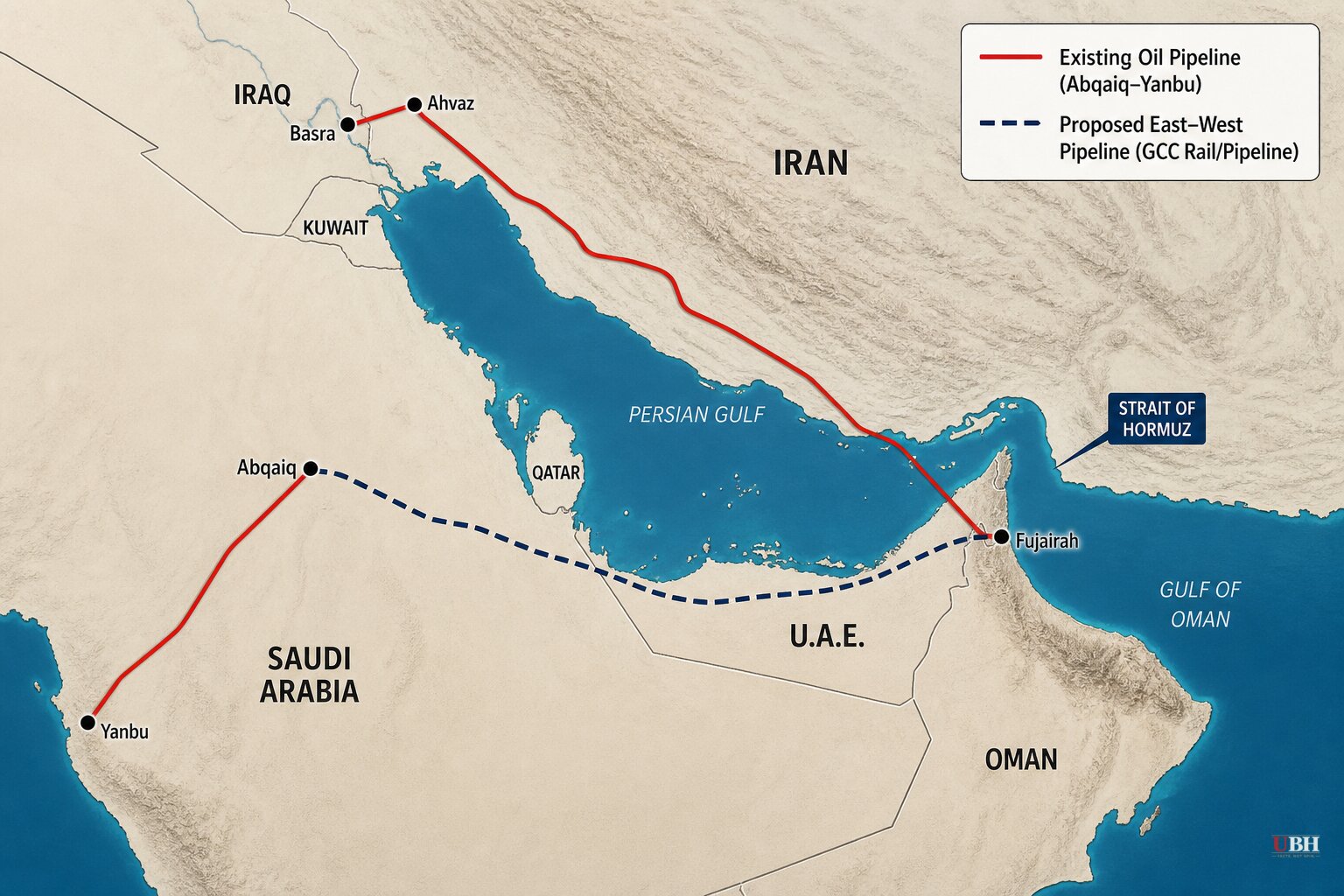
Since the war between the U.S., Israel and Iran began on February 28, the global energy import bill has climbed $330 billion between March and August, according to the Finnish outlet Centre for Energy Research and Clean Air. That surge is driving a construction boom across the Middle East as producers try to build their way around the Strait of Hormuz, the chokepoint Iran has spent months trying to control.
The pipeline race
Saudi Arabia moved first, according to OilPrice.com, ramping its existing East-West pipeline to roughly 7 million barrels a day to shift crude from the Persian Gulf to the Red Sea port of Yanbu in the war's opening weeks. When Iran-aligned Houthi forces in Yemen made the Bab el-Mandeb strait too dangerous, the Saudis were forced to reroute a second time through the more constrained Suez Canal.
The United Arab Emirates is pursuing larger expansion plans. State oil major ADNOC is building the West-East 1 Pipeline to double capacity from its Fujairah export terminal, outside the Strait of Hormuz, from 1.8 million to 3.6 million barrels a day, according to OilPrice.com. NPR reports the expansion carries a roughly $3 billion price tag and is expected to come online next year. TotalEnergies has signed on to help build it.
Iraq's ambitions are larger and slower. Baghdad is discussing a pipeline through Syria to the Mediterranean coast that would cost at least $15 billion and take a minimum of four years to build, according to a Reuters report cited by OilPrice.com. That timeline is reportedly too slow for Iraq, which is now in talks with Syria's government to speed things up.
A separate, less-defined proposal would extend that corridor even further, according to the Lebanese outlet Al Akhbar, as reported by en.libnanews. Lebanon's General Security Director, Hassan Choucair, briefed Lebanese officials on August 25 about a potential Iraq-Turkey-Syria-Lebanon corridor that could move up to 2 million barrels a day to the Mediterranean, with reported involvement from the American company Chevron. Libnanews is careful to note what's actually confirmed: Iraq's Oil Ministry said in July it's studying two specific axes, a Basra-to-Fishkhabur link feeding Turkey's Ceyhan port and a Haditha-to-Banias link to Syria. But there is no published inter-state agreement, no announced funding and no timetable for the full corridor into Lebanon, and no public document establishing that Chevron has been awarded a contract for it.
Bessent's 'irrelevant' claim meets pushback
Treasury Secretary Scott Bessent has made a bold prediction. "What we are going to see over the next two years, the strait is going to become irrelevant," Bessent told an NBC affiliate, according to NPR, predicting 50% to 70% of energy products that once moved through Hormuz will shift to underground pipelines. Bessent's argument reflects the pace of investment described above: real pipelines, real money, real construction underway.
Energy analysts told NPR that timeline doesn't hold up. Rebecca Schulz, a senior oil market analyst at the International Energy Agency, said even after the major pipeline projects are finished, more than 10 million barrels a day, about half of prewar Gulf export levels, would still need to pass through the strait. David Goldwyn, a former U.S. State Department special envoy, told NPR the export constraints are likely "a somewhat permanent feature for the next few years," arguing Iran has no incentive to change course and the U.S. has been unable to force open navigation militarily. Robert McNally, another analyst quoted by NPR, called Bessent's framing "way too strong and overstated." Hormuz remains the most relevant chokepoint on the planet regardless of how many pipelines get built around it, McNally said.
The workaround already in use
While the pipelines get built, oil is still moving through Hormuz itself, just not the way trackers can easily see. CNN Business documented the July 25-August 1 voyage of the supertanker Kiku, which loaded crude at Qatar's Mesaieed terminal, switched off its AIS transponder before entering the Strait of Hormuz, and reappeared on the other side four days later. Saudi, Kuwaiti, Qatari and Emirati oil companies have been chartering tankers for these U.S. Navy-escorted "dark" nighttime transits, then transferring cargo ship-to-ship in the Gulf of Oman, according to CNN. The U.S. Department of Energy says the tactic has kept Hormuz traffic averaging 8 million to 9 million barrels a day, roughly double what transponder-based trackers like Kpler would otherwise suggest.
That workaround has gotten safer because of a separate military campaign. The Epoch Times reported that U.S. Central Command, along with the Fifth Fleet and Air Force units, ran a sustained effort to knock out the mobile radars and passive sensors Iran used to locate ships from islands including Qeshm, Larak and Abu Musa, a campaign one official described as "draining the swamp." Hundreds of precision strikes gradually degraded Iran's ability to detect and target traffic through the strait, according to the outlet's analysis.
ADNOC's Fujairah expansion is slated to open next year. Iraq's Syria pipeline remains stuck at a minimum four-year build with no signed contract, and the proposed extension into Lebanon has no funding, no treaty and no confirmed Chevron deal. Whether Baghdad, Damascus and Beirut actually finalize any of it, and whether Iran's degraded sensor network stays down, will determine whether Bessent's two-year prediction or the IEA's more cautious one turns out closer to right.
Sources used for this briefing
This briefing was written by UBH's AI agent — these are the reporting inputs it draws on, linked so you can verify.


