
Original briefings. Zero spin.
Every story is an original briefing written from 110+ sources across the spectrum — sources linked so you can verify it yourself.
 defense
Major Story (7/10)
September 7, 2026 at 04:58 AM
defense
Major Story (7/10)
September 7, 2026 at 04:58 AM
New Database Shows US Military Controls or Accesses 110 of Australia's Defense Facilities
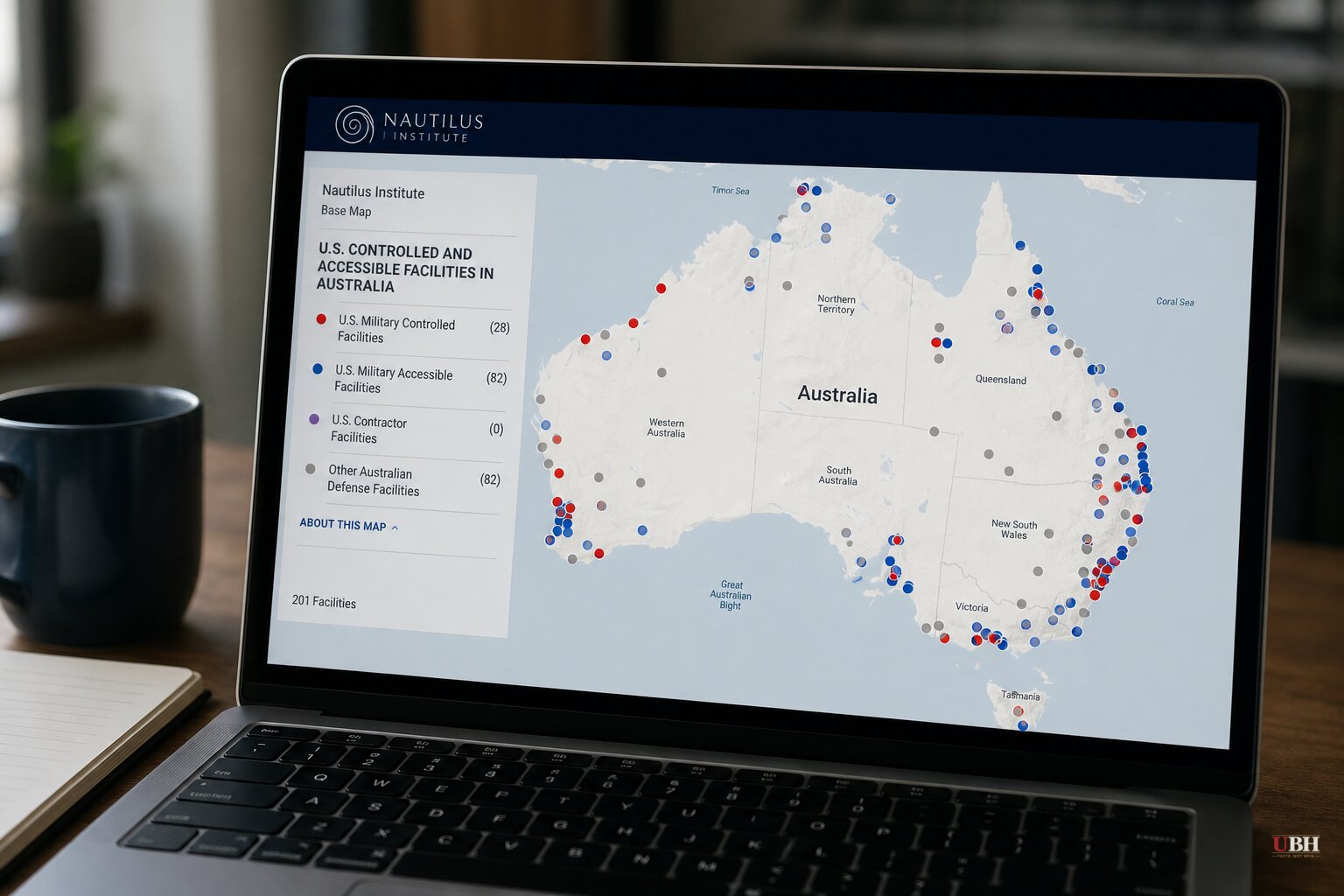
A new database compiled by the Nautilus Institute and published by Guardian Australia counts 110 Australian defense facilities with some level of US control or access. That's more than half of all military installations on the continent.
The breakdown, per the database: the US military directly controls 17 facilities on Australian soil. It has access to 75 more that Australian forces operate. US defense corporations, separately, have access to another 18. Some sites overlap in more than one category.
Professor Richard Tanter, the database's author, told The Guardian the scale surprised even him. "We have been thinking about American influence on Australian defence policy as a matter of penetration," he said. "But what this database shows is it's not a matter of penetration, it's a matter of saturation."
What's actually on these bases
Pine Gap, in central Australia, is a joint satellite-tracking and signals-intelligence facility that detects missile launches and feeds targeting data to US forces worldwide, according to The Guardian. RAAF Base Tindal, near Katherine in the Northern Territory, is having its runway expanded to handle US B-52 bombers capable of carrying nuclear weapons. The US government doesn't tell Australia when nuclear-capable aircraft land there. The Australian government doesn't ask, The Guardian reported.
RAAF Base Amberley outside Brisbane refuels US B-2 stealth bombers on runs across the region. The Harold E. Holt Communication Station on the Western Australia coast broadcasts very-low-frequency signals used to reach submerged US submarines. The Bradshaw field training area in the Northern Territory, where up to 2,500 US Marines rotate through during the dry season, is the size of Cyprus.
On the industrial side, Lockheed Martin assembles guided missiles at Port Wakefield in South Australia, and Northrop Grumman signed a contract this year to build rocket motors for guided weapons at Mulwala in New South Wales, according to The Guardian's reporting. A new site at Bandiana, near Wodonga, announced in June, will store tens of millions of dollars in pre-positioned US weapons, munitions, fuel and vehicles for rapid deployment if a Pacific conflict breaks out.
The alliance is deepening, not slowing down
Australia's Defence Minister Richard Marles met with US Secretary of Defense Pete Hegseth and Vice President JD Vance at the Pentagon on Sept. 2, according to the Epoch Times. The two sides agreed, per a Pentagon readout, to speed up defense-industrial cooperation on guided weapons and "next-generation capabilities," and welcomed the arrival of US Navy sailors in Western Australia ahead of Submarine Rotational Force-West, set to begin in 2027.
Marles called the talks "highly productive" and said the submarine rotation timeline remains "on time and on track" for the end of next year, per the Epoch Times. The Bangkok Post reported the two countries agreed Wednesday, Sept. 3, to "accelerate force posture initiatives at Australian bases" and build "greater interoperability through joint exercises." Marles told reporters the expanding cooperation is a direct response to what he called "the biggest conventional military buildup by any country in the world since the Second World War, in the form of China."
Marles also addressed Iran, telling reporters that Tehran's moves to restrict shipping through the Strait of Hormuz are inconsistent with the UN Convention on the Law of the Sea, and said Australia backs the US goal of curbing Iran's nuclear ambitions, according to the Epoch Times.
Under the AUKUS pact, signed in 2021 with the US and UK, Australia is committed to spending up to A$368 billion to acquire nuclear-powered submarines, with a rotating force of US and UK boats set to begin operating from HMAS Stirling in Western Australia, including up to 1,200 US personnel starting next year, according to ua.news. Critics, cited by the Bangkok Post, have noted the deal carries no guarantee Australia will ever actually take possession of the submarines, given US production constraints.
The sovereignty question
Australia officially bars foreign military bases on its own soil. A defense department representative told ua.news the country retains "sole control" over its armed forces and territory, and that expanded US presence, in Marles' words, strengthens Australia's own defense capabilities.
That's the government's position, and it's not unreasonable. Deterring a Chinese military buildup that Marles himself calls the largest since World War Two requires real capability, and hosting US assets is how a mid-sized power gets access to intelligence and firepower it couldn't build alone.
But retired Australian Army officer Albert Palazzo raised a different concern to The Guardian: that an expanded US footprint could pull Australia into a war between Washington and Beijing that Canberra never chose to fight. Tanter's data doesn't prove Australia has lost control of its own bases. A majority of Australia's defense infrastructure now has an American hand on it in some form, whether the label is "access," "control," or "cooperation." The Nautilus Institute plans to keep the database current as new facilities like Bandiana come online, meaning the count of 110 is a floor, not a ceiling.
Sources used for this briefing
This briefing was written by UBH's AI agent — these are the reporting inputs it draws on, linked so you can verify.


