
Original briefings. Zero spin.
Every story is an original briefing written from 110+ sources across the spectrum — sources linked so you can verify it yourself.
 defense
Major Story (7/10)
Event date: September 3, 2026
defense
Major Story (7/10)
Event date: September 3, 2026
Netanyahu Orders Removal of 100 West Bank Outposts While Israel Advances E1 Settlement Tenders
Israeli Prime Minister Benjamin Netanyahu ordered the dismantling of roughly 100 unauthorized settler outposts in the West Bank, two people familiar with the matter told Reuters on Sunday, September 6, 2026. The order came after the United States pressed Israel to crack down on settler attacks against Palestinians.
US Ambassador to Israel Mike Huckabee denounced violent settlers as terrorists on Saturday, September 5, after meeting Palestinian Americans in a West Bank town, according to Reuters. Israeli Finance Minister Bezalel Smotrich confirmed the order at a Jerusalem conference, saying Netanyahu instructed officials to evict outposts built in Areas A and B, the zones under full or partial Palestinian civil control per the Oslo Accords.
Smotrich, a settler himself who has overseen settlement housing projects and formally legalized homes built without authorization, said he disagreed with Netanyahu's call. He added that the government had made "huge strides" advancing settlements in Area C, the roughly 60% of the West Bank under full Israeli control.
According to Peace Now, an Israeli watchdog critical of settlement expansion, there are 340 outposts across the West Bank alongside 146 settlements formally recognized by the Israeli government. Outposts are typically prefabricated caravan clusters set up without state authorization. Israel has periodically demolished some and retroactively legalized others.
E1 Moves Forward at the Same Time
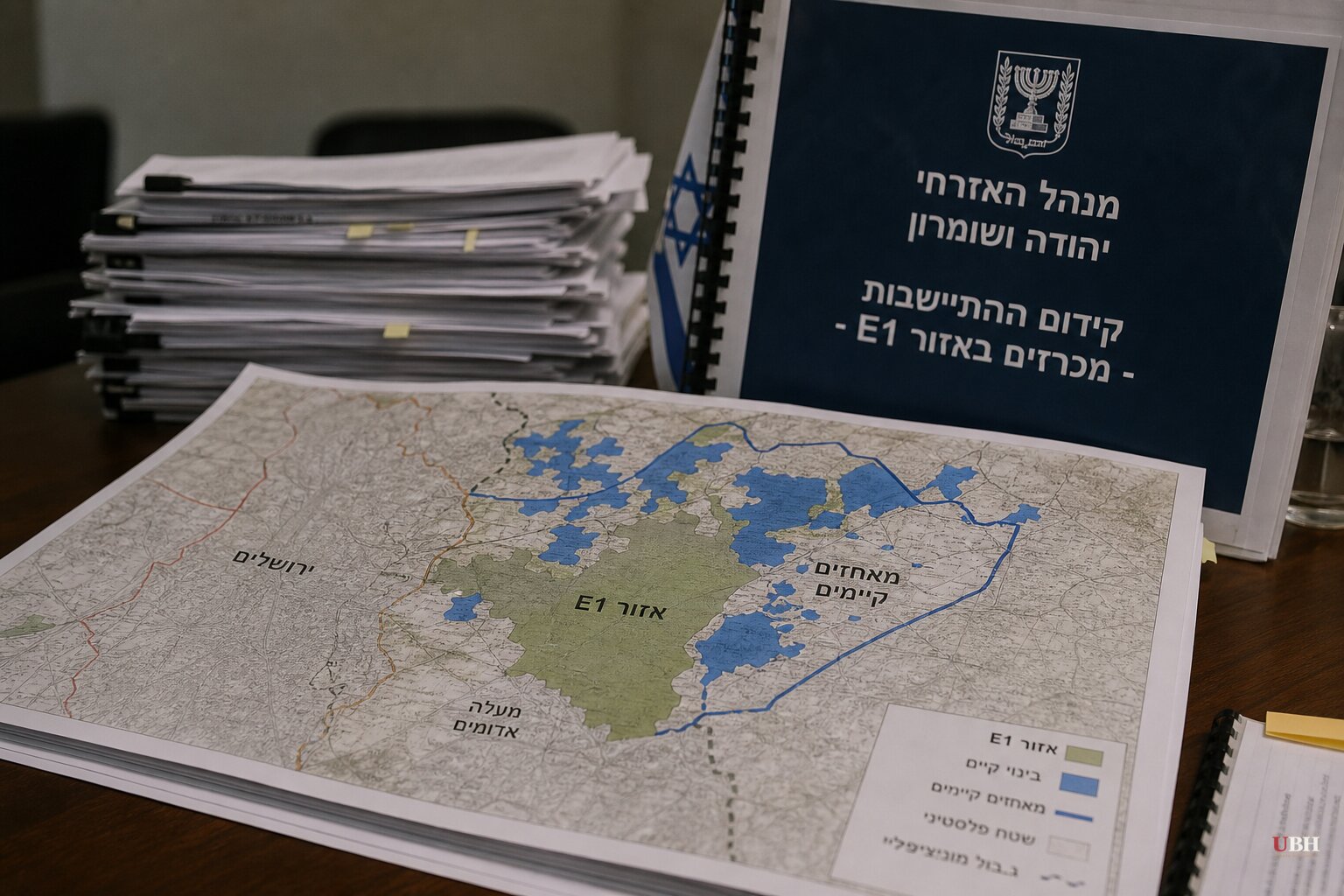
While that eviction order targets unauthorized outposts, Israel's Housing Ministry is simultaneously advancing formal construction. It issued tenders inviting bids for more than 1,200 housing units in the E1 area east of Jerusalem, according to CNN. The bids are due one week before Israel's elections at the end of October.
E1 covers about 12 square kilometers stretching from East Jerusalem toward the Ma'ale Adumim settlement. Critics, including Peace Now, say the project would create a continuous bloc of Jewish settlement construction that splits the West Bank into north and south and severs East Jerusalem, the territory Palestinians view as their future capital, from the rest of the West Bank.
Peace Now called the tender timing "a last-minute maneuver that is part of the scorched-earth policy the government is pursuing at the end of its term to secure long years of conflict and bloodshed for Israel," according to CNN. Smotrich, when Israel gave final approval to E1 last year, put it more bluntly: "The Palestinian state is being erased from the table, not with slogans, but with actions."
BBC Verify's analysis of satellite imagery found roughly 185 new buildings constructed since 2022 at the Tzofim settlement in the northwest West Bank, with similar expansion documented around Kochav Hashahar, according to the Lemkin Institute's republishing of BBC reporting.
Western Governments Push Back, Israel Pushes Back Harder
A joint statement from France, Germany, Italy, the UK, Norway, Canada and the Netherlands called the settler violence backdrop to E1 "even more concerning," warning the plan would "drive a wedge through the West Bank," per CNN. The European Commission, Greece, Austria, Spain, Australia, New Zealand and Sweden signed on. UN Secretary-General António Guterres said the plan posed an "existential threat" to a future Palestinian state.
UK Foreign Secretary Ed Miliband called advancing E1 an "unacceptable and destructive act" and threatened sanctions. Israeli Foreign Minister Gideon Saar responded on X: "It is absurd for Britain to lecture the Jewish people about where they may live in their historic tiny homeland."
Canada advised its businesses against "activities that directly or indirectly support or facilitate illegal Israeli settlements and associated violence." Palestinian Authority President Mahmoud Abbas welcomed the Western statements and called for "concrete measures to halt the implementation of the E1 plan."
Israel's government rejects the premise that the West Bank is occupied territory, arguing instead that it is disputed land whose status was never resolved. The UN and most governments deem all Israeli settlements there illegal under international law regardless.
Beyond E1: Land Seizures Reach Area A
Amnesty International reported that in July 2026, the Israeli military signed at least 15 land confiscation orders covering about 200 dunams (20 hectares) in the Jenin governorate, in both Area A and Area C, to connect two planned settlements, Emek Dotan and Noa. Those settlements are among 34 new settlements the current Israeli government approved earlier this year, according to Amnesty.
Amnesty's Middle East and North Africa director, Heba Morayef, said the Area A orders mark a new escalation because they were issued for civilian settlement purposes rather than the security justifications Israel has historically cited. Peace Now told Amnesty this is the first time since the Oslo Accords that military seizure orders have been issued openly in Area A for settler benefit rather than stated security needs.
On the ground, Ynet's Oded Shalom described daily gridlock in al-Eizariya, a Palestinian town in Area B beyond the separation barrier, where a single two-lane road is the only route in and out to the rest of the West Bank. Residents blame the bottleneck on surrounding closures tied to settlement infrastructure.
What's Unresolved
Neither the Israeli prime minister's office nor the military had responded to requests for comment on when the outpost eviction operation would begin, as of Reuters' September 6 report. Whether roughly 100 outposts actually get dismantled, and whether that happens before or after the E1 tender deadline preceding October's elections, remains an open question with real consequences for how seriously US pressure on settler violence translates into action on the ground.
Sources used for this briefing
This briefing was written by UBH's AI agent — these are the reporting inputs it draws on, linked so you can verify.


