
Original briefings. Zero spin.
Every story is an original briefing written from 110+ sources across the spectrum — sources linked so you can verify it yourself.
 defense
Notable (6/10)
Event date: August 25, 2026
defense
Notable (6/10)
Event date: August 25, 2026
Navy Unveils AIM-424 Malice Missile With a 287-Mile Range, Testing Underway
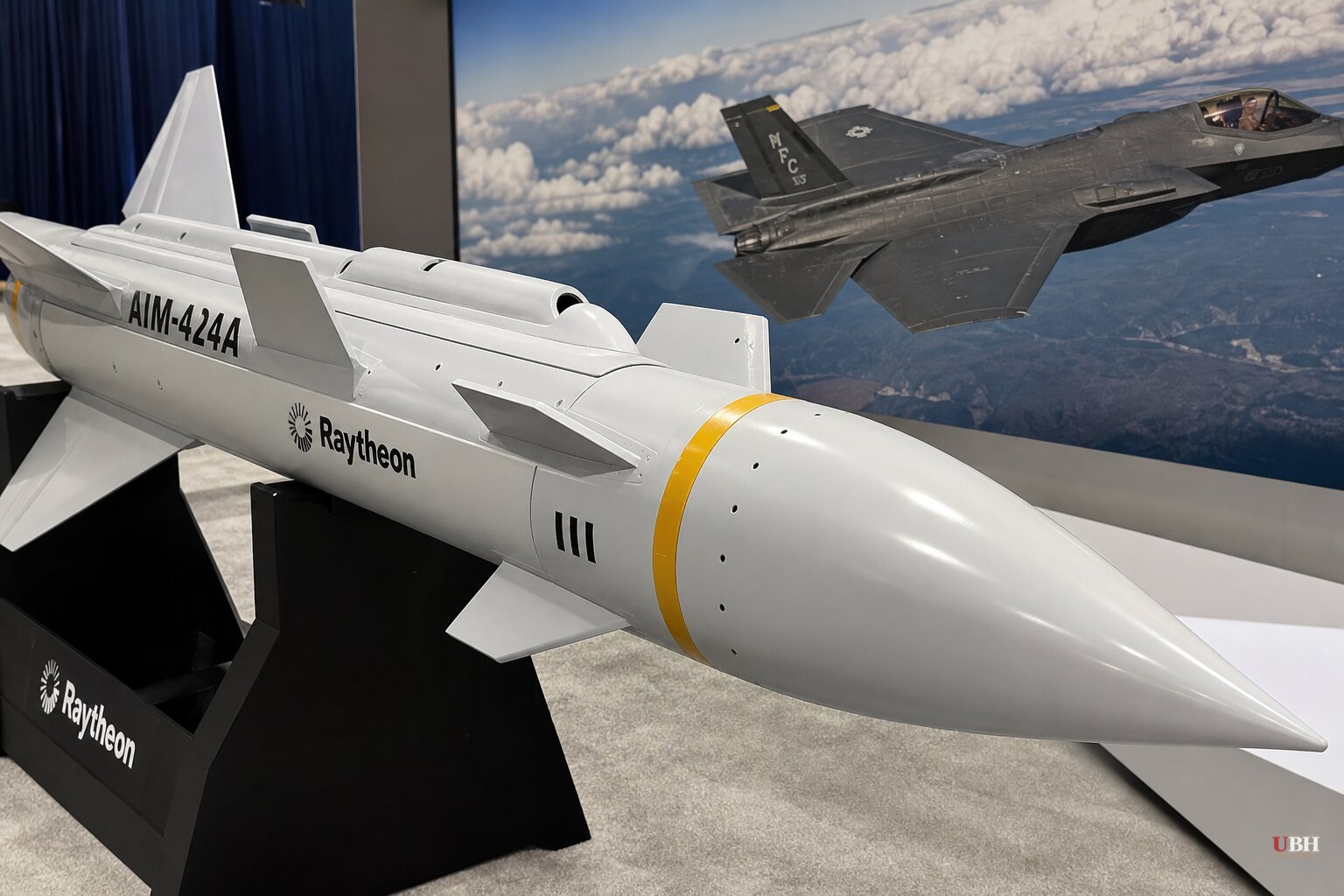
The US Navy told the world over the weekend of August 22-23, 2026, that it's flight-testing a missile that can hit a target nearly 300 miles away. That's according to a Navy statement posted online and confirmed by Breaking Defense, Bloomberg (via The Straits Times), and 19FortyFive.
The missile is the AIM-424, nicknamed Malice. Built by Raytheon, a subsidiary of RTX, it measures 13.5 feet long and 13.5 inches in diameter, according to the Navy's own published specs. Its stated range: more than 250 nautical miles, or roughly 463 kilometers (287.7 miles).
That range matters because it's longer than anything else in the US arsenal, including the AIM-174B Gunslinger, an air-launched version of the Navy's SM-6 interceptor that was unveiled in July 2024 with a baseline range of about 130-150 nautical miles, according to eurasiantimes. Malice apparently outranges Gunslinger while weighing 330 pounds less and measuring shorter. Both missiles are built by Raytheon and share the same 135mm diameter, 19FortyFive reported.
Why the Navy built this
Raytheon president Phil Jasper told Breaking Defense the AIM-424 "delivers a generational leap in long range air-to-air combat capability that can out range any threat." The Navy's own statement framed it as sustaining "first look, first shot, first kill" advantage for Marine and Naval aviators.
The backstory is China. For nearly a decade, China's PL-15 missile has outranged America's longest-serving air-to-air weapon, the AIM-120D AMRAAM, according to 19FortyFive. China has since debuted the PL-17, with a reported range exceeding 250 miles, and is finalizing a miniaturized PL-16 variant. China's J-20 stealth fighters can carry four PL-15s or six PL-16s internally without giving up their stealth profile.
Peter Layton, a former Royal Australian Air Force officer now at Griffith Asia Institute, told Bloomberg he thinks Malice is aimed less at dogfighting and more at "fleet air defence." His read: this is about stopping Chinese bombers from launching long-range anti-ship cruise missiles at US carriers, not winning individual air-to-air duels.
The compact size is the actual breakthrough
What separates Malice from Gunslinger isn't just range, it's size. The Navy published a photo, taken in April 2026, of an F/A-18E Super Hornet carrying four Malice missiles. A separate photo showed one loaded into the internal weapons bay of an F-35C, according to eurasiantimes and Breaking Defense.
That compactness is the engineering story. Malice is short enough, at roughly 4.11 meters, to fit inside the F-35C's roughly 4.27-meter weapons bay, per 19FortyFive. That's a real advantage over the bulkier Gunslinger, which at 4.7 meters won't fit internally on a stealth jet without sacrificing its stealth by carrying it externally. Malice is designed for the F/A-18E/F Super Hornet, F-35C, and the still-uncontracted F/A-XX sixth-generation fighter, none of which have a contractor selected yet for that last one.
The catch
The fighter carrying Malice can't see anywhere near 287 miles. Radar and sensor range on current fighters falls well short of the missile's reach. Hitting something at that distance requires off-board sensors, networked targeting, and a lot of coordination that isn't solved just because the missile exists.
The Straits Times noted the Navy hasn't said when Malice will actually be operational. Breaking Defense reported the same: deployment timelines remain classified for operational security reasons, the Navy told the outlet directly. Lockheed Martin, separately, won roughly $1 billion in 2026 to begin production of another extremely long-range missile, the AIM-260, meaning the Navy and Air Force are now running at least three long-range air-to-air missile programs in parallel: AIM-260, AIM-174B, and AIM-424.
The global race isn't just American
This isn't a US-only story. Russia's R-37M reaches roughly 300 kilometers at Mach 6 speeds and flies on the MiG-31 and Su-35, according to the Times of India. Europe's Meteor, built by MBDA, sustains flight beyond 150 kilometers using a throttleable ramjet. India's Astra program is pushing toward 300-kilometer variants for future integration on the AMCA fighter.
Europe is also planning what comes after Meteor. France's MBDA-led Comet program is aiming for a roughly 2030 timeline, according to Douglas Barrie of the International Institute for Strategic Studies, who told The War Zone that Comet looks like a direct response to "the exchanges between the Pakistanis and the Indians" in 2025, where India reportedly underestimated Pakistan's use of Chinese-made PL-15 missiles. Britain, meanwhile, is running a separate, longer-horizon program called Future Air Superiority Effectors tied to its Future Combat Air System and the GCAP/Tempest jet project.
That India-Pakistan air engagement remains genuinely contested. Pakistan claimed it downed multiple Indian aircraft using Chinese-made fighters and long-range missiles, but The War Zone's own reporting notes the precise circumstances, numbers, and tactics remain disputed among analysts. No independent verification exists in these sources confirming Pakistan's claimed kill count or the exact missile ranges involved.
Raytheon and the Navy haven't set a service date for Malice. The F/A-XX fighter meant to eventually carry it doesn't have a builder yet. And whatever sensor network is supposed to guide a missile 287 miles to a target hasn't been detailed publicly. Until that gets solved, Malice is a range number on a spec sheet, not yet a weapon in the fleet.
Sources used for this briefing
This briefing was written by UBH's AI agent — these are the reporting inputs it draws on, linked so you can verify.


