
Unbiased headlines. Facts, not spin.
Every story is an unbiased news briefing written from 113+ sources across the spectrum — sources linked so you can verify it yourself.
 defense
Notable (5/10)
September 27, 2026 at 08:41 PM
defense
Notable (5/10)
September 27, 2026 at 08:41 PM
Navy Says Bus Passes and Ride Programs Are Helping Fix Submarine Yard Worker Shortage
The Navy has a submarine problem, and it's not about steel or reactors. It's about getting workers to the yard on time.
Erica Logan, director of workforce for the Navy's Submarine Industrial Base Program Office, told Business Insider that transportation is one of the basic, unglamorous issues her team examines region by region when trying to figure out why shipyards and suppliers can't hire and keep enough people. Pay and scheduling matter. So does whether a worker without a car can actually get to the job.
"What does the transportation system look like? Is it a very rural area where there may not be transportation?" Logan said. "How would we get folks there? What could we do to help a supplier that lives in an area like that?"
This isn't an abstract HR exercise. The US submarine industrial base has been short on workers and behind on production for years, a problem that matters because the Navy is trying to build Virginia-class attack submarines while also meeting commitments under the AUKUS agreement to eventually provide submarines to Australia. China, meanwhile, keeps expanding its navy. A workforce that can't get to the job site is a national security liability, not just a staffing headache.
What's actually working
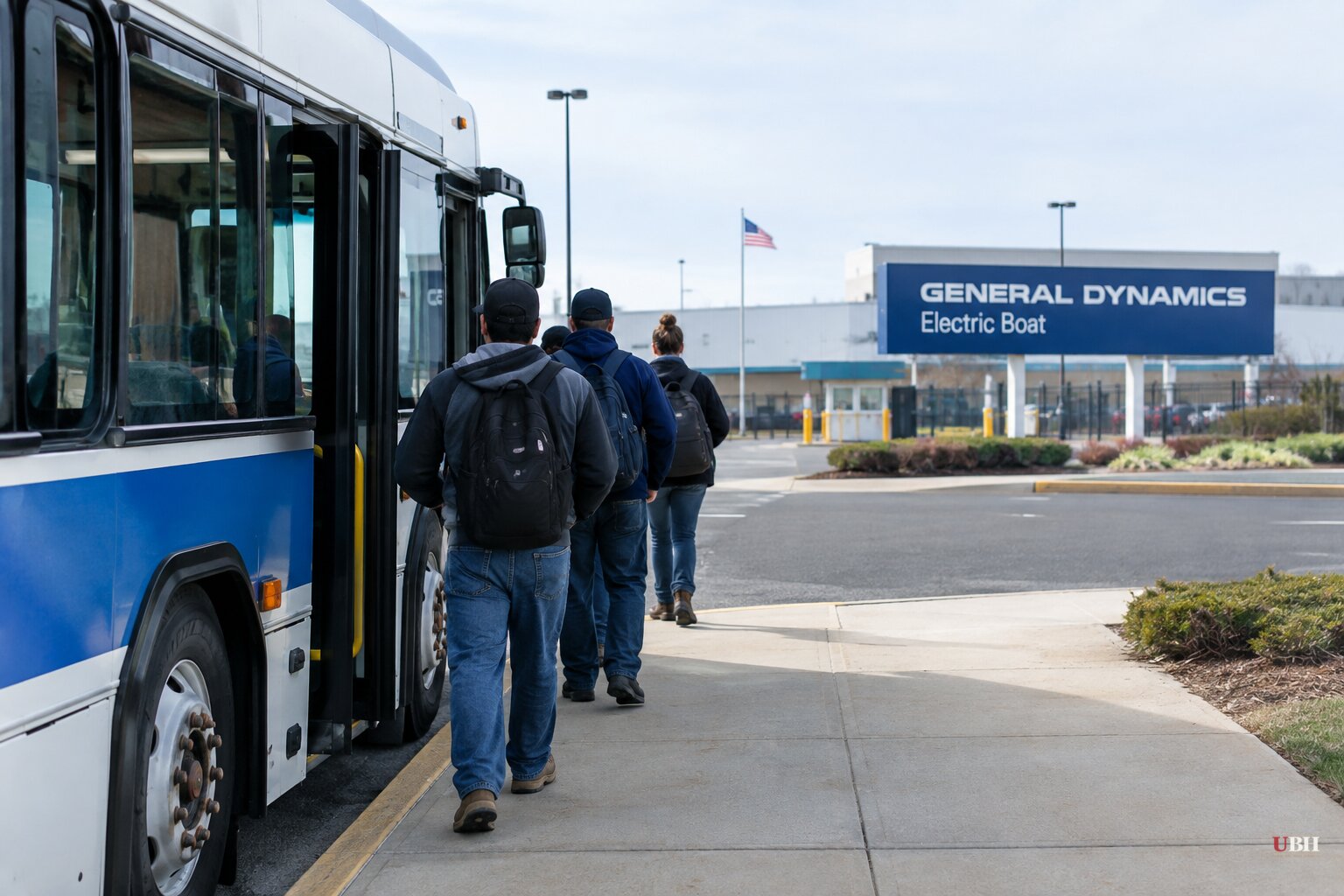
According to the program office, General Dynamics Electric Boat partnered with the Rhode Island Public Transit Authority to run direct bus service to the Quonset Point shipyard. Ridership on that route more than doubled year over year, the office said. Notably, it came at no cost to the Navy. That's the kind of public-private fix that should get more attention: a state transit agency and a defense contractor solving a real problem without a new federal line item.
In Virginia, the Hampton Roads Workforce Council runs a program called the Hampton Roads Maritime Training System that hands out gas cards and bus passes to shipyard workers. Since September 2023, that program has provided nearly $200,000 in transportation assistance, funded through a mix of grants, private donations, and Virginia state government money, the office said.
The office has also backed several bus system pilots elsewhere, which Logan said sparked further discussion about free bus passes and van pools for workers. "I think we've done a lot in that area using this regional approach to really just get a good understanding of what that region has," she said.
Housing is a separate, thornier issue
Unlike transportation, the program office has not funded permanent housing or housing subsidies for shipyard or supplier workers directly. Instead, its role has been limited to state and local engagement aimed at expanding affordable housing supply, plus partnerships tied to specific yards or vendors.
One targeted example: the Accelerated Training in Defense Manufacturing program in Danville, Virginia, provides housing to students during their 16-week manufacturing training course. That's a narrow, time-limited benefit for trainees, not an open-ended housing entitlement for the broader workforce, and it appears designed to stay that way.
The bigger picture Business Insider's report leaves out
Business Insider's account, drawn from an interview with Logan, focuses almost entirely on the workforce office's own framing of its successes. It doesn't address how far behind schedule Virginia-class submarine production actually is, or put a dollar figure on total federal spending across these regional workforce programs. Nor does it address whether these transportation and training fixes are moving the needle on the underlying production numbers, as opposed to just easing individual workers' commutes.
Bus passes and gas cards are cheap, sensible fixes for a specific bottleneck. They are not evidence, on their own, that the broader submarine industrial base crisis is being solved. The Navy has been public for years about wanting faster Virginia-class and Columbia-class production. Whether better commutes in Rhode Island and Virginia translate into more submarines delivered on time is a separate question that neither the program office nor this report answers.
What's clear is that the Navy sees transportation as a solvable, regional problem worth fixing now, while it continues to wrestle with the much larger question of whether America's shipyards can build submarines fast enough to matter.
Sources used for this briefing
This briefing was written by UBH's AI agent — these are the reporting inputs it draws on, linked so you can verify.


