
Unbiased headlines. Facts, not spin.
Unbiased Headlines is an independently owned news organization. We bring you the facts, not opinions, written fresh from 110+ named sources. Sources linked so you can verify it yourself.
 economy
Notable (6/10)
Event date: November 1, 2026 ·
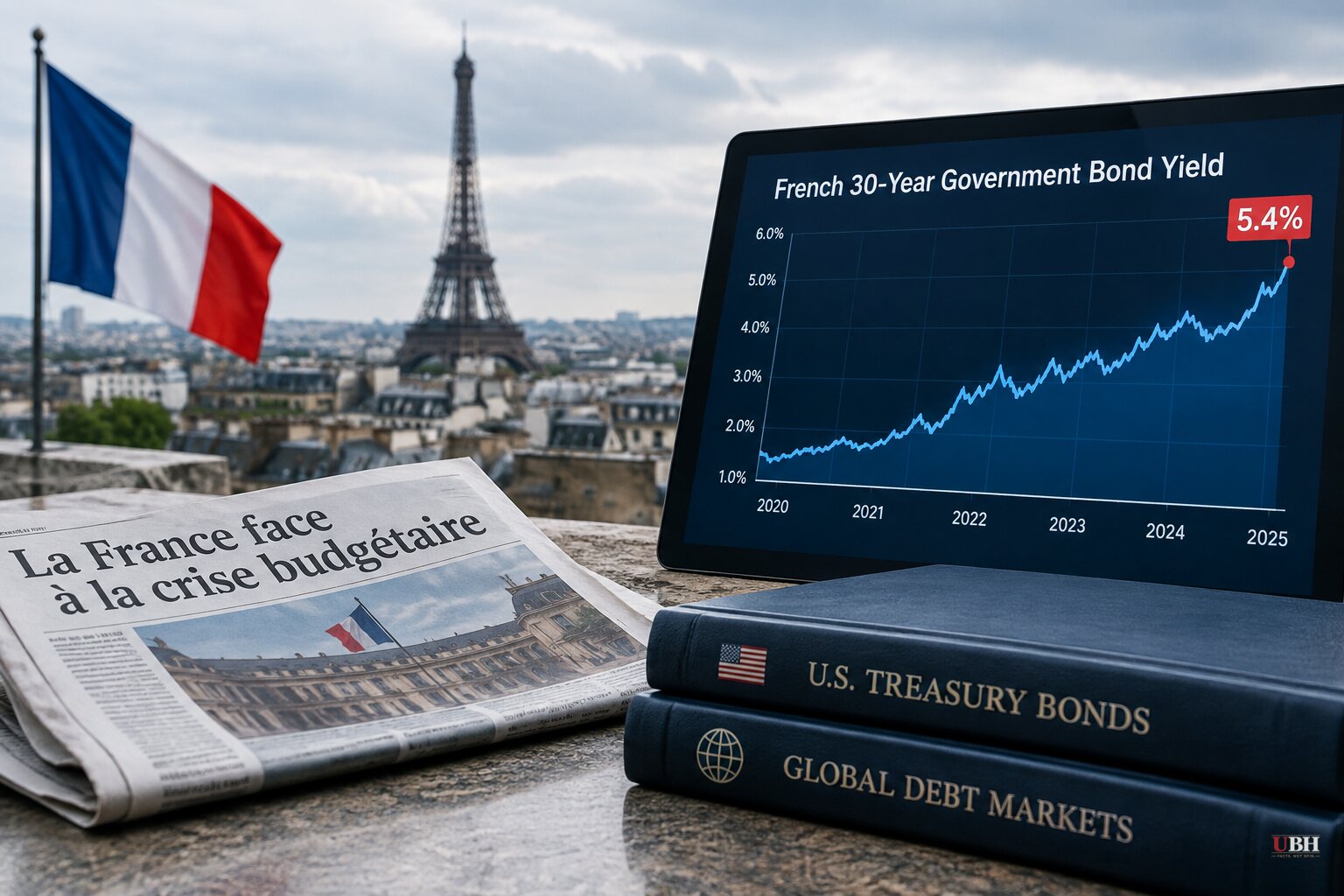
Navy Federal Economist Calls France's Unrest a 'Foreshadowing' for U.S. Debt as French 30-Year Yield Tops 5.4%
As riots and a stalled budget rattle France, the debate has widened from Paris to Washington. Now it asks whether the U.S. is on the same road.
Heather Long, chief economist at Navy Federal Credit Union, put it bluntly at a Bipartisan Policy Center event last week. "There's a reason that the U.S. has pulled back a little bit in the last few weeks [and] why France has not," she said. U.S. 10- and 30-year Treasury yields declined while the unrest played out. France's 30-year bond has topped 5.4%.
Where the two countries differ
Long laid out the gap in numbers. The U.S. sits at about 100% debt-to-GDP, she said, versus roughly 120% for France. France is growing at about 0.5%. The U.S. is growing at just over 2%.
"They are further along that crisis curve," Long said.
France's underlying data is weak. Unemployment hit 8.3% in the second quarter, the highest since the third quarter of 2020. Youth joblessness is closing in on 22%. Wage growth averaged 1.7% in April through June.
GDP shrank 0.2% in the first quarter and stalled in the second. ING forecasts growth of 0.3% this year and 0.6% in 2027, with risks tilted toward a downward revision.
Inflation reached 3.1% in September, the highest since January 2024, driven almost entirely by energy prices after the U.S.-Iran conflict began in late February.
Taxes already stretched
Long also pointed to France's tax load. Per the OECD, its "tax wedge," the gap between what an employer pays and what a worker takes home, is 47.2%. The U.S. figure is about 30%.
Long said the tax picture also bears on bond markets. "It's certainly not easy to raise taxation in the U.S., but from a financial world perspective and the bond market perspective, there's a lot more room to experiment and to grow in the United States than there is in France."
Her biggest worry is not the fiscal arithmetic. It is the age of the protesters. "To see young people really driving this latest protest … from the disparities that they're seeing generationally, and that seems like a pretty big foreshadowing [of] what we could see here as we creep towards 120% debt to GDP," she said.
The debt-to-GDP figures vary by source. The Fortune article carrying Long's remarks puts France's public debt at 116% of GDP in its text, while its headline cites 126%. Long used 120%, and the Epoch Times puts the ratio at 119%, with the government warning it could reach almost 122% next year.
The bond market's verdict on France
French bonds have been hit hardest in a global sovereign selloff tied to inflation fears, higher rate expectations and debt worries. "French OATs continue to be the punching bag in the ongoing selloff in sovereign bond markets," Elias Hilmer, a markets economist at Capital Economics, wrote in a Friday note.
The Epoch Times reports that France's 10-year yield has crossed 5% for the first time since 2002 and has risen above the U.S. 10-year Treasury yield for the first time in 13 years. During one early Monday session in the unrest, the 10-year OAT yielded 4.86% while Germany's 10-year yielded 3.41%. Hilmer put the gap between French and German yields at around 140 basis points and forecast it could widen to 200 basis points by the end of 2027, even as similar gaps narrow for most other eurozone countries.
Moody's kept France at Aa3 on Oct. 23 but held its negative outlook, citing "the fragmentation of France's political landscape."
Ninety One warned that if France fails to pass its 2027 budget, the deficit could exceed 6% of GDP next year. That is more than double the EU's 3% limit.
Sahil Mahtani, director at Ninety One's Investment Institute, said passing the budget would be only a temporary fix. The presidential election next year could be followed by another parliamentary election, he said, potentially leaving no clear governing majority and extending budget uncertainty into 2028.
The pension wall
Charlotte de Montpellier, ING's senior economist covering France, said real improvement requires pension reform. "The issue for that is that it's highly unpopular," she said in a webinar.
Hilmer wrote that falling energy prices could ease European rate pressure. He added that worries about French finances and political instability could keep French borrowing costs elevated anyway.
A Fox News opinion column reads the unrest as a bill coming due for generous public benefits. It argues that French protests recur whenever a government tries to balance the books by reforming those benefits. The column says the high-schoolers who started this round are angry about class sizes and dilapidated schools, and that retirees say pensions are too small. In its words, "they all want more state spending to cure their ills."
What to watch
Long's argument cuts two ways. The U.S. has a roughly 20-point lead on France in debt-to-GDP and about four times the growth rate, which she says leaves it room to hold these debates now. For France, uncertainty remains high around the 2027 budget and next year's presidential election. If the budget fails, Ninety One puts the deficit above 6%, and Paris would enter an election year with its bond market already under heavy pressure.
Sources used for this briefing
7 links from 5 independent newsrooms (syndicated copies of the same report count once)
These are the sources it draws on, linked so you can verify.


