
Unbiased headlines. Facts, not spin.
Unbiased Headlines is an independently owned news organization. We bring you the facts, not opinions, written fresh from 110+ named sources. Sources linked so you can verify it yourself.
 economy
Notable (6/10)
Event date: October 27, 2026 ·
Factory Orders Up 8% Through September, but Hiring Is Narrow and Plant Construction Spending Has Dropped
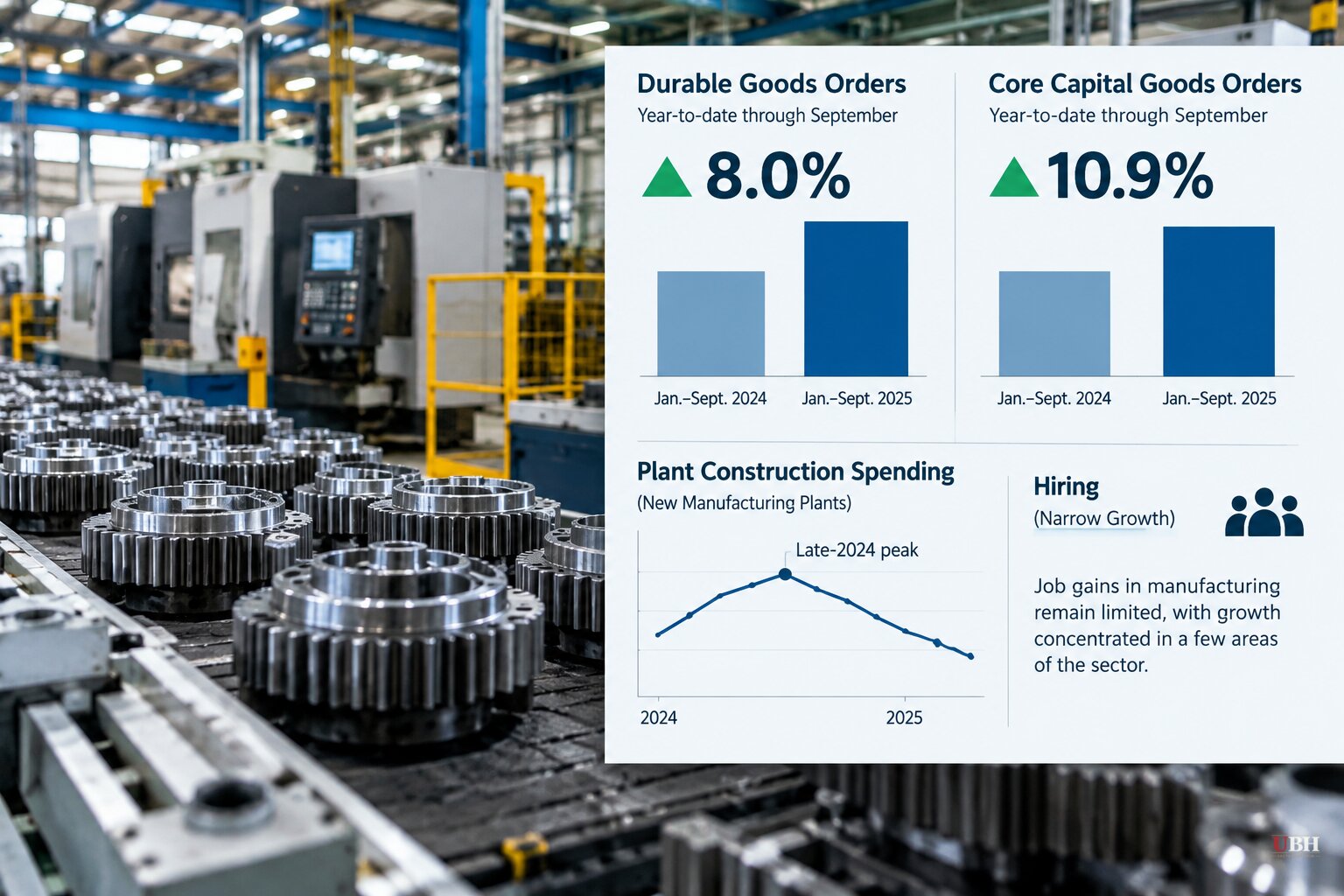
American factories are busy. Whether that adds up to a broad revival is still being argued.
The Census Bureau's latest durable goods report shows new orders up 8.0% year-to-date through September. Core capital goods orders, which cover non-defense equipment excluding aircraft, are up 10.9%.
The category numbers vary widely. Primary metals orders are up 16%, fabricated metal products 8.8%, machinery 13.4%, and electronic equipment and appliances 6.5%. Computer and related equipment orders are up 20.3%.
Shipments are rising too. Durable goods shipments are up 8.5%, core capital goods shipments are up 8.8%, and computer shipments are up 18.8%.
Against the last year of the Biden administration
The Breitbart Business Digest compared January through September of this year with the same period in 2024, President Biden's final year in office. By its calculation, durable goods orders are up 15.9% and core capital goods orders are up 13.9%.
Those are nominal figures. Adjusted with the Bureau of Labor Statistics' producer price index for private capital equipment, Breitbart puts the core capital goods gain at 6.4%. That is a smaller number, but still a gain.
Factory output also rose 0.3% in September, even as auto production fell 3%. The White House is pointing to the trend as proof its economic agenda is working.
Plant construction is the weak spot
Not every indicator points up. Politico reported that spending on manufacturing construction has fallen since late 2024. The St. Louis Fed data it cited show an annual rate of about $250 billion in November 2024 dropping to $170 billion in August, the lowest level since the end of 2022.
Politico also quoted economists who dispute that tariffs are driving a manufacturing boom. It described the current activity as an output bump and noted that rising productivity lets firms produce more with the same resources. On that reading, higher output does not necessarily mean surging investment.
Breitbart rejects that framing. It argues that even after the decline, manufacturers were spending $168 billion annually on construction in August, more than twice the roughly $81 billion pace of August 2019. Its own calculation, using the BLS producer price index for industrial building construction, finds real spending well above the 2019 level. Breitbart calls the Politico story "bunk."
Both sets of numbers can be true at once. Construction spending is far above 2019 and also well below its late-2024 peak. The dispute is over which comparison matters.
Output is not the same as jobs
The hiring picture is less impressive than the orders data. Gad Levanon, chief economist at the Burning Glass Institute, analyzed the employment numbers and found a sharp split. "The manufacturing recovery is real, but it is narrow," he wrote.
Axios reported that gains are concentrated in industries tied to the AI and energy buildout, while traditional factory sectors are being left behind. Auto production's 3% drop in September fits that pattern.
The long-run history explains part of the gap. U.S. manufacturing employment peaked at about 19.6 million in June 1979. By June 2019 it was about 12.8 million, a 35% decline. Over the same period manufacturing's share of nonfarm payrolls fell from about 22% to roughly 9%.
The jobs left because factories got more productive, companies moved production abroad, and the economy shifted toward services. Automation was a large part of it. A modern plant can turn out far more with far fewer people, so bringing production home does not rebuild a 1970s workforce.
A view from the shop floor
Richmond Fed President Tom Barkin visited Gestamp, an auto-parts maker in Union, South Carolina, to hear from manufacturers directly. Bloomberg's Wall Street Week aired the visit on November 8.
At Gestamp, demand remains solid and investment continues. But the business is dealing with rising costs, changing technology and an uncertain policy environment.
That last item bears on the tariff argument. Whether trade policy is pulling investment into the country or adding to costs and uncertainty for firms like Gestamp is exactly what the economists above disagree on. The orders data alone cannot settle it.
The Fed risk
James Knightley, chief international economist at ING, told Axios that the Fed's latest tightening cycle could widen the divide between American manufacturers before it threatens the recovery itself. Capital-intensive firms in the AI and energy boom may be better placed to absorb higher borrowing costs than traditional producers.
The orders are real, and so are the shipments. What remains unresolved is whether the strength spreads to the auto and traditional factory sectors that are still shrinking, or stays confined to the industries already pulling ahead.
The next durable goods report and the monthly jobs data will show whether payrolls begin to follow orders.
Sources used for this briefing
4 links from 4 independent newsrooms (syndicated copies of the same report count once)
These are the sources it draws on, linked so you can verify.


