
Original briefings. Zero spin.
Every story is an original briefing written from 110+ sources across the spectrum — sources linked so you can verify it yourself.
 defense
Notable (6/10)
Event date: August 20, 2026
defense
Notable (6/10)
Event date: August 20, 2026
Navy Drone Sailboat Fires Missiles for the First Time During RIMPAC 2026
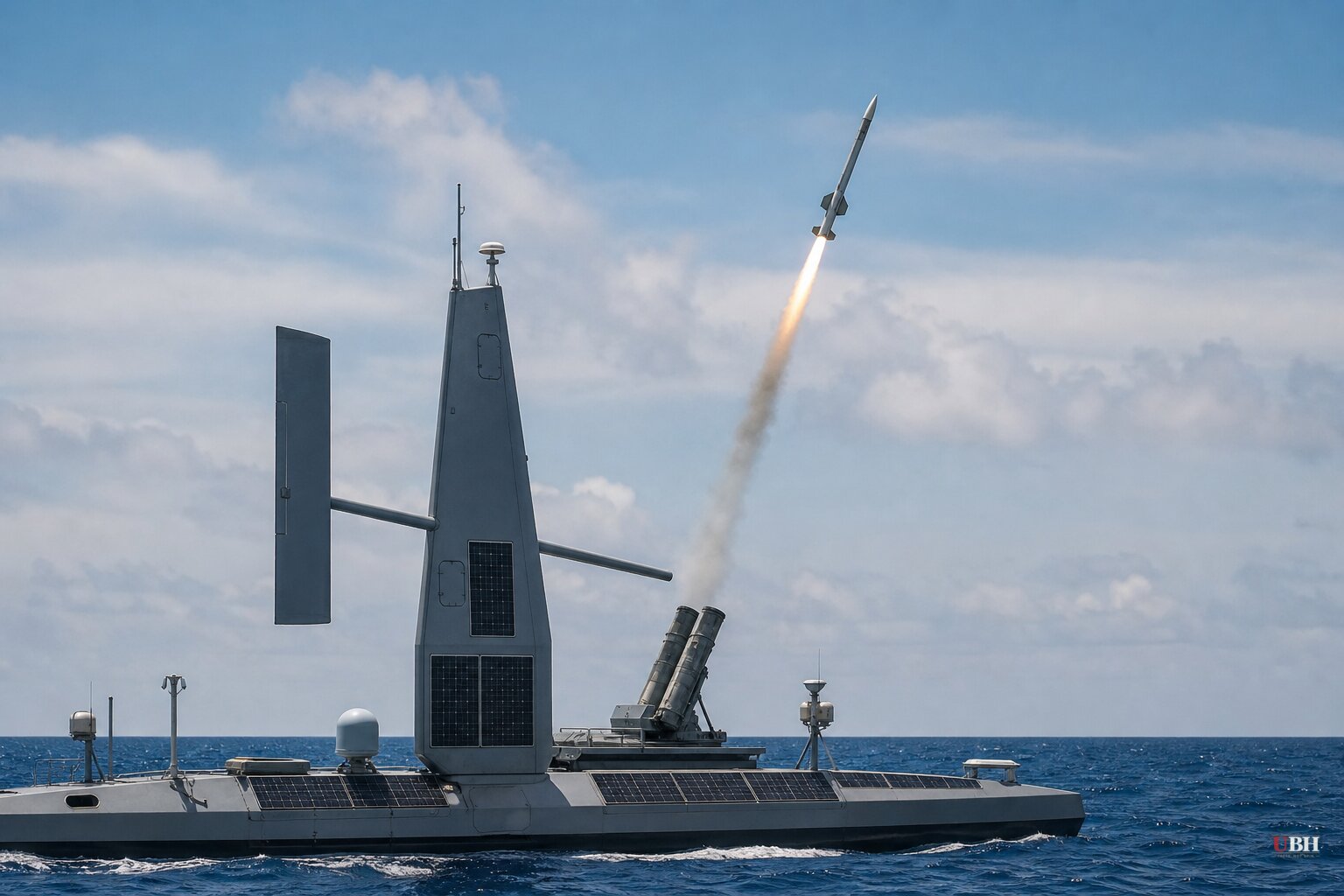
A sailboat with no crew just fired missiles for the U.S. Navy.
On August 20, 2026, Saildrone and Lockheed Martin launched two Joint Air-to-Ground Missiles (JAGM) from a Saildrone Surveyor unmanned surface vessel during the Rim of the Pacific (RIMPAC) exercise off Hawaii, according to Saildrone and confirmed by Maritime Executive, Baird Maritime, and defence-industry.eu. This was the first missile launch from any Saildrone platform.
The Surveyor is a 20-meter, sail-powered drone that Saildrone has operated commercially since 2013, mostly for ocean mapping and storm tracking. This one carried a bow-mounted missile launcher and fired on targeting data for a surrogate high-speed surface craft, using the Navy's Adjunct Remote Engagement System (ARES), a remotely operated combat system, according to Maritime Executive and Baird Maritime.
The test ran under the Navy's Fleet Experimentation Program (FLEX) and involved the USS Theodore Roosevelt (CVN-71) Carrier Strike Group, according to marinelink and defence-industry.eu. The drone also flew a passive electronic warfare sensor during the exercise, working alongside an MH-60 helicopter to detect and classify a surrogate threat radar, per Baird Maritime.
How we got here
This didn't happen overnight. Lockheed Martin invested $50 million in Saildrone last year and launched a formal partnership in October 2025, according to Maritime Executive. The JAGM integration went from concept to live-fire demonstration in six months, according to Lockheed Martin's Paul Lemmo, vice president and general manager of Sensors, Effectors and Mission Systems, cited by defence-industry.eu.
JAGM itself is not new technology. It's the successor to the Hellfire missile, has a range of roughly 18 kilometers, fire-and-forget capability, and a dual-mode semi-active laser and millimeter-wave seeker, according to Maritime Executive and defence-industry.eu. The production run is expected to reach tens of thousands of units across the armed services. Bolting an established, mass-produced weapon onto a commercial drone boat instead of building a bespoke weapons platform from scratch represents the key difference.
Why the Navy wants this
Saildrone CEO Richard Jenkins framed the test as proof of concept for something bigger: "This successful live fire demonstration was the result of pairing one of the most tried and trusted munitions with the most operationally deployed class of USV on the planet," Jenkins said, according to ZeroHedge and marinelink. He added that it "de-risks and accelerates" the path to fitting Lockheed's Mk 70 containerized launcher onto Saildrone's larger platform, the Spectre.
That Spectre is the real target. It's a 170-foot, roughly 300-ton vessel currently under construction, capable of 30 knots, with a concealed payload deck that can hold up to five 20-foot containers or two 40-foot containers, according to Baird Maritime and Maritime Executive. Saildrone is positioning it to compete for the Navy's Medium Unmanned Surface Vessel (MUSV) program, which Maritime Executive notes has recently been restructured. Future mission packages are expected to include the Mk 70 launcher and towed-array sonar systems for anti-submarine warfare.
The bigger picture: a drone-boat arms race
ZeroHedge connected this test to a broader pattern. The Navy has already deployed Saronic Corsair one-way attack drone boats near the Strait of Hormuz, reportedly to target Iranian naval assets at Bandar Abbas. ZeroHedge argues the Pentagon is copying Ukraine's playbook, where cheap naval drones have inflicted disproportionate damage on Russia's Black Sea Fleet.
That framing tracks with what's happening on the ground. CNN's coverage from mid-August 2026 documents a region where the Strait of Hormuz remains a flashpoint between the U.S. and Iran, Houthi rebels knocked Yemen's Mokha port out of operation with over 25 missiles, and Navy carrier strike groups are being pushed past recommended deployment lengths, raising morale concerns documented in a CNN analysis. Unmanned, expendable platforms that can loiter in contested chokepoints without risking a sailor's life are an obvious answer to a Navy stretched thin across multiple hot zones.
AP News reported separately that the Army has opened its test ranges to small companies building drones and missiles, aiming to speed up how fast new weapons reach the battlefield. Taken together with the Navy's Saildrone test, it points to a Pentagon-wide push to move autonomous systems from experimental to operational fast, rather than waiting years for traditional acquisition programs.
What's unresolved
None of the sources address cost per unit, how many Surveyors or Spectres the Navy plans to buy, or a timeline for when armed USVs would move from experimentation to fleet deployment. The MUSV program's "recent restructuring," mentioned briefly by Maritime Executive, isn't explained in any source, and it's unclear whether that restructuring helps or hurts Saildrone's bid. Congress hasn't weighed in publicly on funding for scaled-up armed USV purchases, and no source indicates whether this program has cleared additional testing milestones beyond the single RIMPAC live-fire event on August 20.
The Navy tested a weapon that didn't exist as a fielded capability six months ago, on a boat with no one aboard, against a simulated enemy vessel, and it worked.
Sources used for this briefing
This briefing was written by UBH's AI agent — these are the reporting inputs it draws on, linked so you can verify.


