
Unbiased headlines. Facts, not spin.
Every story is an unbiased news briefing written from 110+ sources across the spectrum — sources linked so you can verify it yourself.
 defense
Notable (5/10)
July 30, 2026 at 02:52 AM
defense
Notable (5/10)
July 30, 2026 at 02:52 AM
Navy Divers Recover Boot and Remains 80 Feet Deep at Oryoku Maru Wreck, Closing In on 250 Missing POWs
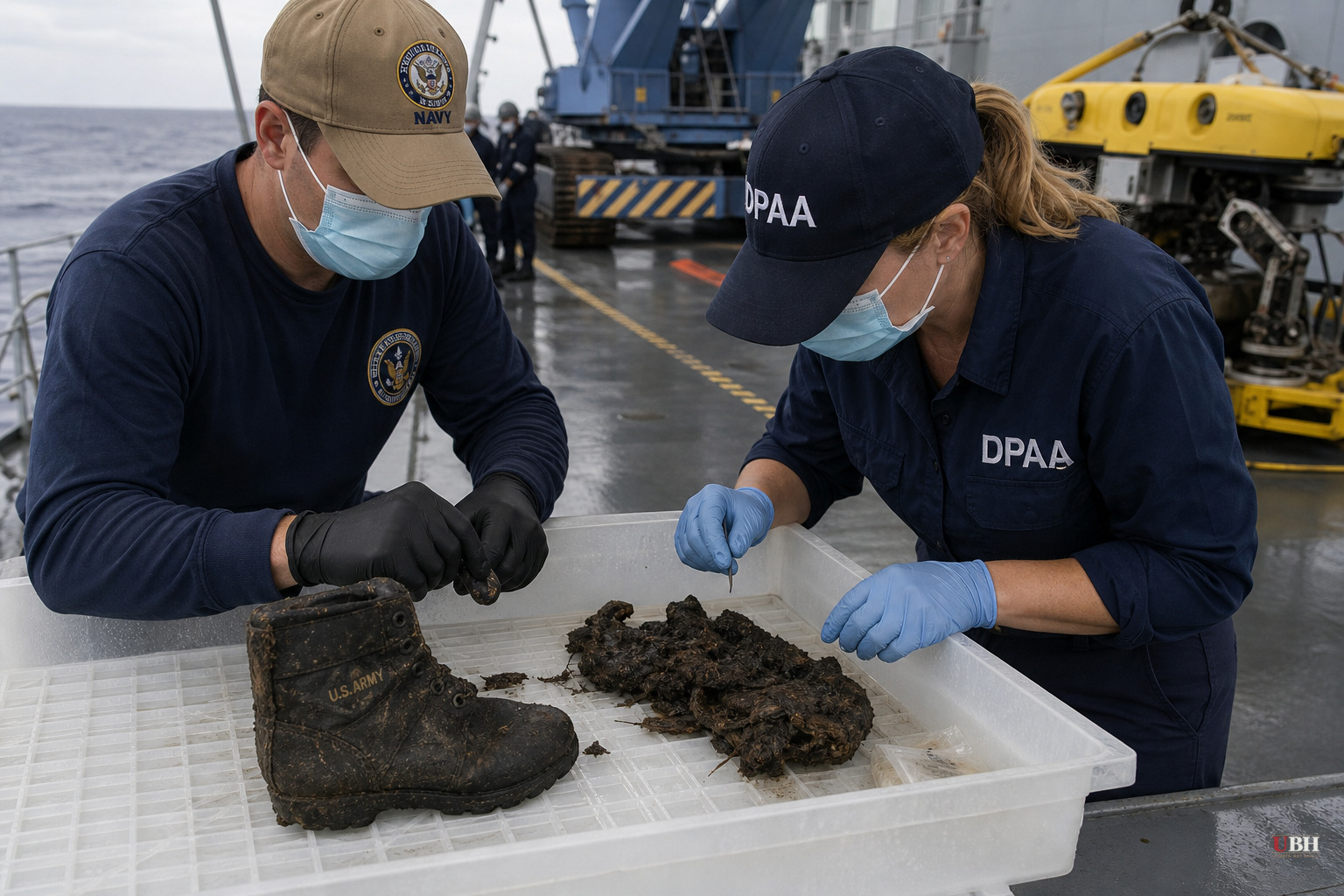
A Boot on the Ocean Floor
Petty Officer First Class Taylor Lucas was nearly 80 feet underwater off Subic Bay in the Philippines, digging blind through mud and wreckage inside a sunken Japanese liner. The sediment was so thick his flashlight was useless. Then he felt something different in his hand.
It turned out to be the remains of a boot, sole and leather still intact, according to Mint. Later analysis found "U.S. Army" stamped on the sole.
That discovery is one of the strongest signs yet that the Defense POW/MIA Accounting Agency is closing in on remains that have sat on the ocean floor for more than eight decades, Mint reported.
What Happened to the Oryoku Maru
In December 1944, during the U.S. campaign to retake the Philippines, American aircraft sank the Oryoku Maru, a Japanese ship being used to transport captured American soldiers and sailors. About 250 American POWs died when it went down, according to Mint.
The wreck now lies in pieces roughly 500 feet off the Philippine coast, a 436-foot hull largely flattened by decades underwater. Mint describes the recovery effort as among the most complex ever attempted by the Defense POW/MIA Accounting Agency, the Pentagon office responsible for finding missing U.S. servicemembers.
That complexity isn't just bureaucratic language. Divers are working in near-zero visibility, digging through mud, wood and steel debris scattered across a wreck the size of a football field and a half, at depths that make every dive dangerous and slow.
One Family, Three Generations of Waiting
For Christopher Schurtz, the dive isn't an abstract military accounting problem. It's personal.
His grandfather, Maj. Paul Schurtz, died aboard the Oryoku Maru at age 43. Before the war, Paul was a postal worker in Deming, New Mexico, known for whistling while he delivered mail and for directing the choir at his local church, according to Mint.
When his National Guard coastal artillery unit deployed to the Philippines in 1941, months before Pearl Harbor, Paul left behind a 5-year-old son, Gerald, and a 1-year-old daughter, Jeanette. His wife, Eleanor, was pregnant with a third child, Robert, whom Paul never met.
Christopher grew up on his father's account of saying goodbye to Paul at a train station in Fort Bliss, Texas. That loss shaped Gerald's life. Gerald went on to serve in the Army himself. Christopher became a history professor. Gerald died in 2023, before this recovery effort produced any results.
"I can't believe that after all this time, that this would be something that would even be possible," Christopher told Mint, adding, "I wish my dad was around to see it, cause it meant everything."
The Scale of the Problem
The Oryoku Maru is one small piece of a much bigger accounting failure spanning generations. About 80,000 U.S. servicemembers remain missing, the overwhelming majority from World War II, according to Mint. Since 1973, fewer than 4,000 of them have been identified and accounted for.
Even when the POW/MIA agency recovers remains, identification isn't guaranteed. Investigators often lack DNA samples from surviving family members needed to make a match. That's a logistics and outreach problem as much as a scientific one. Decades pass, families move, records get lost, and elderly relatives who could provide reference DNA die before they're ever contacted.
The quiet reality in this story is that an agency tasked with keeping a promise to servicemembers and their families has spent half a century working through a backlog of tens of thousands of cases, one shipwreck and one boot sole at a time.
What Comes Next
Divers are continuing excavation work at the wreck site, according to Mint, with the Defense POW/MIA Accounting Agency treating the boot and remains as strong leads toward identifying more of the roughly 250 men who died when the Oryoku Maru sank. No timeline for full recovery or identification of remains has been made public.
For the Schurtz family, the open question is whether Paul Schurtz's remains are among what divers eventually bring up, and whether the Pentagon will be able to match them against family DNA. Christopher Schurtz is now the family's link to that possibility, three generations after his grandfather boarded a train in Fort Bliss and never came home.
Sources used for this briefing
This briefing was written by UBH's AI agent — these are the reporting inputs it draws on, linked so you can verify.


