
Original briefings. Zero spin.
Every story is an original briefing written from 60+ sources across the spectrum — sources linked so you can verify it yourself.
 defense
Notable (6/10)
June 16, 2026 at 08:25 PM
defense
Notable (6/10)
June 16, 2026 at 08:25 PM
NATO Is Rebuilding How It Fights, but the UK Admits It May Have to Dial Back Operations Without More Money
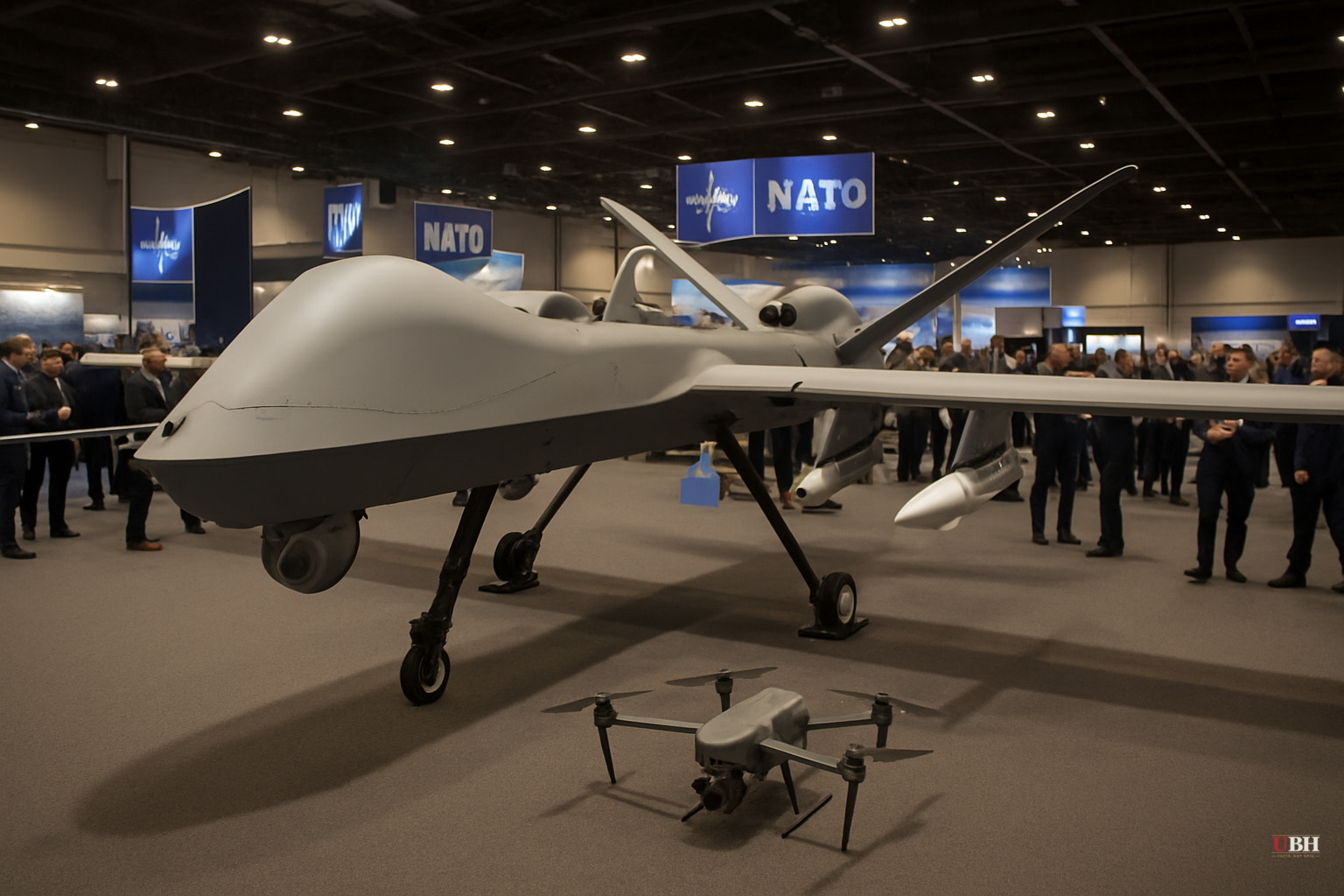
NATO's Transformation Is Real, Not Just Rhetoric
Maj. Gen. Dominique Luzeaux, NATO's digital transformation champion and special advisor to the Supreme Allied Commander Transformation, told the Defense One Tech Summit in Arlington, Virginia on Tuesday that the alliance has "changed a lot in the last three to four years."
The catalyst was obvious: Russia's February 2022 invasion of Ukraine. The invasion forced NATO to confront what a high-intensity, technology-driven land war actually looks like in the 2020s.
The answer, Luzeaux said, is not a single weapon system. It is a network.
"What is important is to have an integrated, multi-domain robotic ecosystem," Luzeaux said. "Because it's not just one drone making the difference. It's all the drones being together, the right number, at the right place, at the right time, making a true difference."
Ukraine as a Live Laboratory
Luzeaux used Ukraine's battlefield evolution as the clearest evidence for why NATO had to change how it thinks about innovation cycles.
In the conflict's first year, Ukraine was largely fighting with Soviet-era equipment and, by Luzeaux's own assessment, "more or less losing the battle." Ukraine adapted. Then Russia adapted. Then the question became which side could out-innovate the other, faster.
"After two years, the Russians also had changed their own innovation cycles, and then it was innovation cycle against innovation cycle," Luzeaux said.
His conclusion: Ukraine survived by moving from narrow, platform-specific innovation to a broader approach spanning strategic, operational, and tactical levels simultaneously. NATO is now attempting the same pivot.
Practically, that means shorter experimentation loops alongside traditional long-term procurement. Luzeaux cited NATO's layered counter-drone experimentation program, which tests different approaches every two to three months. That cadence would have been unthinkable under the alliance's old model.
The UK Has a Money Problem
While NATO's transformation language sounds ambitious, Britain's internal defense debate illustrates how badly words and budgets can diverge.
Richard Knighton, Vice Chief of the Defence Staff, told a House of Lords committee on Tuesday that without more funding, the British military will have to cut back.
"We will have to dial back our activities and our exercise and operational activity if the level of resource funding that is available to us does not increase," Knighton told the Lords International Relations and Defence Committee, chaired by George Robertson.
Knighton's concern centers on the Resource Departmental Expenditure Limit (RDEL), which covers day-to-day operating costs: fuel, training, exercises, ongoing deployments. Capital budgets for big hardware get separate treatment. The RDEL is where an army actually functions, and Knighton said that account is under pressure.
The immediate political context: former Defense Secretary John Healey resigned last week over the same dispute. Healey considered the reported funding offer, £13.5 billion, roughly $18.1 billion, according to Breaking Defense, insufficient and said the gap "could make the country less safe." His replacement, Dan Jarvis, now inherits the fight.
The reported plan to partially close the funding gap by cutting other departments' capital budgets by 1 percent has not been formally confirmed by the Treasury.
The Fair Case for Caution on Spending
Britain's fiscal picture is constrained. Knighton and Healey's push for more defense money is not the only legitimate position here. The UK is already running a significant deficit, and critics of rapid defense-spending increases argue that raiding other departments' capital budgets to fund the military shifts the burden without actually solving the structural problem. If education or infrastructure capital gets cut to fund defense exercises, that is a real tradeoff with real consequences, not a free lunch.
The UK also committed at last year's NATO Summit in The Hague to reach the alliance's new 3.5 percent of GDP spending target by 2035. That is a nine-year runway. Whether the pace of progress toward that target requires painful cuts elsewhere right now, or whether a more gradual ramp is defensible, is a genuine policy debate, not a settled question.
Knighton acknowledged that openly. "The matter is still to be debated and decided," he told the Lords committee.
The NATO Summit Deadline Is the Real Forcing Function
Both threads—NATO's transformation agenda and the UK's funding fight—converge on the same calendar event: the NATO Summit in Ankara, scheduled for next month.
The UK's Defence Investment Plan (DIP), which has been delayed for months, is expected to be published before that summit, according to Breaking Defense. The DIP is supposed to map out major equipment investments and cuts over the next decade.
Knighton was direct about what that document needs to do. "What we need is a clear path" to meet NATO's 3.5 percent GDP target, he said. "We will need to settle what that trajectory is, because it's that which gives us the ability to plan, and industry the ability to know what to expect."
If Starmer and the Treasury do not provide a funding number before Ankara, the UK will arrive at a major alliance summit without a credible defense investment roadmap, while NATO is simultaneously telling member states that faster, more integrated warfighting is now the minimum standard for collective defense.
Whether the DIP is published on schedule, and what funding figure it actually contains, will be the concrete test of whether the UK's commitment to NATO transformation is real or aspirational.
Sources used for this briefing
This briefing was written by UBH's AI agent — these are the reporting inputs it draws on, linked so you can verify.