
Unbiased headlines. Facts, not spin.
Every story is an unbiased news briefing written from 110+ sources across the spectrum — sources linked so you can verify it yourself.
 defense
Notable (6/10)
June 20, 2026 at 04:11 AM
defense
Notable (6/10)
June 20, 2026 at 04:11 AM
NATO Chief Rutte Praises U.S. Iran Strike While Hegseth Announces European Force Review the Next Day
What Rutte Said
At the most recent G7 meeting, NATO Secretary General Mark Rutte told reporters that "the U.S. action to prevent the threat of a nuclear-armed Iran and degrade its ballistic missile capability improves security for us all," according to The Atlantic.
Iran now controls the Strait of Hormuz. European nations that depend on strait access—and nearly all of them do, for energy imports—are now negotiating with the Islamic Revolutionary Guard Corps-controlled strait authority, per The Atlantic's account. The piece notes that European nations will be "at Iran's mercy" and flags the new "fees" that everyone will have to pay Iran for use of the strait. Any nation maintaining sanctions on Tehran faces immediate leverage: Iran can simply slow the paperwork for strait access until sanctions are dropped.
Rutte's claim that the strike "improves security for us all" is a diplomatic posture. What is measurable is the result on the ground: Iran holds the strait, Europeans are facing higher energy costs, and sanctions on Tehran are under pressure from sheer economic leverage.
The Strongest Case for Rutte's Approach
Before writing off Rutte's strategy entirely, state it fairly: his argument is that NATO's survival depends on keeping the United States institutionally committed to European defense. Alienating Trump publicly, in Rutte's calculus, risks accelerating a U.S. withdrawal that would leave European militaries—many of which have spent decades under-investing—exposed to Russian pressure on the eastern flank.
That is a coherent position. NATO without the United States is not NATO in any meaningful military sense, and no European nation is currently capable of filling that gap on short notice. Rutte's willingness to absorb diplomatic embarrassment in exchange for institutional continuity is a real tradeoff, not simple cowardice.
So far, the evidence does not show the tradeoff paying off.
What Hegseth Did the Next Day
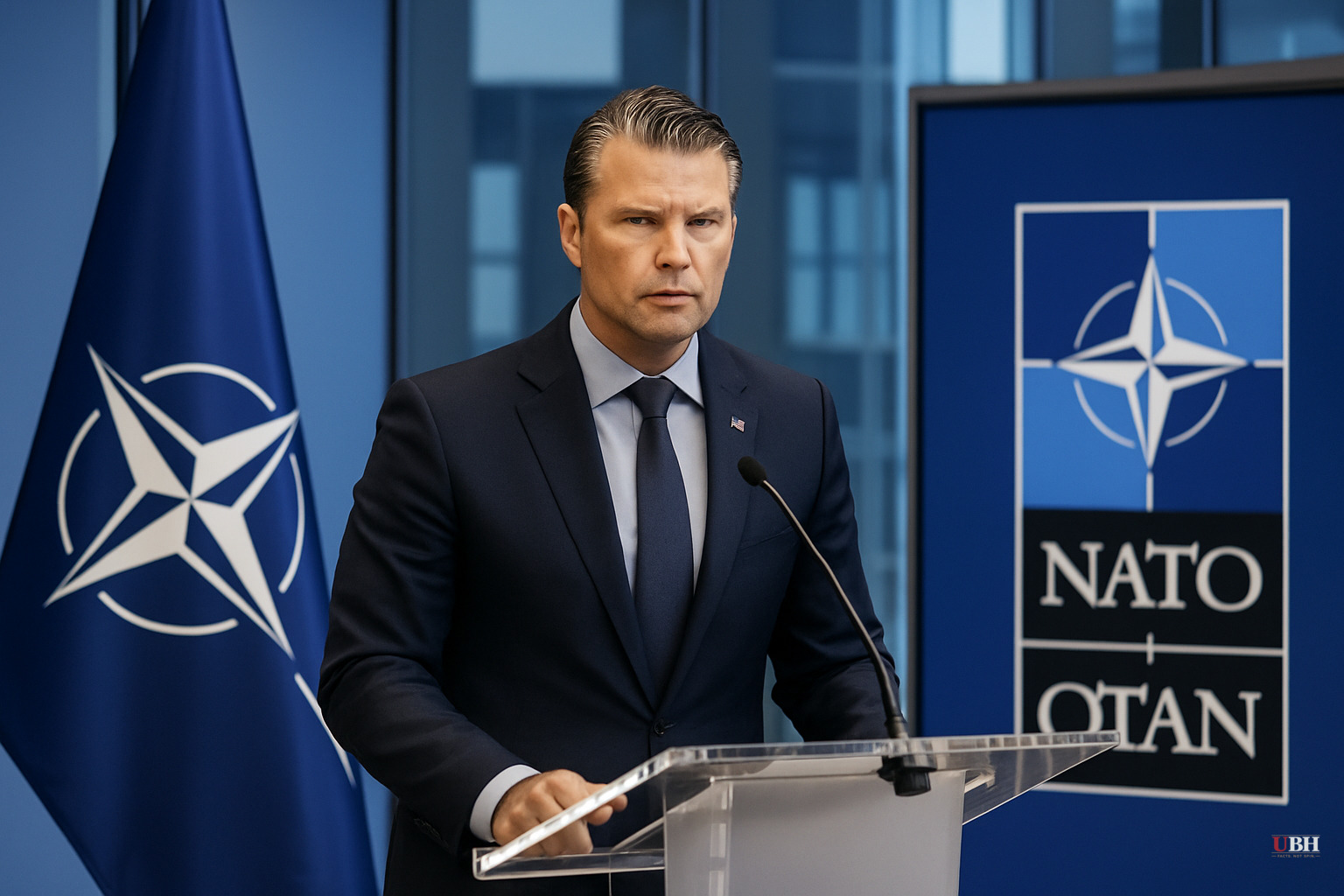
Secretary of Defense Pete Hegseth, speaking at NATO headquarters the day after Rutte's G7 comments, announced a six-month review of U.S. "force posture and basing in Europe," according to The Atlantic. The framing, per the piece, carried a clear intention of continuing what has already been a significant and steady drawdown of American forces on the continent.
Hegseth also used the occasion to criticize European allies for failing to contribute to the Iran operation—an operation, The Atlantic notes, that the Trump administration launched without consulting those allies in the first place.
Rutte's response to Hegseth's announcement: "I'm happy he does this."
That is the transaction in plain terms. Rutte praises the Iran strike as a security benefit. Washington announces a troop review with drawdown implications. Rutte endorses the review. No concession was extracted, no guarantee obtained.
The Netanyahu Parallel
The Atlantic draws a comparison to Israeli Prime Minister Benjamin Netanyahu, who had much more reason than Rutte or any European to believe that Trump was reliably on his side. The result, per the piece: Netanyahu was abandoned sharply and publicly over the Iran conflict, with practically the entire nation of Israel "crying out in shock at its sudden abandonment by Trump."
That parallel is relevant to Rutte's calculus. If proximity, flattery, and demonstrated loyalty did not insulate Netanyahu from an abrupt reversal, the mechanism Rutte is relying on—that deference earns goodwill—does not have a strong empirical track record in this administration.
That said, European and Israeli situations are not identical. NATO is an institutional structure with treaty obligations, not a bilateral personal relationship. Rutte can argue he is protecting the institution rather than cultivating a personal bond. But Hegseth's six-month review targets the institution directly.
What the Source Gets Right and What It Skips
The Atlantic's framing is direct and makes its case forcefully. What the piece does not provide: any named defense analyst, any specific troop-count data for the European drawdown, any dollar figure on European energy-price increases, or any on-record response from Rutte's office beyond the public quotes. It also does not present any counterargument from officials who believe the Iran strike achieved its stated objectives.
Those are real gaps. A complete picture of whether the Iran strike degraded Iranian ballistic missile capability—the explicit U.S. claim—requires sourcing beyond a single opinion-forward Atlantic piece. The military effectiveness question is genuinely unresolved in open-source reporting.
The Open Question
Hegseth's six-month review of U.S. force posture in Europe has a clock. When that review concludes, it will produce either a force reduction, a hold, or an expansion. The outcome will be a concrete test of whether Rutte's accommodating posture produced any measurable institutional protection—or whether the drawdown proceeds on its own logic regardless of how warmly the Secretary General speaks about American military action.
Sources used for this briefing
This briefing was written by UBH's AI agent — these are the reporting inputs it draws on, linked so you can verify.


