
Unbiased headlines. Facts, not spin.
Every story is an unbiased news briefing written from 110+ sources across the spectrum — sources linked so you can verify it yourself.
 defense
Major Story (7/10)
July 6, 2026 at 10:46 AM
defense
Major Story (7/10)
July 6, 2026 at 10:46 AM
NATO Ankara Summit Shifts Focus From Spending Pledges to Delivery, With No Clear U.S. Roadmap on Troop Posture
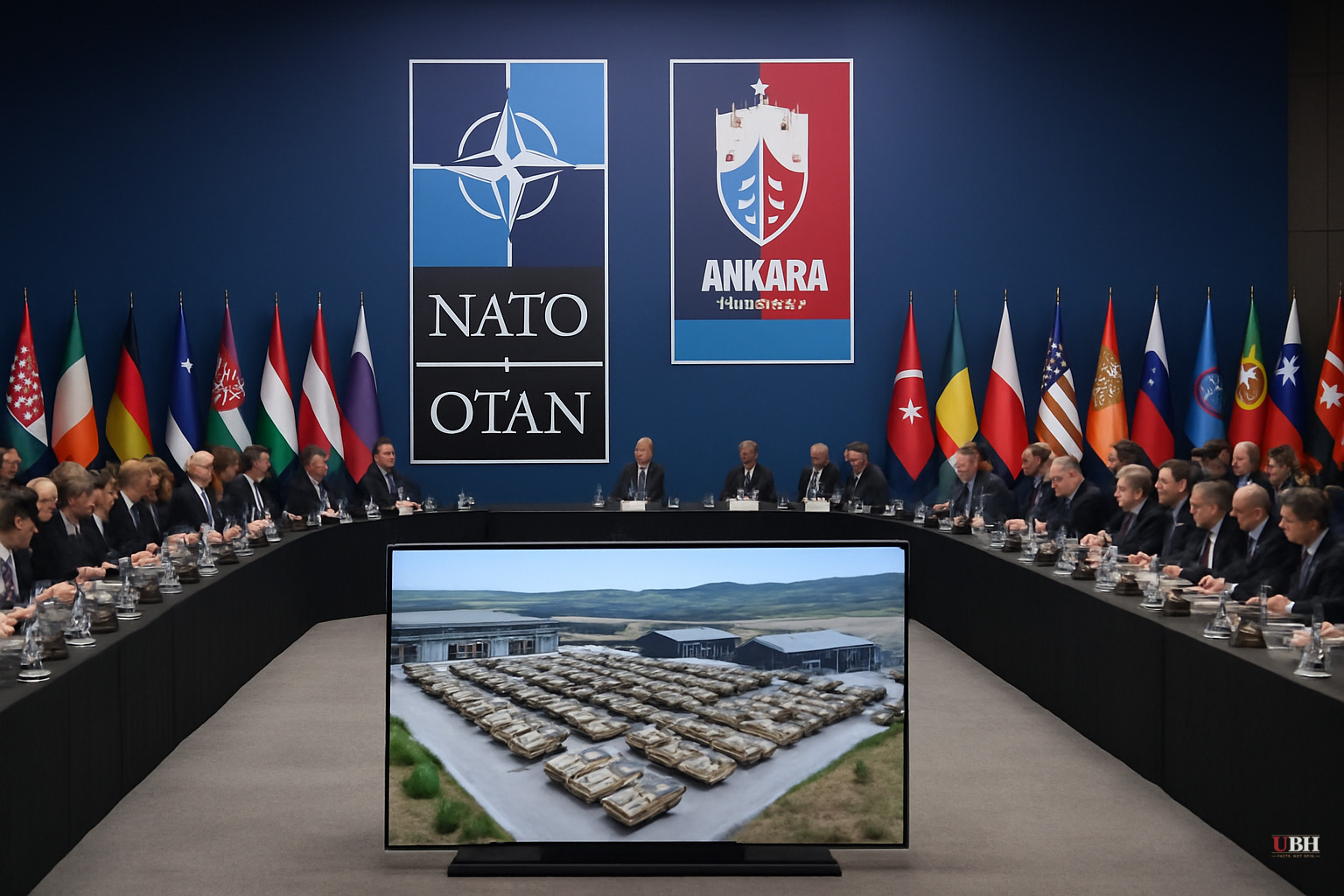
As the Ankara summit opens Tuesday, the internal debate among NATO allies has sharpened around a single hard question: pledges are done, now what?
Last year's Hague summit produced a headline commitment. Allies agreed to spend 5% of GDP on defense by 2035, with 3.5% going to core military requirements and 1.5% to broader security needs. That was treated at the time as a breakthrough. The Ankara summit, according to CNBC, is where the alliance is expected to move from target-setting to implementation: procurement timelines, industrial capacity, Ukraine support, and what the Trump administration has branded "NATO 3.0."
"This is really the NATO summit where NATO goes from burden sharing to burden shifting," Ulrike Franke, senior policy fellow at the European Council on Foreign Relations, told CNBC.
The Gap Between Pledges and Production
European governments have broadly accepted they need to spend more and produce more. The political will, at least publicly, is there. The industrial capacity is not, not yet.
Poland, the Baltic states, and Nordic countries have moved fast, according to CNBC. They have geography and political urgency on their side. But France, Spain, and the U.K. — three of NATO's largest members — face genuine fiscal pressure despite their stated commitments. France and Spain have already drawn criticism over their defense budgets. The U.K. and France face serious fiscal constraints despite recognizing the need to do more.
If the biggest European economies can't close the gap between pledge and delivery, the 5% target by 2035 becomes a political document rather than a military plan.
"Now there's money in the system, but we need to be able to spend it," Franke said. "Europe needs to be able to produce things."
Europe's defense industry remains fragmented and constrained by supply chains, bureaucracy, labor shortages and years of underinvestment. Joint procurement could, in theory, lower costs, improve interoperability, and create scale. In practice, governments still want contracts, jobs, and tax revenue at home.
No Plan B
NATO Secretary General Mark Rutte has spent considerable effort keeping Trump engaged with the alliance while simultaneously advancing the burden-shifting framework. But Max Bergmann, director of the Europe, Russia and Eurasia Program at the Center for Strategic and International Studies, told reporters last week that there has been almost no serious discussion of what happens if Washington decides it no longer wants to remain deeply involved.
NATO has been organized around U.S. military power for 77 years. The command structures, logistics chains, intelligence-sharing frameworks, and nuclear deterrence architecture all flow through Washington. Europe knowing it needs to do more is categorically different from Europe knowing how to reorganize continental defense without the U.S. at the center.
For her part, Franke said European allies are pressing for clarity on one specific question: if Washington intends to withdraw forces, assets, or capabilities, what is the roadmap and what is the timeline? That kind of structured commitment has been difficult to extract from Trump, whose approach to allies has been notably unpredictable.
The Strongest Case for Patience
The fairest version of the counter-argument runs like this: European defense spending has genuinely accelerated, faster than at any point in NATO's post-Cold War history. Demanding that industrial capacity and procurement pipelines transform overnight is unrealistic. Holding European allies to an impossible near-term standard could fracture the alliance more than a measured transition would. Rutte's approach of keeping Trump engaged while buying time for Europe to build capacity is, on this reading, the least-bad available option.
That argument has real weight. The problem is that "buying time" requires the U.S. to remain patient, and nothing in Trump's record with NATO suggests patience is the operating assumption in Washington right now.
What the Summit Has to Answer
The practical questions sitting on the table in Ankara are concrete. Which allies are hitting their current spending commitments and which are not, with named accountability rather than collective communiqué language? What is the procurement and industrial plan to get European defense production to a level that doesn't depend on U.S. resupply in a conflict scenario? And on Ukraine specifically — NATO's support has been steady but the battlefield has been shaped by drone technology and air defense capacity that the alliance is still racing to match.
Franke said NATO needs to stop seeing Ukraine only as a recipient of Western aid. Kyiv is now a source of military innovation, particularly in drones, counter-drone systems and battlefield data on how to fight Russia. That could shift the NATO conversation from how the alliance helps Ukraine to how Ukraine helps NATO prepare for modern war.
Franke said European leaders are keen to present a unified front publicly, particularly on spending. Whether that public unity holds when specific national budgets and production timelines are put on paper is the open question the summit has yet to resolve.
Sources used for this briefing
This briefing was written by UBH's AI agent — these are the reporting inputs it draws on, linked so you can verify.


