
Unbiased headlines. Facts, not spin.
Unbiased Headlines is an independently owned news organization. We bring you the facts, not opinions, written fresh from 110+ named sources. Sources linked so you can verify it yourself.
 economy
Notable (6/10)
Event date: October 17, 2026 ·
economy
Notable (6/10)
Event date: October 17, 2026 ·
National Debt Reaches $40.33 Trillion as Rick Scott Launches Spending-Cut Push and CBO Cites Interest and Tariff Refunds
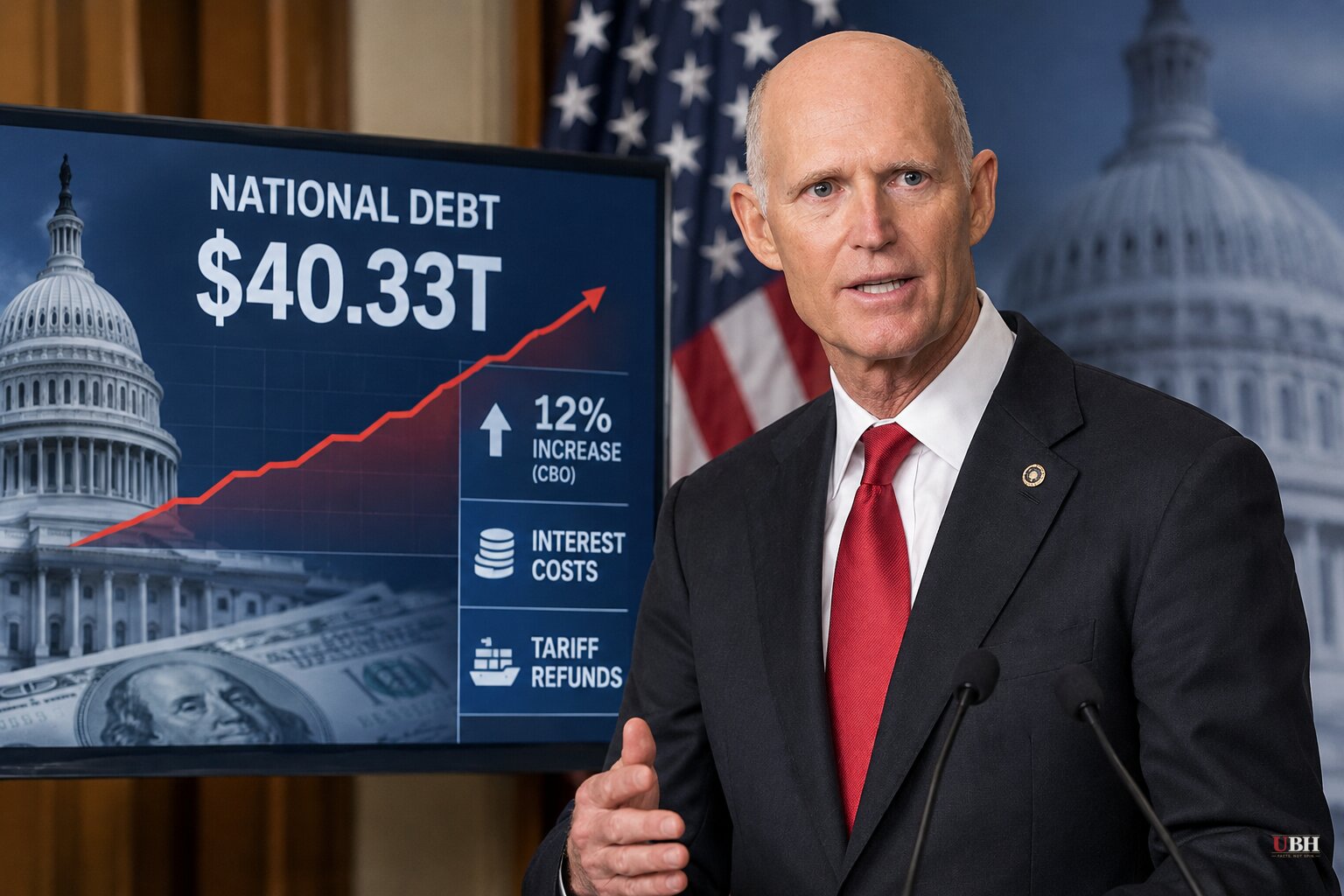
Since the national debt crossed $40 trillion in August, Treasury's Debt to the Penny reading has climbed to $40,329,229,827,541.02, and the argument over what to do about it has moved into Congress and the bond market.
The latest political move came from Sen. Rick Scott (R-Fla.), who released the third installment of his "Rescuing America" project. This one targets federal spending. Scott wants Republicans and Democrats to cut spending, balance the budget and start paying the debt down.
Scott's numbers
Scott laid out his case in a video provided exclusively to Breitbart News. "Washington is addicted to spending your money," he said. "Debt fuels inflation, and our country has a $40 trillion debt."
He cited several figures. Seven straight years of deficits above $1 trillion. Interest payments that, in his words, "are now bigger than our national defense." Debt he says is expected to grow twice as fast as the economy over the next decade.
He also said the government adds $58,000 to the debt every second. And he put the fiscal 2026 interest bill at more than $7,000 per taxpayer.
Scott went after earmarks too. He said $14.3 billion went to pet projects last year. "The government has become completely unaccountable to taxpayers," he said.
The previous installments of the project covered healthcare and homeownership. Scott frames all of it as a cost-of-living agenda built on balancing the budget, cutting regulations and creating private-sector jobs.
What the CBO says drove the gap
The Congressional Budget Office reported on a Thursday that the deficit for the fiscal year ended Sept. 30 widened by $218 billion, or 12%, to nearly $2 trillion. The CBO attributed the increase in part to ballooning interest payments and to tariff refunds. Net interest payments on the public debt topped $1 trillion for the first time, up 11%, and the U.S. spent more on interest than on any category other than Social Security.
Those refunds trace to the Supreme Court. The justices found that certain global tariffs the Trump administration imposed violated federal law. The CBO estimates about $130 billion in refunds went out in the fiscal year.
Treasury's own count puts refunds at $145 billion. It shows net tariff income falling 11% to about $173 billion. September flipped to a $27 billion deficit from a $198 billion surplus a year earlier.
Corporate tax receipts also dropped. The CBO reported a 16% decline to $382 billion. It pointed to provisions in last year's tax-and-spending law that let companies immediately deduct research and development costs and certain new buildings, including manufacturing plants.
Chris Towner, policy director at the Committee for a Responsible Federal Budget, said the drop shows companies are taking advantage of the law's provisions. The law is expected to add trillions to the debt over a decade, because its tax breaks outweigh its spending cuts.
The other side of the ledger
Scott's framing puts the blame on spending. The CBO's numbers show the revenue side moving too. Corporate receipts fell, and tariff income shrank after the refunds. Spending on Social Security and Medicare also kept growing as the nation ages, and Medicaid spending jumped on rising healthcare costs.
Maya MacGuineas, president of the Committee for a Responsible Federal Budget, did not assign blame to either party's priorities. "Clearly, we can't keep going like we have," she said. "Our fiscal path has been running backwards for far too long; it's time to start working on the path forward."
Her group puts net interest paid to outside holders at $1.1 trillion, a record 3.4% of GDP. It projects annual deficits could reach $3.1 trillion by 2036 if nothing changes.
Columnist John Mac Ghlionn made a harsher version of the argument in The Hill. He wrote that the debt rose from $36.2 trillion when Trump began his second term in January 2025 to above $40 trillion now. He also wrote that the government now spends more servicing interest than it allocates to defense or healthcare. He tied part of the spending to what he called a protracted war with Iran.
Bond market reaction
The bond market has not collapsed, but it is not relaxed. The 20-year Treasury yielded 5.47% and the 30-year 5.43% on Oct. 16. Those were the highest points on the curve. Both were below the 5.67% and 5.63% readings of Oct. 2.
The iShares 20+ Year Treasury Bond ETF closed Oct. 16 at $80.05, up 0.1%. It is down 4.95% for 2026 and 33.99% over five years, and sits near the low end of a 52-week range of $76.43 to $92.19.
CNN reported that the fiscal picture, rising corporate debt supply and expectations for higher Federal Reserve rates have fed turmoil in bond markets in recent months. Higher long-term yields have pushed up mortgage rates. The Fed's target upper bound was set at 4.00% in September.
Analysis in CEOWORLD Magazine notes the U.S. holds a structural advantage because it borrows in its own currency. The same piece argues that inflation, higher rates and a weaker dollar can still spread the cost of debt to investors, businesses and households even when Treasury holders are paid on schedule.
What comes next
Scott is calling on Congress to act, while CNN notes that neither Republicans nor Democrats on Capitol Hill have been willing to fully address the issue. Lawmakers will likely have another chance next year, when the U.S. is expected to hit the debt ceiling again.
The open question is whether the bond market keeps absorbing record supply at 5.4% long yields. Treasury has to keep selling debt to cover a deficit that reached $1.99 trillion, or 6.2% of GDP, up from 5.8% a year earlier.
Sources used for this briefing
7 links from 7 independent newsrooms (syndicated copies of the same report count once)
These are the sources it draws on, linked so you can verify.


