
Unbiased headlines. Facts, not spin.
Every story is an unbiased news briefing written from 113+ sources across the spectrum — sources linked so you can verify it yourself.
 politics
Notable (6/10)
September 27, 2026 at 11:27 PM
politics
Notable (6/10)
September 27, 2026 at 11:27 PM
Nassau County Has a Flock Surveillance Camera Every 9.5 Miles While NYPD Can't Explain 1,710 Database Searches
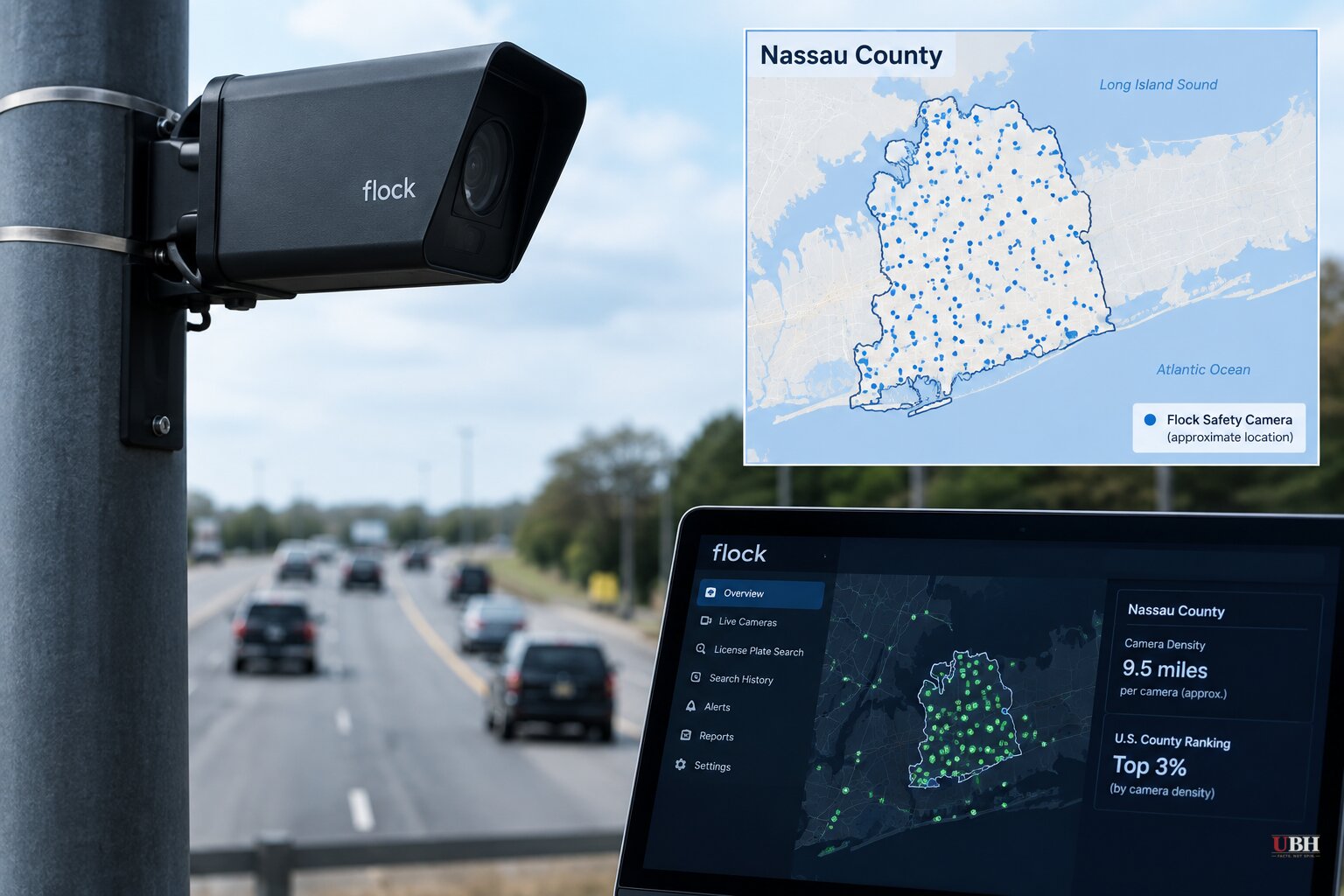
Long Island drivers are getting photographed a lot more than they probably realize.
Nassau County now has more than 330 Flock Safety cameras mapped across roughly 3,200 miles of road, according to open-source data compiled by DeFlock, a volunteer group that tracks the company's camera locations through OpenStreetMap. That works out to about one camera every 9.5 miles, placing Nassau in the top 100 counties nationwide for camera density and within the top 3% of the most surveilled driving populations in America, according to the New York Post's analysis of that data.
Neighboring Suffolk County shows fewer mapped cameras, roughly one every 33 miles across 7,100 miles of road, though the Post notes the DeFlock map likely hasn't caught every unit installed there. Newsday, drawing on the same DeFlock database, put the combined Nassau-Suffolk total at more than 700 plate readers.
License plate readers have been running on Long Island for roughly two decades, and police say they've helped solve homicides, recover stolen cars, and make arrests across a range of crimes. Nassau County Executive Bruce Blakeman told the Post the cameras are "an important tool in law enforcement" and said the county has "put in place strict guidelines to protect privacy and eliminate any potential for abuse." Nassau signed a $1 million deal with Flock Safety last year, according to a recording of a November 2025 county legislature meeting.
Suffolk County, meanwhile, delayed a separate $4 million deal with Flock for its "Raven" audio-detection add-on earlier this month, per the Post, while it continues exploring a smaller camera-only agreement.
The Scale Problem
A national tally of open-source data, current as of mid-August 2026, counted 127,344 plate readers across 49 states, with roughly 104,883 of those, about 82%, carrying the Flock Safety brand. The rest come from competitors like Motorola Solutions, Genetec and Axis. Knox County, Tennessee Mayor Glenn Jacobs has described what the software actually builds as a "vehicle fingerprint." It captures not just a plate number but make, model, color, bumper stickers and roof racks, all searchable together.
That searchability is drawing scrutiny. The Post reported Long Island police ran nearly 3,000 manual searches through Flock's database in June alone. New York City has roughly 600 more cameras stretched from the Queens border to Montauk, with thousands more across the five boroughs.
NYPD's Undisclosed Access
The accountability gap gets sharper in New York City. Amsterdam News reported that civil rights groups LatinoJustice PRLDEF and the Surveillance Technology Oversight Project (S.T.O.P.) found NYPD entries on HaveIBeenFlocked.com, a public-records-based tracking site, showing the department searched the Flock camera database 1,710 times between 2023 and 2025 despite no publicly known contract between the NYPD and Flock Safety.
"The outstanding question is, was the NYPD knowingly using Flock?" S.T.O.P. Research Director Eleni Manis asked, per Amsterdam News. LatinoJustice PRLDEF Senior Counsel Andrew Case argued the broader problem is structural: "This is a tool that is incredibly expansive and powerful and there don't appear to be any appropriate limits or regulations on how people use it." Both groups filed a public records request this week seeking NYPD audit logs, training materials, and any communications or payments involving Flock.
It's possible the NYPD's searches came through data-sharing arrangements with other agencies that do have Flock contracts, which is a legitimate explanation the advocates themselves floated, but it hasn't been confirmed by the NYPD either way. A government agency can apparently tap a nationwide surveillance database without the public knowing it exists, let alone what rules govern it. A tool this powerful, running without a disclosed contract or clear retention rules, presents a transparency problem regardless of how one views law enforcement broadly.
The law enforcement side of the ledger is real too. Cameras that solve homicides and recover stolen vehicles have obvious value, and Blakeman's guidelines argument deserves a hearing, not a reflexive dismissal.
Nassau County Chapter NYCLU Director Susan Gottehrer told Newsday the fix is oversight, not abolition: "We want to make sure that New Yorkers are living their lives freely." The NYCLU helped draft pending New York legislation that would restrict license plate reader use to felony investigations, stolen vehicles and missing persons, bar sharing data outside the state, and cap retention at 48 hours unless it's evidence in an active case.
That bill hasn't passed yet. There's also no state requirement that police departments even register their license plate readers, according to Newsday, meaning nobody in Albany has a full count of how many cameras exist or who's watching the watchers. The NYPD has not publicly responded to the records request from LatinoJustice PRLDEF and S.T.O.P., and whether the department will disclose its Flock relationship remains unanswered.
Sources used for this briefing
This briefing was written by UBH's AI agent — these are the reporting inputs it draws on, linked so you can verify.


